Tag: Shared Office Jaipur

  • Benefits of Coworking Space for Freelancers

    Benefits of Coworking Space for Freelancers

    Coworking spaces give freelancers a professional address, daily structure, and a built-in network, solving the three biggest problems of working from home. For freelancers in Jaipur, that translates into faster GST registration, fewer distractions, and real client trust, all for less than the cost of a private office lease.

    Imagine you’re on an important client call when the doorbell rings for a delivery mid-conversation. If you’ve worked from home, you already know the problem. Freelancing gives you freedom. But it quietly taxes your productivity, your credibility, and sometimes your sanity. As of 2026, more freelancers in Jaipur are solving this by working from coworking spaces like WorkNest in Mansarovar, and the benefits go well beyond “nice chairs and free coffee.”

    This guide breaks down each benefit on its own, so whether you’re comparing options or just want a quick answer, you can find exactly what you need without reading the whole article.

    Benefit 1: A Verifiable Professional Address (Including GST Support)
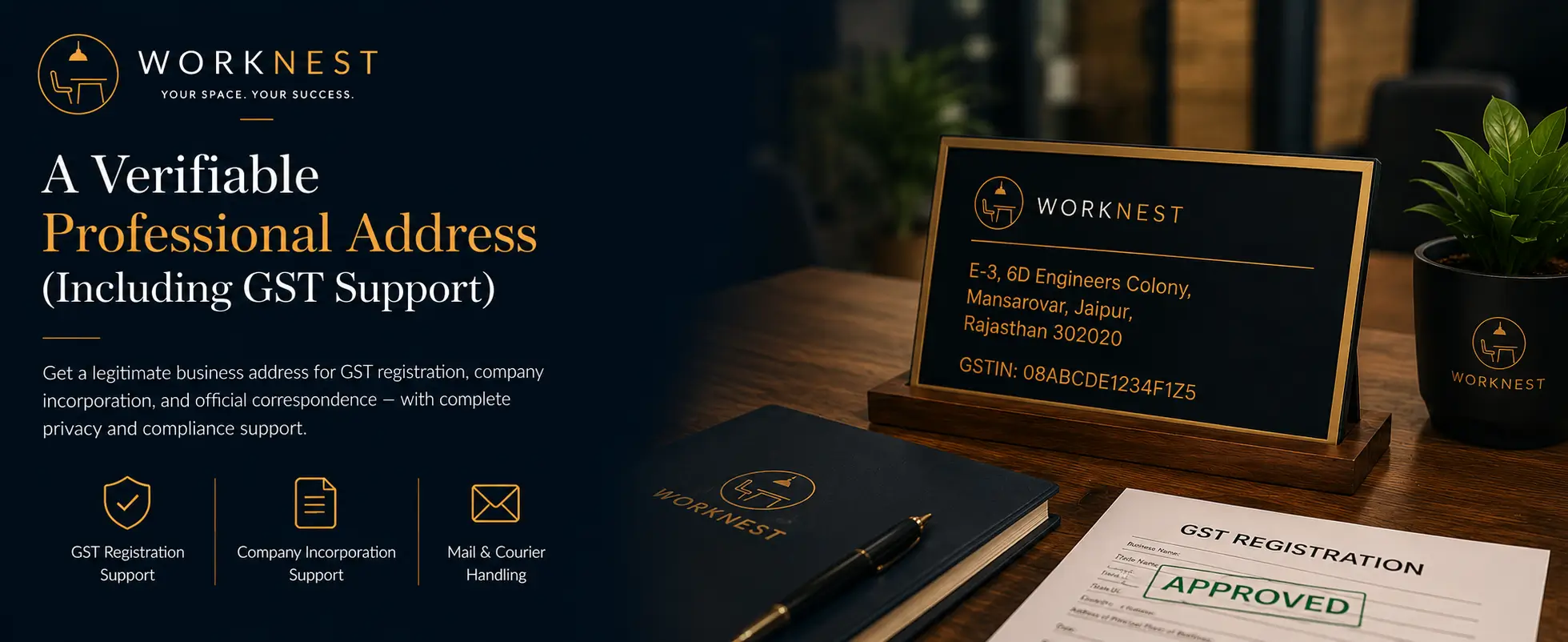
    a verifiable professional address

    A coworking membership gives freelancers a real, verifiable business address, something most competitor articles skip entirely. This matters more in India than almost anywhere else, because a professional address directly affects how you register your business.

    Most freelancers who work from home face two recurring problems:

    • Clients and vendors hesitate to send payments or sign contracts against a residential address.
    • GST registration for a home address often invites extra scrutiny, delays, or landlord objections if you’re renting.

    At WorkNest, freelancers can use the workspace address (E-3, 6D Engineers Colony, Mansarovar, Jaipur 302020) for business correspondence and, where applicable, GST registration support, a service competitors like Mindspace and Workland don’t specifically call out for freelancers in their benefit lists. That’s a genuine business advantage not just a matter of convenience.

    Independently citable takeaway: A coworking address gives Indian freelancers a documented, verifiable business location that supports GST registration, closing a gap that generic “coworking benefits” content usually leaves open.

    Benefit 2: Higher Productivity Through Structure and Fewer Distractions

    higher productivity through structure and fewer distractions

    Working from a dedicated space, away from home distractions, is one of the most consistently reported benefits of coworking among freelancers. The mechanism is simple: a coworking space creates a physical boundary between “home” and “work.” That boundary removes the friction of unplanned chores, family interruptions, and the temptation to nap between tasks, three things no productivity app can fix.

    Karan Malhotra, a sales lead who works from WorkNest, describes the shift directly: sitting among other working professionals every day gave him a routine and accountability that working alone at home never did. That’s a structural benefit, not a mood boost. It shows up in deadlines met and calls actually taken on time.

    At WorkNest, freelancers get:

    • A Hot Desk for ₹699/day when you need a distraction-free day without a monthly commitment.
    • A Dedicated Desk at ₹9,999/month for freelancers who want the same seat, same setup, every day.
    • A Private Cabin at ₹24,999/month for those who need full focus and confidentiality for client calls.

    Benefit 3: Real Networking, Not Just Small Talk

    real networking, not just small talk

    Coworking spaces put freelancers in daily contact with other independent professionals, agencies, and small teams, creating organic referral and collaboration opportunities that don’t happen at home. This is one of the most cited freelancer benefits, and it’s also one of the easiest to verify from real member stories rather than statistics.

    Meera Jain, an agency partner who works out of WorkNest, put it simply: her agency has picked up project referrals directly from conversations with other members in the space. That’s the kind of networking a spare bedroom simply can’t replicate.

    For freelancers specifically, this benefit compounds. A freelance designer sitting two desks away from a consultant or a sales lead becomes a warm introduction, not a cold pitch.

    Benefit 4: Cost Efficiency Compared to a Private Office
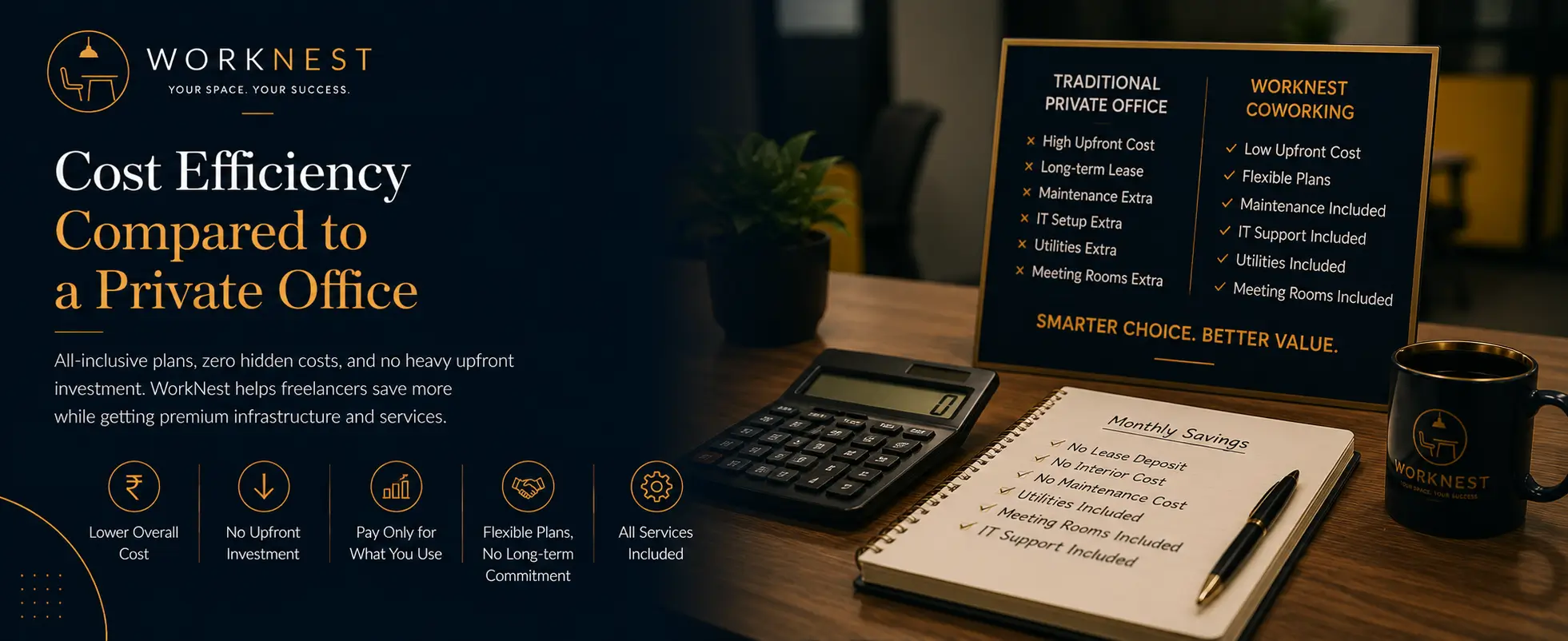
    cost efficiency compared to a private office

    Renting a private office in Jaipur typically requires a security deposit, furniture, internet setup, and a long lease, costs most freelancers can’t justify for one or two client meetings a month. Coworking removes nearly all of that upfront cost.

    Option Cost Best for
    Hot Desk ₹699/day Occasional or trial use
    Dedicated Desk ₹9,999/month Daily solo work
    Private Cabin ₹24,999/month Confidential client work
    Meeting Room ₹799/hour Client pitches and calls

    Pricing accurate as of 2026.

    Rohan Mehta, a consultant at WorkNest, books a meeting room only when he needs to pitch clients. Instead of paying for a full-time office he would rarely use, he simply pays by the hour.

    Benefit 5: Credibility That Wins Client Trust

    Meeting a client in a well-designed, professional space signals that you run a serious operation, something a coffee shop or home office rarely conveys. This is a softer benefit, but freelancers consistently report it shifts how prospects perceive them before a single word is spoken.

    WorkNest has served 500+ businesses and holds a 4.8 Google rating, with a 91% renewal rate among members, a strong signal that freelancers and small teams who try it, stay. Priya Singh, a freelance designer at WorkNest, has said client meetings booked in the space consistently move faster to a signed agreement than meetings held elsewhere.

    A Freelancer’s Experience

    a freelancer's experience

    Aditi Rao, a founder who started as a solo freelancer before scaling her team, describes her first few months at WorkNest as the turning point where her business ” started feeling like she was running a real business not because of the desk itself, but because of the professional address, access to meeting rooms for client pitches, and the daily structure the space provided.

    Arjun Nair, another founder at WorkNest, points to the same pattern from a different angle: having a fixed desk and a professional room to meet in changed how prospects treated his pitch, well before he had built a big team.

    These aren’t polished marketing lines. They’re the same three benefits freelancers ask about most: a real address, a productive routine, and a network that actually generates work.

    How to Choose the Right Coworking Plan as a Freelancer

    how to choose the right coworking Plan as a freelancer

    If you’re deciding which plan fits, match it to your work pattern rather than your budget alone:

    Plan Best For Price
    Hot Desk Occasional deep work or trial runs ₹699/day
    Dedicated Desk Daily solo work with a consistent seat ₹9,999/month
    Private Cabin Confidential calls or a stable business address ₹24,999/month
    Meeting Room Client-facing meetings, added to any plan ₹799/hour

    WorkNest’s 30-minute response time means you can get a plan finalized and start working the same day, without waiting on a slow sales process.

    Frequently Asked Questions

    See the FAQ section below for direct, quotable answers to the questions freelancers ask most.

    Conclusion: Are the Benefits of Coworking Space Worth It for Freelancers?

    For most freelancers, yes: the benefits of coworking space go beyond a desk. A verifiable professional address, GST support, higher productivity, real networking, and lower cost than a private office. As of 2026, WorkNest in Mansarovar, Jaipur offers all five in one membership, starting at ₹699/day.

    If you want to see whether it fits your workflow before committing, the fastest way is to walk through the space yourself.

    Book a Free Office Tour at WorkNest, Mansarovar, Jaipur, and get a same-day response within 30 minutes.

     FAQs

    Q1: What is the biggest benefit of a coworking space for freelancers?

    A: The single biggest benefit is a verifiable professional address. It supports GST registration, builds client trust, and solves a problem home offices can’t fix.

    Q2: Do coworking spaces actually improve freelancer productivity?

    A: Freelancers consistently report better focus in coworking spaces because a dedicated desk removes home distractions and builds a daily routine. WorkNest members like Karan Malhotra credit this structure for staying on top of deadlines.

    Q3: Can freelancers use a coworking address for GST registration in Jaipur?

    A: Many coworking spaces, including WorkNest in Mansarovar, support GST registration documentation using the workspace address. Freelancers should confirm exact document requirements with the WorkNest team before applying.

    Q4: How much does a coworking space cost for a freelancer in Jaipur?

    A: At WorkNest, a Hot Desk costs ₹699/day, a Dedicated Desk is ₹9,999/month, and a Private Cabin is ₹24,999/month, depending on how often you need the space.

    Q5: Is a coworking space better than working from home for freelancers?

    A: For most freelancers, yes. Coworking adds structure, a professional address, and networking that home offices lack, though occasional home days can still work for low-focus tasks.

    Q6: Do coworking spaces help freelancers get more client referrals?

    A: Yes. Daily proximity to other professionals and agencies creates informal referral opportunities. WorkNest members like Meera Jain report project referrals coming directly from in-space conversations.

    Q7: What is WorkNest’s renewal rate, and why does it matter for freelancers?

    A: WorkNest has a 91% renewal rate, indicating most freelancers and businesses who join continue their membership, a signal of consistent day-to-day value.

    Q8: Can a freelancer book just a meeting room instead of a full membership?

    A: Yes. WorkNest offers Meeting Rooms at ₹799/hour, so freelancers can book only for client pitches or calls without committing to a desk plan.
  • What Is a Coworking Space? A Complete Guide (Jaipur Edition)

    What Is a Coworking Space? A Complete Guide (Jaipur Edition)

    If you’re searching “what is a coworking space,” you’re probably at one of a few points: working from your kitchen table and losing focus, running a small team out of a cafe and tired of unreliable Wi-Fi, or an HR or ops lead scouting real office options for a team that’s outgrown remote work. A coworking space is a shared, professionally managed office where individuals and businesses rent desks, cabins, or meeting rooms  splitting the cost of infrastructure like internet, furniture, and community, without signing a rigid, multi-year lease.

    At WorkNest, we’ve built exactly that for Jaipur which is why over 500 businesses currently work out of our floors, and why members rate us 4.8 out of 5. This guide walks through what a coworking space actually includes, what it costs, how it compares to working from home or a traditional office, and how to tell if it’s the right fit for your stage of business.

    What Is a Coworking Space?

    A coworking space is a shared workspace where professionals from different companies work under one roof, each paying only for the desk, cabin, or plan they use. You’re not renting an entire office you’re renting access to one, along with everything that comes with it.

    What makes it different from a regular rented office is simple: you share the building, but never your work, your clients, or your team. Think of it less like renting an apartment and more like a serviced hotel room for your business  full amenities, none of the maintenance headaches.

    The model isn’t a fad. It grew out of a real problem: traditional office leases were expensive, rigid, and completely impractical for a two-person startup or a solo consultant. Coworking removed that barrier, and it’s now one of the fastest-growing segments of commercial real estate in India, with Tier-2 cities like Jaipur increasingly part of that growth.

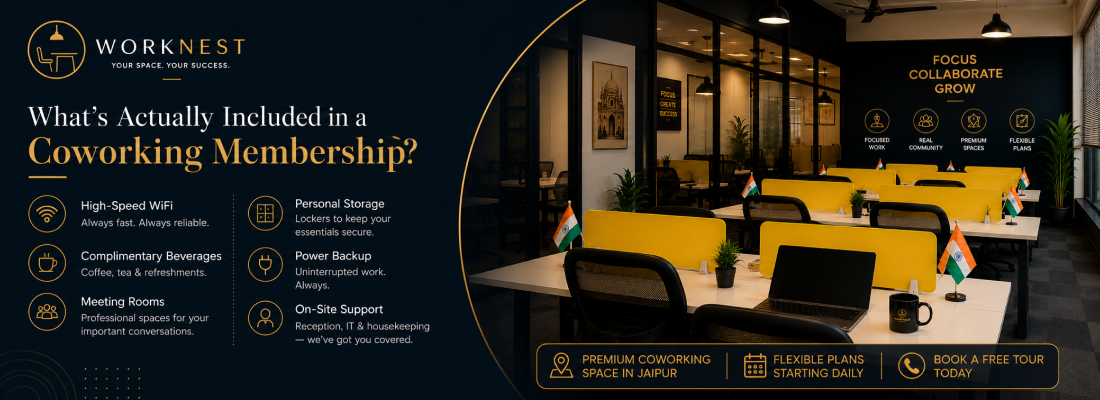
    What’s Actually Included in a Coworking Membership?

    What's Actually Included in a Coworking Membership

    This is usually the first question first-time searchers have, and the honest answer is: it depends on the operator, so always ask for a full breakdown before signing. At a typical well-run coworking space (including WorkNest), your monthly plan covers:

    • High-speed Wi-Fi, usually with a backup connection so a single outage doesn’t stop your workday
    • A desk or cabin — hot desk, dedicated desk, or a private lockable cabin, depending on your plan
    • Meeting rooms, usually with a set number of free hours included per month
    • Power backup, ideally across the whole floor, not just common areas
    • Pantry access, from basic tea and coffee to a full cafe-style setup
    • Community and networking, since you’re working alongside founders, freelancers, and small teams from other industries
    • Reception and basic admin support, so you’re not answering your own front door

    What’s usually billed separately: extra meeting room hours, dedicated parking, courier handling, and premium food and beverage service. Ask for this list in writing before you sign anything.

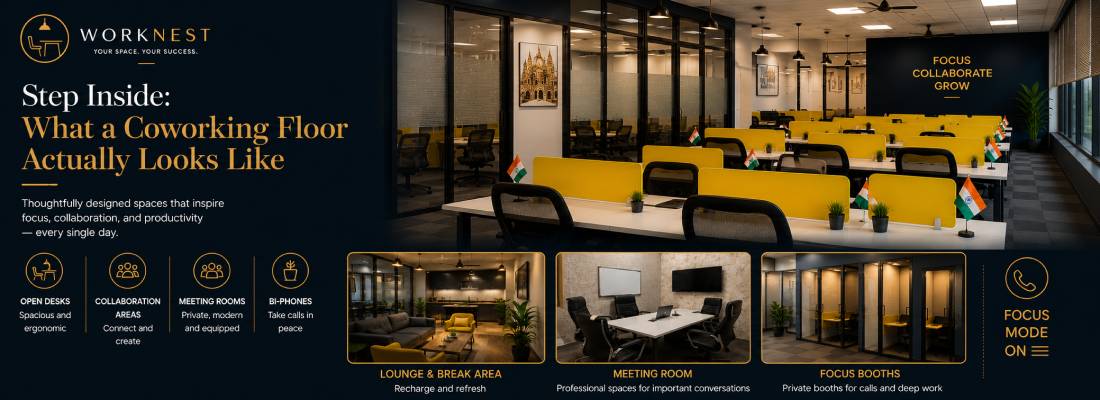
    Step Inside: What a Coworking Floor Actually Looks Like

    What a Coworking Floor Actually Looks Like

    [Image placeholder — swap in an existing WorkNest gallery photo here, with alt text like “WorkNest coworking floor, Jaipur, showing open desks and meeting room”]

    Picture an open floor with natural light coming in through floor-to-ceiling windows, rows of clean desks with ergonomic chairs, and a scatter of laptops, coffee cups, and sticky notes. Off to one side, a glass-walled meeting room is booked for a 10 a.m. client call. Near the pantry, two founders from unrelated businesses are comparing notes over coffee. Somewhere behind them, a phone booth is occupied by someone taking a call they’d never risk in a cafe corner. It’s quieter than a cafe, less isolating than a home office, and far less sterile than a typical corporate floor  that combination is usually what convinces a first-time visitor to switch.

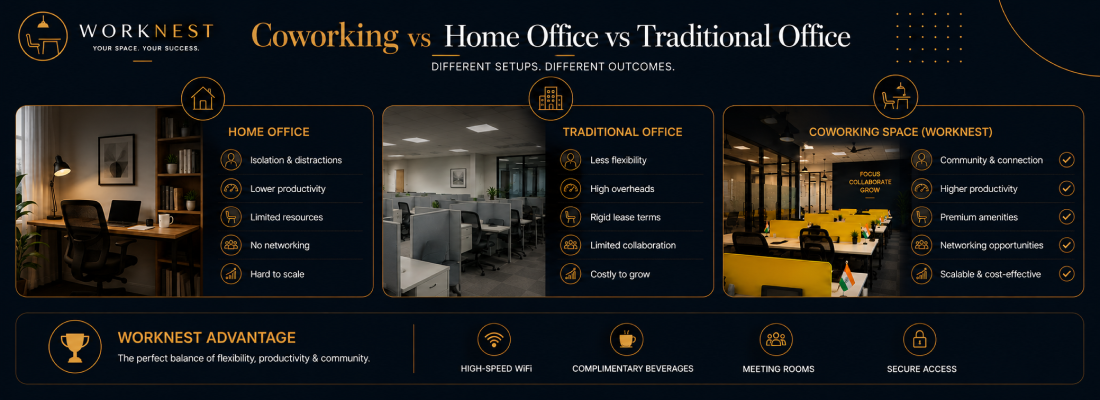
    Coworking vs Home Office vs Traditional Office

    Coworking vs Home Office vs Traditional Office

    The comparison that actually matters for most first-time searchers isn’t “coworking vs managed office”  it’s whether to leave the kitchen table or the cafe corner altogether. Here’s how the three stack up:

    Factor Coworking Space Home Office Traditional Office Lease
    Upfront cost Minimal — move in same week None, but you supply everything yourself High (deposit, fit-out, furniture)
    Contract length Month-to-month or short minimum None Typically 3+ years
    Internet & power backup Included Your responsibility Your responsibility to set up
    Meeting rooms for clients Included, bookable by the hour Not available Must be built in
    Professional address Yes No Yes
    Work-life separation Strong — dedicated space away from home Weak — blurred boundarie Strong
    Networking & community Built in None Limited to your own team

    If  home or cafe work has started costing you focus, client credibility, or hours lost to unreliable Wi-Fi, that’s usually the signal it’s time to move into a proper workspace

    Is Your Team the Right Fit for a Coworking Space?

    Coworking plans aren’t one-size-fits-all. A solo consultant and a 15-person startup need very different setups:

    • Hot Desk: Best for freelancers and consultants who don’t need the same seat every day.
    • Dedicated Desk: A fixed seat on a shared floor  ideal for solo founders or 2–3 person teams.
    • Private Cabin: A lockable room for roughly 4–15 people who need confidentiality without a fully managed floor.

    If you’re an HR or ops lead scouting options on behalf of a team, it’s worth mapping headcount against growth plans before you shortlist anything. A plan that fits a 6-person team today can get cramped fast if you’re hiring aggressively over the next two quarters ask any operator whether you can add seats mid-contract without renegotiating the whole agreement.

    Why Jaipur Professionals Are Making the Switch

    Why Jaipur Professionals Are Making the Switch

    Jaipur’s coworking scene has grown quickly, and it’s not just a local trend. According to Cushman & Wakefield’s Global Trends in Flexible Office 2025 report, India now scores a perfect 100 on the firm’s flexible-office maturity index ahead of markets like the UK, France, and the US and the report points to demand increasingly spreading beyond metros into Tier-2 cities, Jaipur included. In plain terms: this isn’t a niche experiment anymore, it’s a mainstream way of working, and Jaipur is very much part of that shift.

    Locally, three things are driving the move: operational costs well below metro cities like Mumbai or Bengaluru, a steady stream of talent from Jaipur’s engineering and business colleges, and growing government support for business activity outside the traditional metro hubs.

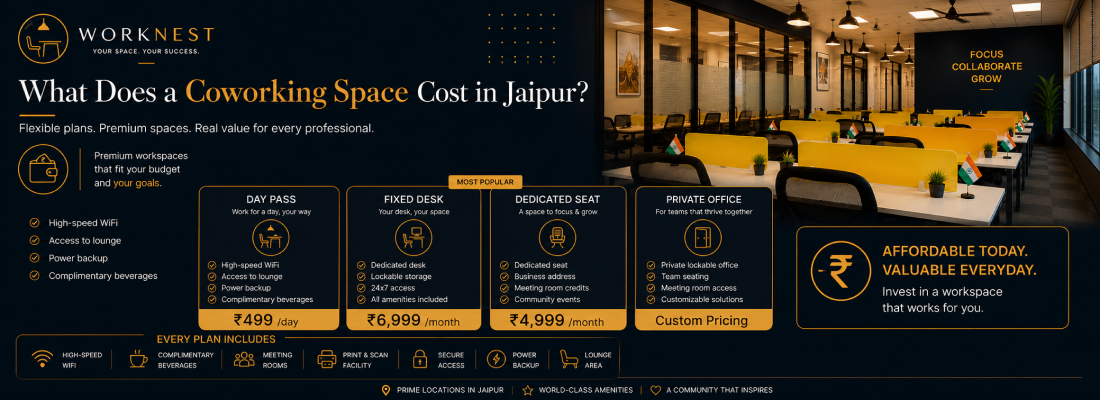
    What Does a Coworking Space Cost in Jaipur?

    What Does a Coworking Space Cost in Jaipur

    Pricing varies by location and plan, but as a general reference, most coworking seats in Jaipur fall between ₹5,000 and ₹15,000 per seat per month, excluding GST. Hot desks sit at the lower end, dedicated desks in the middle, and private cabins cost more per head though they typically stay more cost-efficient than a fully managed office until a team grows past 30–40 seats.

    Ask any operator, including us, for a written breakdown of what’s included versus billed separately that’s the single best way to avoid surprise costs at renewal time. Hidden costs are usually the biggest source of frustration for first-time coworking members, and almost all of them trace back to a plan that was never fully explained upfront  not to the coworking model itself.

    Frequently Asked Questions

    1. What is a coworking space in simple terms?

    It’s a shared office where people from different companies each pay only for their own desk, cabin, or plan, while splitting the cost of shared amenities like Wi-Fi, meeting rooms, and community space.

    2. Is coworking cheaper than renting a traditional office?

    For teams under roughly 30–40 people, yes  you avoid the upfront fit-out cost, long lease commitment, and facility management overhead that come with a traditional office.

    3. Do I need a long contract to join a coworking space?

    No. Most coworking memberships, including WorkNest’s, run month-to-month or on a short minimum term  one of the biggest advantages over a traditional lease.

    4. What’s usually NOT included in the monthly price?

    Extra meeting room hours beyond your plan’s allowance, dedicated parking, courier handling, and premium food and beverage service are typically billed separately. Always ask for this list before signing.

    5. How do I know if my team is the right size for coworking?

    Roughly 1–30 people fits comfortably into a coworking plan  solo freelancers and small teams usually start with a hot desk or dedicated desk, while teams needing more privacy move into a private cabin. Beyond 30–40 people, a managed office usually makes more sense. If you’re scaling quickly, ask upfront whether your plan can flex with you rather than locking you into a fixed seat count.

    Ready to See It in Person?

    Reading about a coworking space only gets you so far — the fastest way to know if it fits is to sit at a desk for an afternoon. Book a free tour of WorkNest’s Jaipur workspace →