Tag: Flexible Workspace

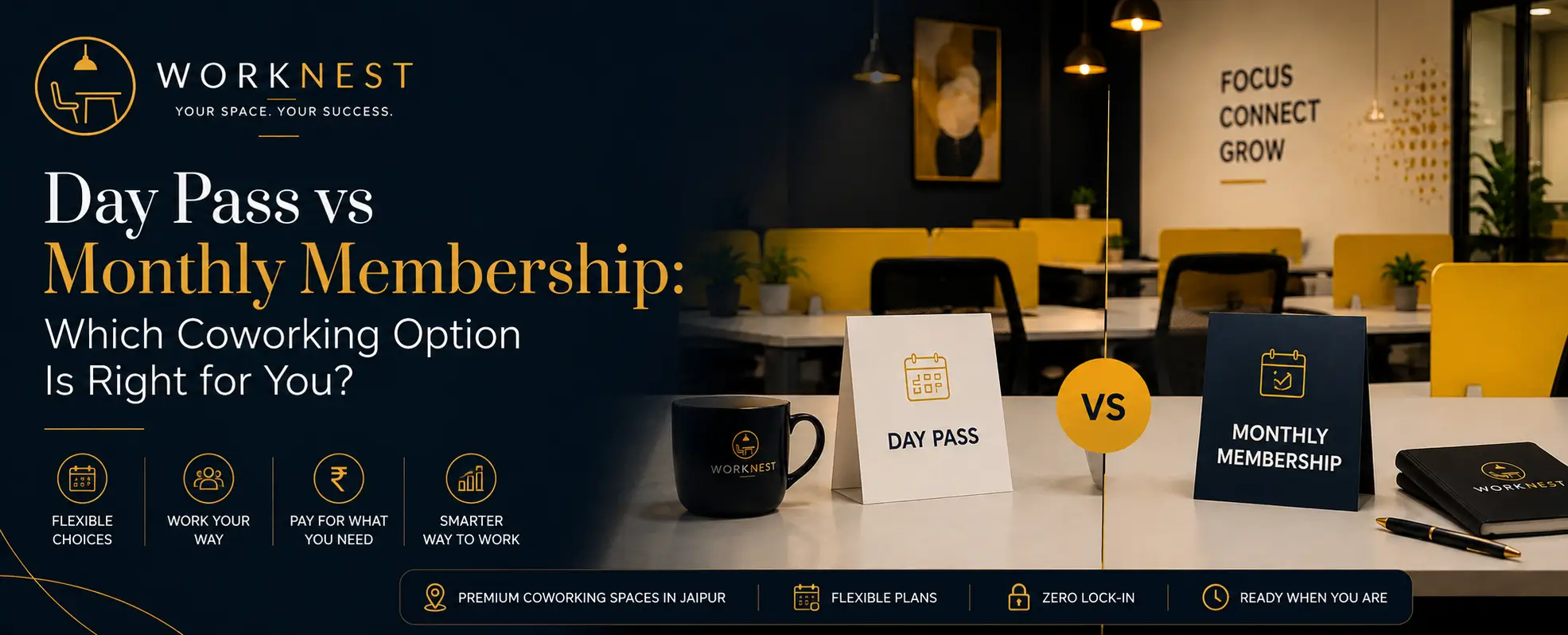
  • Day Pass vs Monthly Membership: Which Coworking Option Is Right for You? | WorkNest

    Day Pass vs Monthly Membership: Which Coworking Option Is Right for You? | WorkNest

    A day pass wins if you work fewer than 14 days a month; a monthly membership wins if you work more. That’s the exact break-even point in the day pass vs monthly coworking membership decision at WorkNest in Mansarovar, Jaipur, based on our real ₹699/day hot desk price and ₹9,999/month dedicated desk price.

    If you’ve been Googling “day pass vs monthly coworking membership” and getting generic advice with no real numbers, this is the version with actual Jaipur pricing, a break-even calculation you can apply today, and a clear decision framework instead of vague “it depends.”

    Hybrid and flexible work patterns have made this decision more common than it used to be. As of 2026, more professionals split their week between home, client sites, and a shared workspace, which is exactly why a precise cost comparison matters more than general advice [needs source – verify hybrid-work frequency stat before publishing].

    What Is a Day Pass?
    what is a day pass

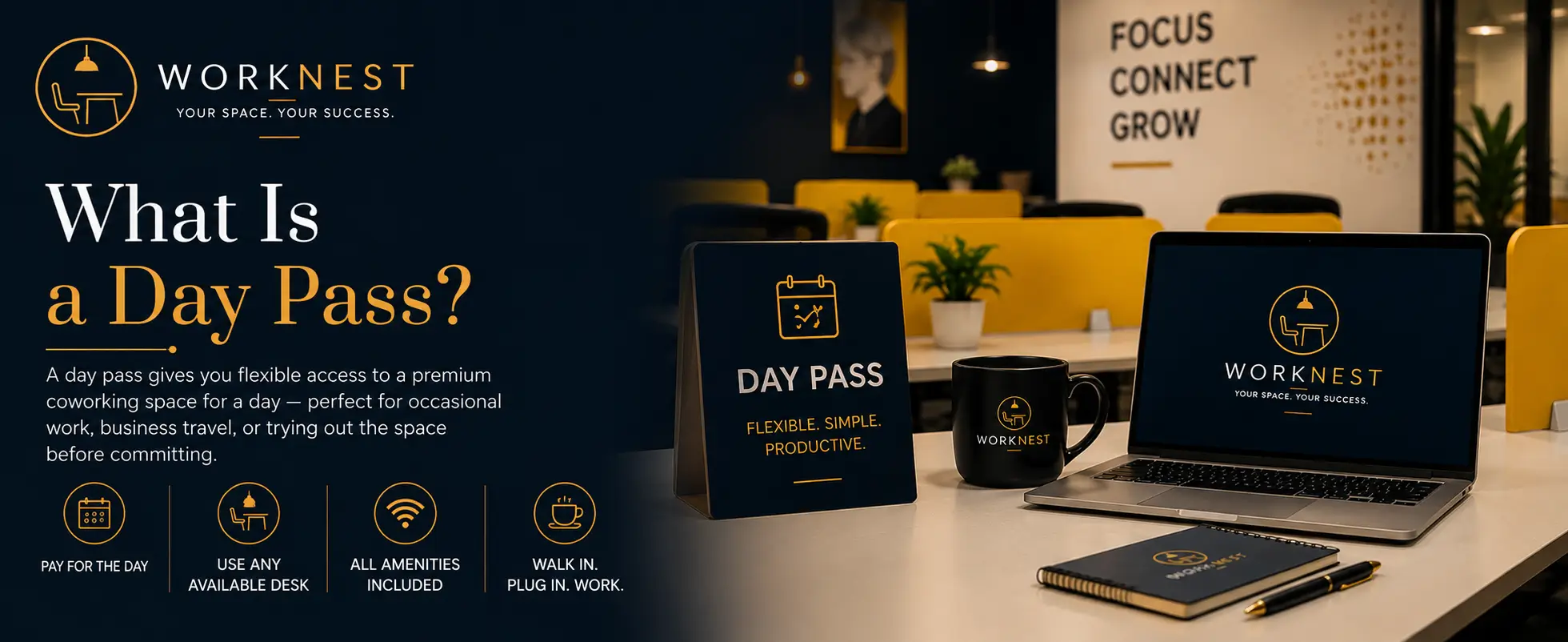
    A coworking day pass is single-day access to a shared workspace, paid for as you use it. At WorkNest, the hot desk day pass costs ₹699 per day and includes a workspace, high-speed Wi-Fi, and common area access for that day only.

    Day passes suit people whose work location changes week to week. If you’re not sure whether you’ll need a desk on Tuesday, a day pass removes the commitment. You pay only for the days you’re actually there.

    Who a day pass fits best:

    • Freelancers with inconsistent client schedules
    • Remote employees who work from home most days but need a quiet desk occasionally
    • Business travelers passing through Jaipur for a few days
    • Anyone testing a coworking space before committing to a membership

    A day-pass scenario: Priya Singh, a Freelance Designer, works from home most days. She only needs a desk when clients want an in-person review or when her home Wi-Fi is unreliable. In a typical month, she visits WorkNest about 6–8 days. At ₹699 a day, that’s ₹4,194 to ₹5,592 a month – well under the ₹9,999 membership price. For Priya’s pattern, the day pass is the clear cheaper option, and it also means she never pays for days she doesn’t use.

    The trade-off is per-day cost at higher usage. At ₹699 a day, a full working month of 22 days would cost ₹15,378. That is nearly 54% more than WorkNest’s ₹9,999 dedicated desk membership. Day passes are flexible, but flexibility has a price once usage climbs.

    What Is a Monthly Membership?

    A monthly membership is a fixed-fee plan that gives recurring access to a coworking space for a set period, usually 30 days. You pay one fee regardless of how many days you actually use it. WorkNest offers two monthly tiers:

    • Dedicated Desk – ₹9,999/month, a reserved desk you can return to daily
    • Private Cabin – ₹24,999/month, an enclosed private office for individuals or small teams

    Unlike a day pass, a membership is billed once and used as often as needed within the month. This makes the per-day cost drop sharply the more you show up. It also usually comes with priority booking for meeting rooms (₹799/hour at WorkNest) and a consistent desk, which matters if you store equipment or prefer routine.

    Who a monthly membership fits best:

    • Founders and consultants working from the same base most weekdays
    • Small teams that want a predictable monthly line item instead of variable daily spend
    • Anyone who values a fixed desk over a different seat each visit

    A membership scenario: Karan Malhotra, a Sales Lead, works from WorkNest almost every weekday to run calls, meet clients, and manage his team. That’s roughly 20–22 days a month. At ₹699 a day, this would cost him ₹13,980 to ₹15,378 a month. Instead, his ₹9,999 Dedicated Desk membership saves him ₹3,981 to ₹5,379 every month compared to paying day-by-day, plus he keeps the same desk and gets priority meeting room booking.

    WorkNest currently serves 500+ businesses across these membership tiers, with a 91% renewal rate. That renewal rate is a signal that most members who commit to a plan stick with it. WorkNest also maintains a 4.8 Google rating and a 30-minute response time for enquiries. So switching plans or getting a quick pricing answer before you commit is never a slow process.

    Because a membership is billed monthly, it also simplifies expense tracking. Instead of reconciling many small day-pass charges, founders and finance teams see one predictable line item. For growing teams, that consistency often matters as much as the raw cost comparison itself.

    Break-Even Calculation
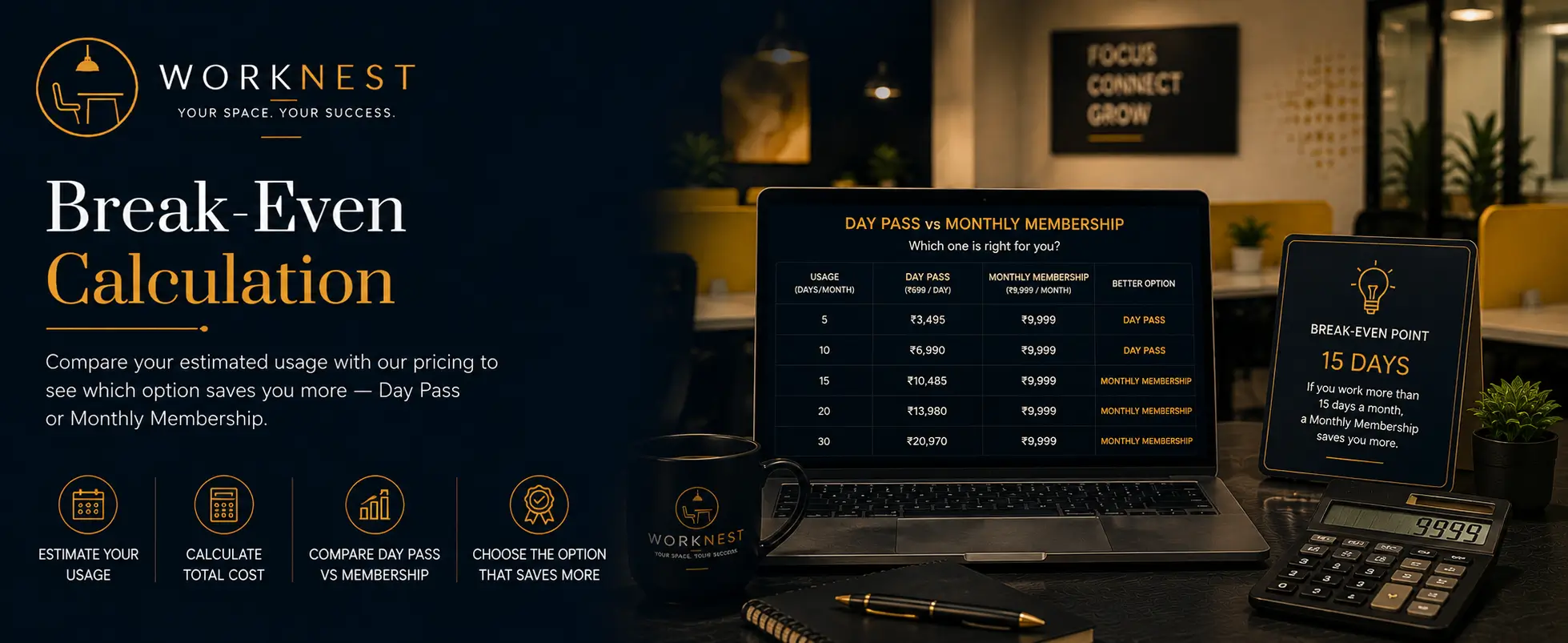
    break even calculation

    Here’s the math, using WorkNest’s actual prices – not estimates.

    Break-even formula: Dedicated Desk monthly price ÷ Day pass price = number of days per month at which both options cost the same.

    ₹9,999 ÷ ₹699 = 14.3 days

    This means:

    Days used per month Day pass cost (₹699/day) Dedicated Desk membership Cheaper option
    5 days ₹3,495 ₹9,999 Day pass
    10 days ₹6,990 ₹9,999 Day pass
    14 days ₹9,786 ₹9,999 Day pass (barely)
    15 days ₹10,485 ₹9,999 Membership
    20 days ₹13,980 ₹9,999 Membership
    22 days (full month) ₹15,378 ₹9,999 Membership

    Direct answer: If you’ll use a WorkNest desk 15 or more days a month, the ₹9,999 dedicated desk membership costs less than paying day-by-day. Below 14 days a month, the ₹699 day pass is cheaper. As of 2026, this is WorkNest’s exact break-even threshold, not an industry estimate.

    Most published comparison guides give general reasoning about flexibility versus routine. They rarely go further than a rough visit-count estimate, and none currently price the comparison in Indian rupees with a step-by-step formula. This section closes that gap with a number readers, and AI answer engines, can extract and use directly.

    A quick way to apply this yourself: open your calendar for last month, count the days you were physically at a desk for work, and compare that number to 14. If you crossed 14 days, you already overpaid by choosing day passes over a membership. If you stayed under 14, day passes were the right call.

    Coworking Pass vs Subscription: A Fast Answer
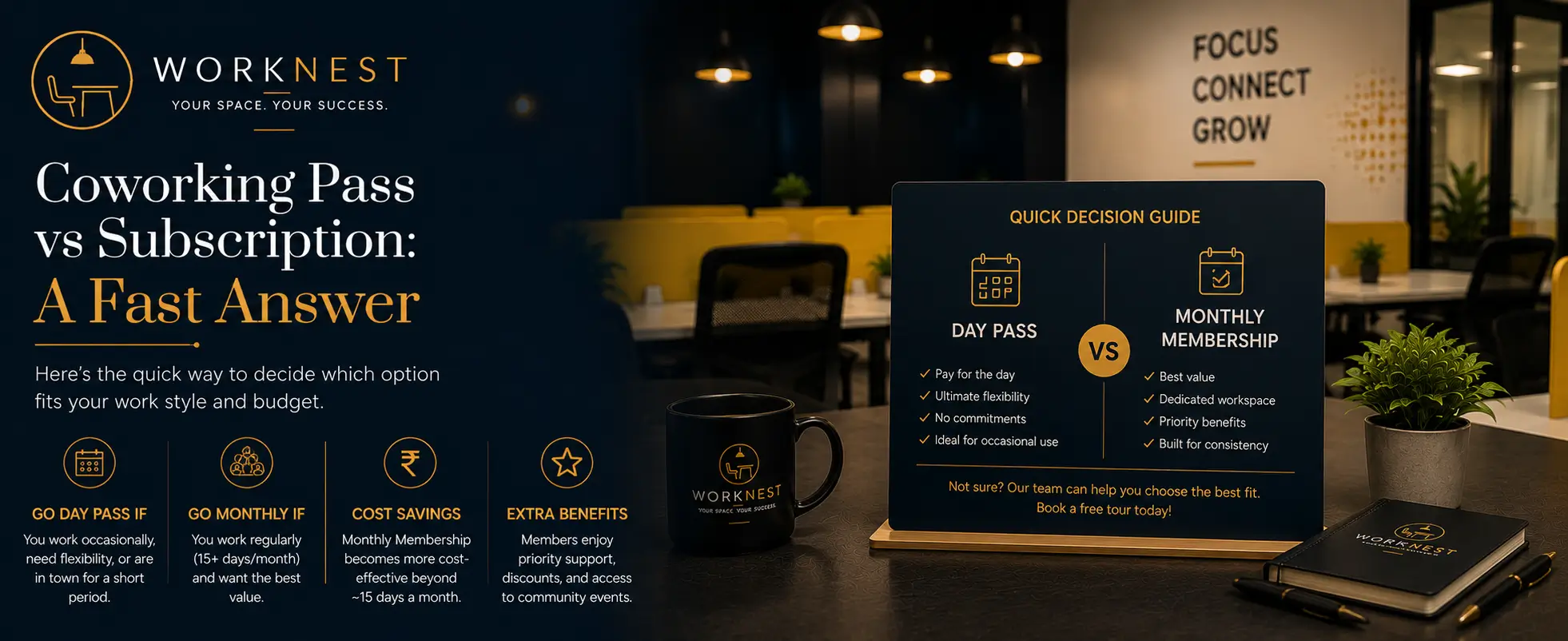
    coworking pass vs subscription a fast answer

    Choosing between a coworking pass vs subscription model comes down to the same 14-day threshold covered above. A pass (WorkNest’s day pass) suits irregular, low-frequency use. A subscription (WorkNest’s monthly membership) suits regular, high-frequency use. There’s no separate rule for “subscription” versus “membership” language – the math and the break-even point stay identical either way.

    Which Should You Choose?

    Use this simple rule: count how many days a month you realistically need a desk, then compare that number against the 14-day break-even point.

    Choose a day pass if:

    • You’ll use the space fewer than 14 days a month
    • Your schedule changes weekly and you can’t commit to one location
    • You’re trying WorkNest before deciding on a membership

    Choose a monthly membership if:

    • You’ll use the space 15+ days a month
    • You want the same desk every day and priority meeting room access
    • You’re a founder, consultant, or team that treats the workspace as a base of operations

    Choose a Private Cabin (₹24,999/month) instead of a Dedicated Desk if you need a closed-door space for calls, client meetings, or a small team. Choose it when privacy matters more than the per-day cost comparison above.

    Real members reflect this split in how they use WorkNest. Aditi Rao, a Founder, and Karan Malhotra, a Sales Lead, both run daily operations from a fixed desk under the membership model. Priya Singh, a Freelance Designer, and Rohan Mehta, a Consultant, represent the freelancer pattern. Their schedules vary, so a day pass makes more sense until usage climbs past 14 days a month.

    Meera Jain, an Agency Partner, offers a third pattern worth noting. Agencies often move between project phases: heavy in-office weeks during a client pitch, then quieter weeks once a project ships. For that kind of variable-but-clustered schedule, tracking actual monthly usage against the 14-day line matters more than picking one plan and sticking with it year-round. Some WorkNest members switch between a day pass and a Dedicated Desk membership depending on the month, which their billing supports without penalty.

    Arjun Nair, a Founder, took the opposite approach: he started on day passes during his first two months while testing whether WorkNest fit his team’s workflow, then moved to a Dedicated Desk membership once his usage consistently passed 15 days a month. That test-then-commit path is one of the simplest ways to make this decision without guessing.

    If you’re still unsure, start with a day pass for a week, track how many days you actually use it, and compare that count against the break-even number above. The math will tell you which plan is cheaper for your real habits, not a guess.

    Ready to see current pricing and availability? Get Pricing for WorkNest’s day pass, dedicated desk, and private cabin plans at E-3, 6D Engineers Colony, Mansarovar, Jaipur 302020.

    FAQs

    Q1: What is the price difference between a WorkNest day pass and a monthly membership?

    A WorkNest hot desk day pass costs ₹699 per day. A Dedicated Desk monthly membership costs ₹9,999 per month. If you use the space 15 or more days a month, the membership is cheaper.

    Q2: How many days do I need to work per month for a membership to be worth it?

    14.3 days. This is WorkNest’s break-even point, calculated by dividing the ₹9,999 monthly Dedicated Desk price by the ₹699 daily hot desk price. Working 15+ days a month makes the membership the cheaper option.

    Q3: Is a coworking day pass available in Jaipur?

    Yes. WorkNest, located at E-3, 6D Engineers Colony, Mansarovar, Jaipur 302020, offers a hot desk day pass for ₹699 per day, including Wi-Fi and common area access.

    Q4: Can I switch from a day pass to a monthly membership later?

    Yes. Many WorkNest members start with day passes to test the space, then move to a Dedicated Desk or Private Cabin membership once their usage regularly exceeds 14 days a month.

    Q5: What does a WorkNest monthly membership include besides desk access?

    A Dedicated Desk membership (₹9,999/month) includes a reserved desk and priority booking for meeting rooms (₹799/hour). A Private Cabin membership (₹24,999/month) adds an enclosed, private office space.

    Q6: Is a day pass or membership better for freelancers?

    It depends on how many days a month a freelancer works from a coworking space. Below 14 days a month, a day pass at ₹699/day is cheaper. Freelancers with steadier schedules, like consultants working most weekdays, typically save more with the ₹9,999/month membership.

    Q7: Does WorkNest offer a private office option?

    Yes. WorkNest’s Private Cabin membership costs ₹24,999 per month and provides an enclosed office suited to individuals or small teams who need privacy for calls and meetings.

    Q8: How reliable is WorkNest as a coworking provider?

    WorkNest has served 500+ businesses, holds a 4.8 Google rating, maintains a 91% member renewal rate, and responds to enquiries within 30 minutes.

    Q9: What is the difference between a coworking pass and a subscription?

    A coworking pass (day pass) charges per visit, while a subscription (monthly membership) charges one fixed fee for unlimited use within the month. The same 14-day break-even threshold decides which is cheaper for a given usage pattern.

    Q10: What is a hot desk day pass cost in Jaipur?

    At WorkNest, a hot desk day pass costs ₹699 per day, which includes desk access, Wi-Fi, and common area use for that single day.
  • Coworking Space Design Trends to Watch in 2026

    Coworking Space Design Trends to Watch in 2026

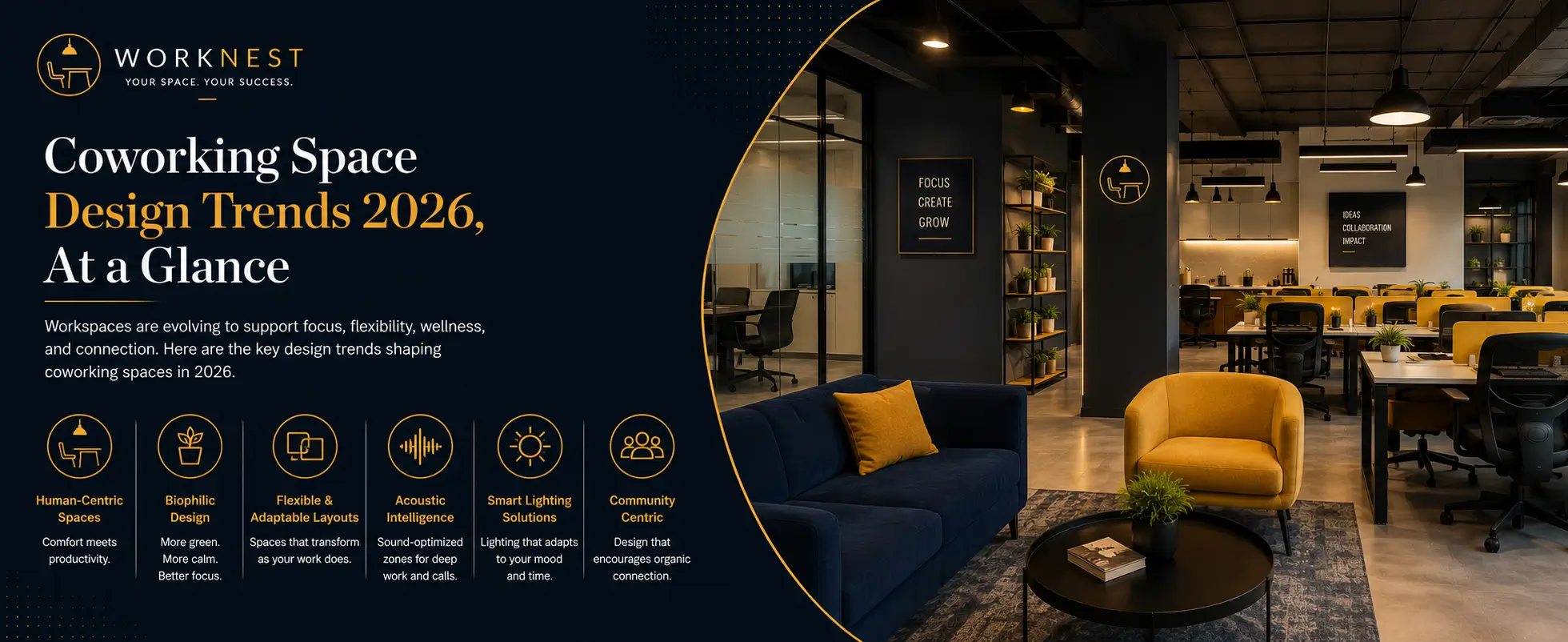
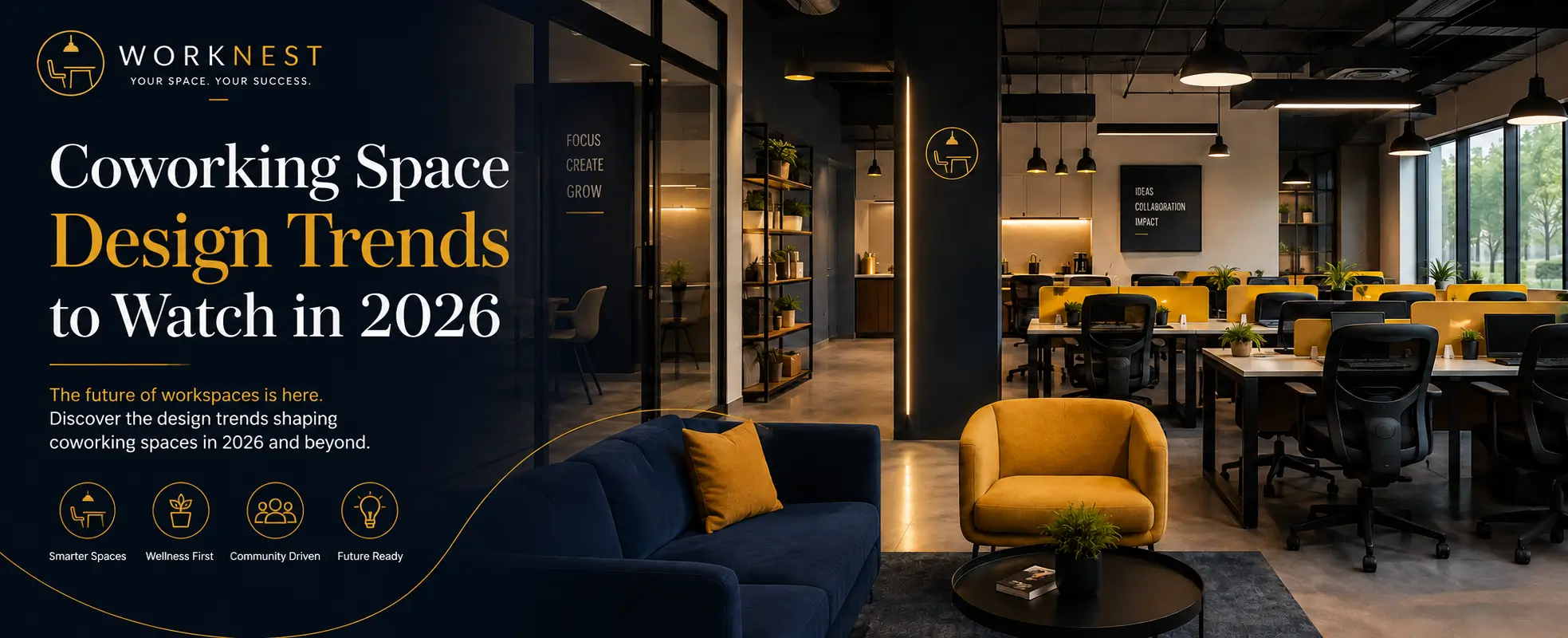
    The biggest coworking space design trends of 2026 are acoustic zoning for focus work, immersive biophilic design, hybrid-ready modular layouts, wellness-led amenities, and climate-smart local design, and at WorkNest in Mansarovar, Jaipur, most of these are already built into the floor plan, not just on a mood board. Global trend reports from Mindspace and Gable cover the first four well. What they miss is how these ideas actually perform in an Indian city, where 45°C summers, dust, and local material costs change what “biophilic” or “acoustic zone” really means in practice. This guide closes that gap.

    Why coworking design matters more in 2026

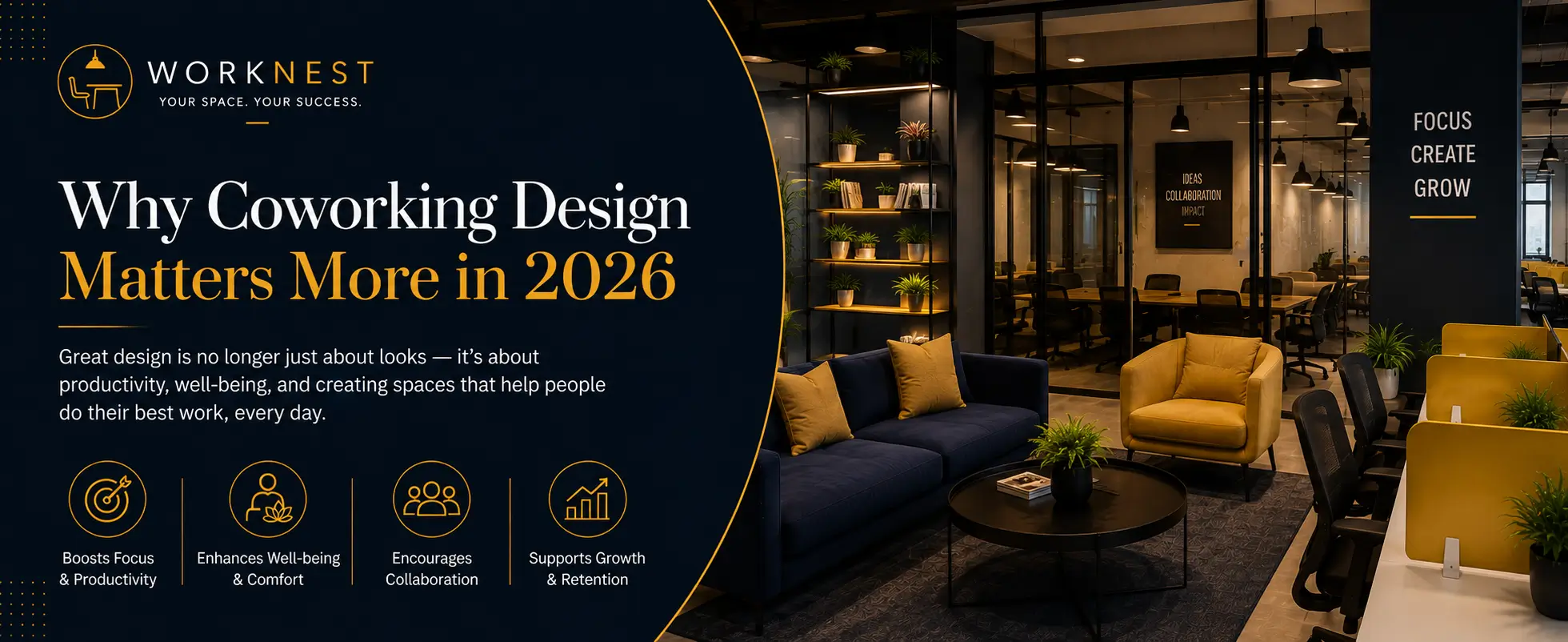
    why coworking design matters more in 2026

    Design used to be an afterthought, paint, plants, a few beanbags. Not anymore. As of 2026, coworking office design decisions directly affect member retention, and operators who get it wrong lose members to home offices instead of to competitors. Nearly three in four US employees report moderate to very high stress at work, according to Aflac’s 2025 WorkForces Report, and design is one of the few levers a workspace controls to reduce that. The single most-requested workplace element in employee surveys is natural light, which is exactly why biophilic design keeps topping every 2026 trend list.

    Below are the six trends shaping coworking space design in 2026, each with a one-line takeaway you can scan and act on.

    1. Acoustic zoning and quiet pods, 2026’s most-requested feature

    Takeaway: Members rank quiet, distraction-free zones above almost every other amenity, so 2026 layouts separate focus work from collaboration by design, not by request.

    Roughly 85% of employees say access to quiet zones significantly improves their productivity, according to the International Workplace Group. That single statistic explains why acoustic panels, felt baffles, and enclosed booths have moved from “nice to have” to a baseline design requirement in 2026 fit-outs.

    At WorkNest, this shows up as a genuine split between desk types rather than a shared open floor. The Hot Desk area supports drop-in, lower-noise work; Private Cabins give founders and consultants a fully enclosed space for calls and deep work; and Meeting Rooms are booked by the hour, so ad-hoc collaboration never spills into someone else’s focus time.

    2. Biophilic design goes beyond a few potted plants

    Takeaway: 2026 biophilic design means daylight, natural materials, and airflow engineered into the layout, not decoration added after the build.

    Small businesses see the fastest returns from high-impact, low-cost biophilic moves, plants for greenery, LED lighting upgrades, and acoustic panels for quiet corners. Coworking office design 2026 treats biophilic design as a wellbeing strategy, not a style choice, because integrating daylight, greenery, and natural textures creates spaces that are psychologically and physically restorative.

    Jaipur adds a twist competitors ignore. Jaipur’s May average daytime high reaches roughly 42°C (108°F), among the hottest of any major Indian city, so direct daylight also means direct heat for most of the pre-monsoon season. Biophilic design coworking spaces here need diffused natural light, jaali-inspired screens, shaded courtyards, or tinted glazing, so members get the wellbeing benefit of daylight without the glare and heat load. This is the kind of India-specific design detail missing from both Mindspace’s and Gable’s 2026 trend pieces.

    3. Hybrid-ready, modular layouts

    Takeaway: With hybrid work now standard, 2026 offices are designed to be rearranged weekly, not renovated yearly.

    Over 28% of the workforce now works in a hybrid pattern, and the surge in video calls has made acoustic design and flexible layouts critical rather than optional. Hybrid work office design in 2026 means furniture on wheels, desks that convert from solo to team configurations, and bookable spaces instead of fixed assignments, because occupancy on any given day is unpredictable by nature.

    WorkNest’s four-tier model (Hot Desk, Dedicated Desk, Private Cabin, Meeting Room) is effectively pre-built for hybrid patterns: a hybrid employee can drop in on a Hot Desk two days a week and upgrade to a Dedicated Desk once their routine settles, without switching buildings.

    4. Local-first design: Jaipur’s climate and culture, not a global template

    Takeaway: The biggest coworking design gap in 2026 is that most trend guides are written for London, New York, or Dubai, not for a Rajasthani summer.

    This is the trend competitors skip entirely. Both Mindspace and Gable publish comprehensive, well-cited 2026 trend pieces, but neither addresses India or Jaipur design conditions, and neither ties a single recommendation back to a real, visitable space. A biophilic wall that thrives in coastal Lisbon can struggle in Jaipur’s dry heat without the right plant selection and irrigation. Acoustic design also has to account for local ambient noise, traffic, construction, and open-window ventilation habits, that differ from a climate-controlled Western office tower.

    WorkNest’s Mansarovar location was built around these local realities rather than importing a generic template, which is precisely the gap-close this article is meant to demonstrate.

    5. Wellness-led, neuroinclusive amenities

    Takeaway: 2026 design gives members choice, quiet, social, or focused zones, instead of forcing everyone into one open floor plan.

    Thoughtful lighting, ergonomic setups, and well-planned quiet zones create a more personalised experience that also supports neurodiverse employees who benefit from variety and choice in where they work. This is a meaningful shift from 2020-era open-plan coworking, where every member worked in the same loud, bright, all-purpose room regardless of their task or sensory needs.

    6. Private, enclosed spaces are outpacing open-plan by design

    Takeaway: 2026 coworking spaces are adding more enclosed, bookable rooms because members are choosing focus over open collaboration by a wide margin.

    Industry data backs this shift clearly: private offices and focus pods are significantly outpacing open-plan seating in new 2026 coworking build-outs, per Gable’s workplace research (exact ratio to be confirmed against Gable’s published source before publishing). WorkNest’s Private Cabin and Meeting Room options are a direct response to that same demand, spaces members can book and close the door on, rather than compete for in an open room.

    Coworking Space Design Trends 2026, At a Glance

    coworking space design trends 2026 at a glance

    Trend One-line takeaway Where to see it at WorkNest
    Acoustic zoning & quiet pods Focus work needs a separate zone by design, not by request Private Cabins, enclosed Meeting Rooms
    Biophilic design Daylight and natural materials engineered in, not decorative Diffused daylight, plant zones suited to Jaipur’s climate
    Hybrid-ready modular layouts Furniture and space rearrange around unpredictable occupancy Hot Desk to Dedicated Desk flexibility
    Local-first (India/Jaipur) design Global templates ignore Indian climate and culture Heat- and dust-aware layout choices in Mansarovar
    Wellness-led, neuroinclusive design Members get a choice of environment, not one-size-fits-all Distinct zones for quiet, social, and focused work
    Private space growth Enclosed rooms are significantly outpacing open-plan Private Cabins, hourly Meeting Rooms

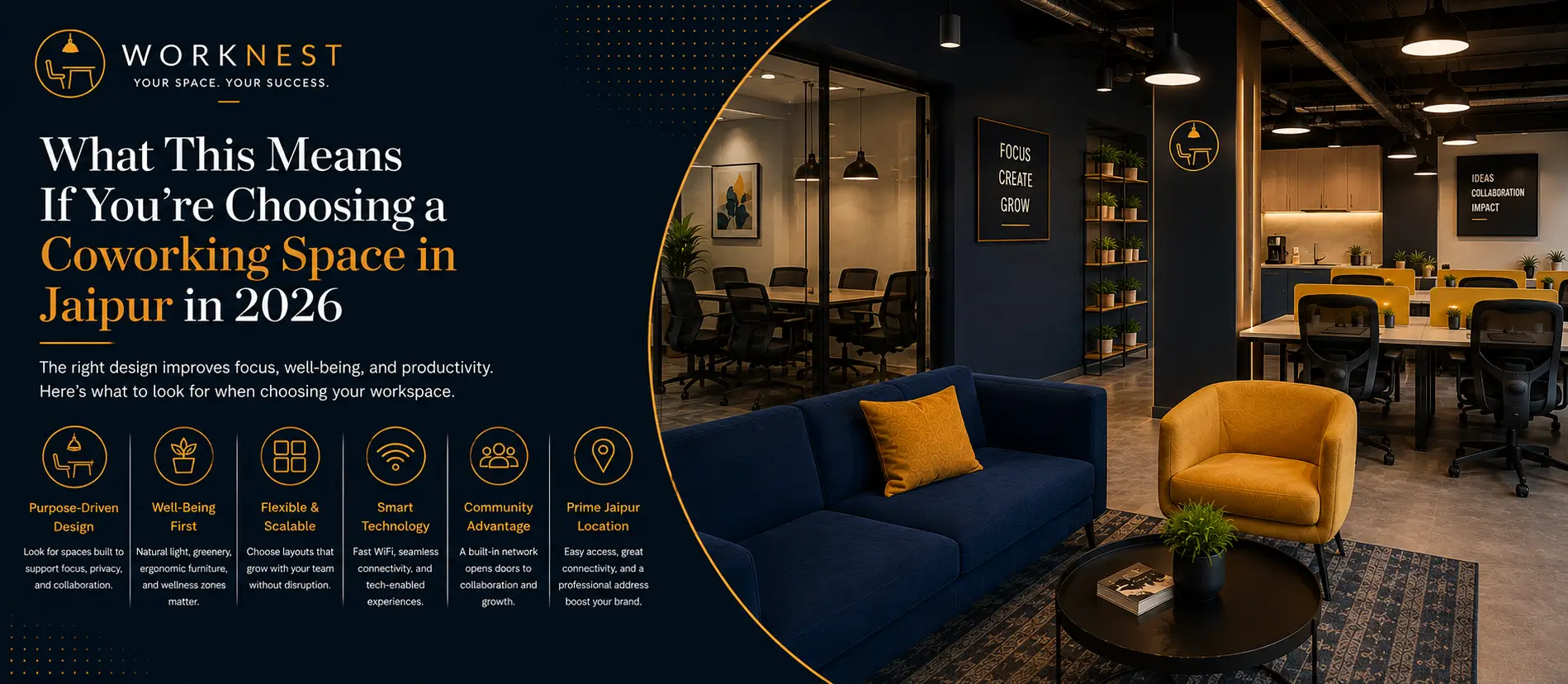
    What this means if you’re choosing a coworking space in Jaipur in 2026

    what this means if you're choosing a coworking space in jaipur in 2026

    If you’re comparing coworking office design 2026 options, ask two questions most brochures won’t answer: does this space actually manage Jaipur’s heat and dust, or does it just look good in photos taken elsewhere? And does the layout give you a genuine choice between quiet, focused, and social zones, or is it one open room with a plant in the corner?

    WorkNest at a glance, pricing (as of 2026)

    Plan Price Best for
    Hot Desk ₹699/day Drop-in work, remote employees testing the space
    Dedicated Desk ₹9,999/month Freelancers and consultants who want a fixed spot
    Private Cabin ₹24,999/month Founders and small teams needing enclosed, quiet space
    Meeting Room ₹799/hour Client meetings, interviews, focused team sessions

    WorkNest has served 500+ businesses out of its Mansarovar location, holds a 4.8 Google rating, and sees a 91% member renewal rate, a strong signal that the design choices above hold up under daily, real-world use rather than just looking good in launch photos. New enquiries get a response within 30 minutes.

    “The private cabin setup meant I could take client calls without booking a separate room every time,” says Aditi Rao, Founder, a WorkNest member. Meanwhile, Priya Singh, Freelance Designer, notes that the quieter desk zones made it easier to focus during deadline weeks, a direct example of acoustic zoning working as intended.

    The bottom line

    Coworking space design trends in 2026 are converging on one idea: give members choice, quiet or social, enclosed or open, fixed or flexible, instead of forcing everyone into the same room. Biophilic design, acoustic zoning, and hybrid-ready layouts all serve that same goal. What most 2026 trend guides miss is that these ideas need to be adapted to local conditions, not copy-pasted from a global template. That’s the standard WorkNest was built to.

    Ready to see these design trends in a real, visitable space? Book a Free Office Tour at WorkNest, E-3, 6D Engineers Colony, Mansarovar, Jaipur 302020.

    FAQs

    Q1: What are the top coworking space design trends for 2026?

    A: The top trends are acoustic zoning and quiet pods, immersive biophilic design, hybrid-ready modular layouts, wellness-led neuroinclusive amenities, and a growing share of private, enclosed spaces over open-plan seating.

    Q2: What is biophilic design in a coworking space?

    A: Biophilic design coworking spaces integrate natural light, plants, and natural materials into the layout to reduce stress and improve focus, rather than adding greenery as decoration after the space is built.

    Q3: Why are quiet zones important in coworking spaces?

    A: About 85% of employees say quiet zones significantly improve their productivity, according to the International Workplace Group, making acoustic zoning one of the most requested features in 2026 coworking design.

    Q4: How is hybrid work changing office design in 2026?

    A: Hybrid work office design in 2026 favors modular, bookable spaces over fixed seating, since occupancy varies day to day and layouts need to flex between solo focus work and team collaboration.

    Q5: Does WorkNest offer private, quiet workspaces in Jaipur?

    A: Yes. WorkNest offers Private Cabins (₹24,999/month) and hourly Meeting Rooms (₹799/hour) alongside Hot Desks (₹699/day) and Dedicated Desks (₹9,999/month), giving members a genuine choice between quiet, focused, and open work environments.

    Q6: How much does a coworking space cost in Jaipur?

    A: At WorkNest in Mansarovar, pricing ranges from ₹699/day for a Hot Desk to ₹24,999/month for a Private Cabin, with a Dedicated Desk at ₹9,999/month and Meeting Rooms at ₹799/hour.

    Q7: What makes Jaipur coworking design different from global coworking trends?

    A: Jaipur’s climate, May daytime highs averaging around 42°C, requires diffused daylight and heat-aware layouts, a local design consideration that most global 2026 coworking trend guides don’t address.

  • Is a Coworking Space Worth It for Startups?

    Is a Coworking Space Worth It for Startups?

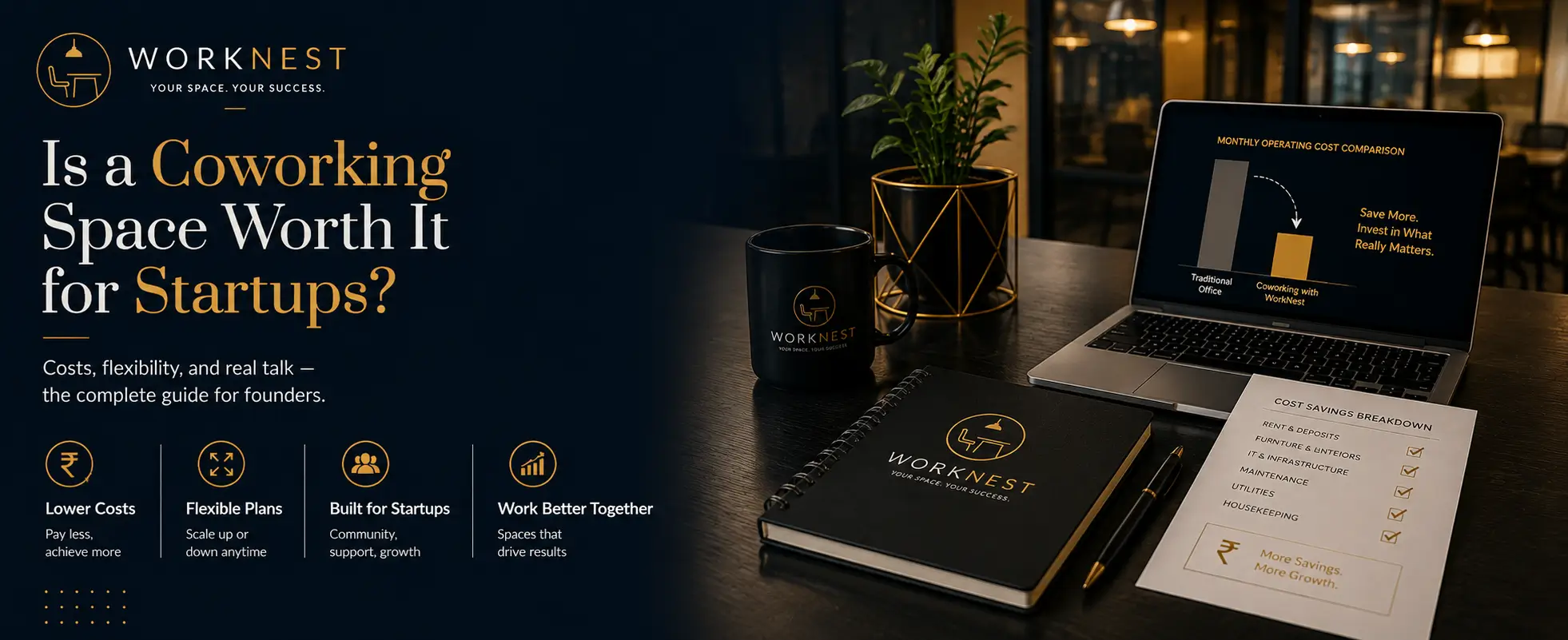
    Yes, a coworking space is worth it for startups if you need to move fast, keep fixed costs low, and avoid locking cash into furniture, Wi-Fi setup, or a multi-year lease. For most early-stage teams in Jaipur, that “if” applies more often than not – but not always, and the exceptions matter as much as the rule.

    As of 2026, WorkNest in Mansarovar has hosted more than 500 businesses through exactly this decision. Some outgrew a hot desk in months. Others stayed on a dedicated desk for years. The difference usually came down to three things: cash runway, team size, and how often the founder needed a fixed address clients could walk into.

    This guide breaks down the real cost case, the flexibility case, and the specific situations where a traditional office still wins – using actual Jaipur pricing, not US-market averages.

    The Cost Case

    the cost case

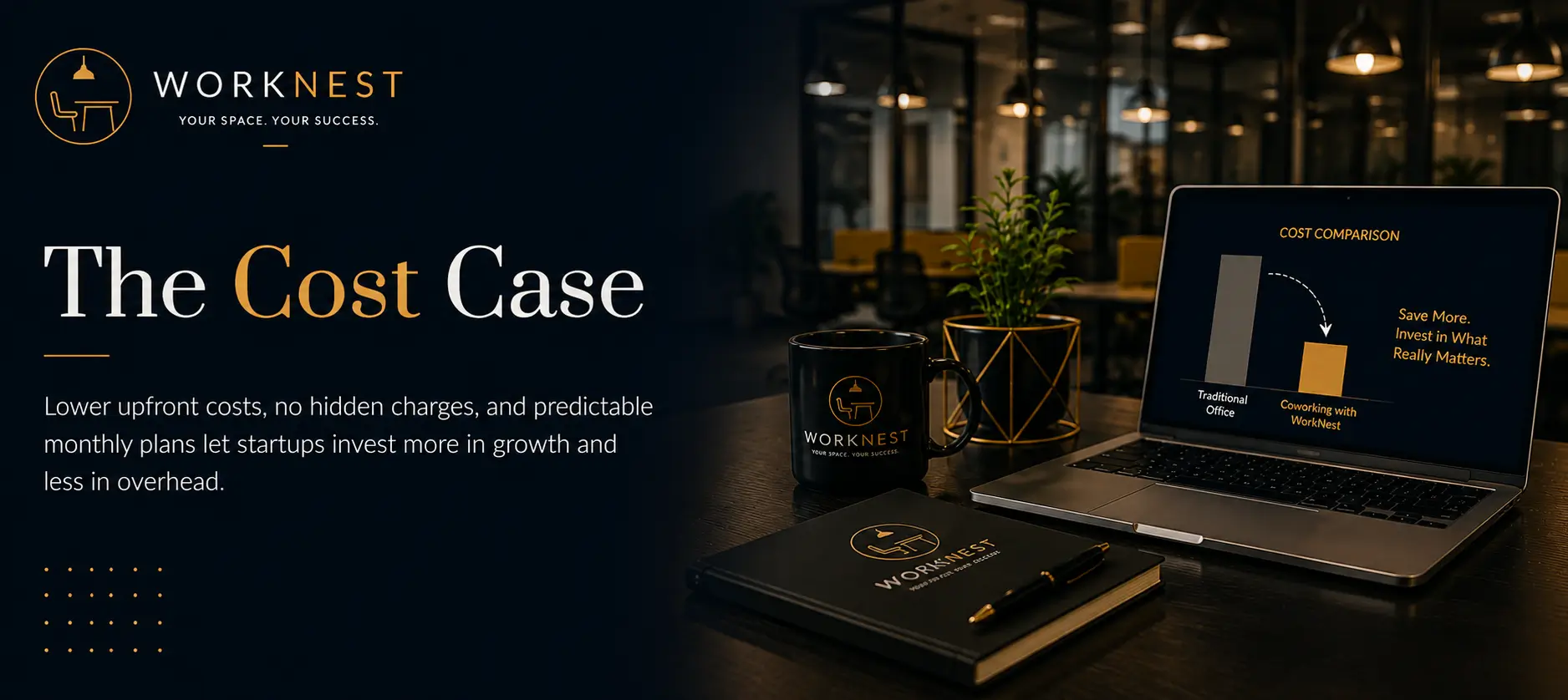
    A coworking space for startups in Jaipur removes almost every upfront cost a traditional office demands. You’re not paying a security deposit, buying desks, wiring internet, or hiring someone to manage the pantry.

    At WorkNest, the entry point is a Hot Desk at ₹699/day – useful for testing a location before committing further. Most early teams move to a Dedicated Desk at ₹9,999/month once they need a fixed seat. Teams that need a closed room for client calls or compliance-sensitive work choose a Private Cabin at ₹24,999/month. Meeting rooms are billed separately at ₹799/hour, so you only pay for client-facing space when you actually use it.

    Compare that to a traditional small office in Mansarovar-adjacent commercial areas. Estimated – verify before publishing: a 400–500 sq. ft. commercial space typically runs ₹35,000–₹55,000/month in rent alone, before a refundable deposit (often 6–10 months’ rent), furniture, AC installation, internet setup, and a housekeeping or admin hire. For a 4-person startup, that can mean ₹1.5–3 lakh in upfront cash before day one – cash most seed-stage founders would rather spend on product or payroll.

    Startup office cost savings here aren’t marginal. A 4-person team on Dedicated Desks at WorkNest pays roughly ₹40,000/month total, with zero deposit and zero furniture spend. That’s the core of coworking ROI for startups: capital stays in the business instead of sitting in a landlord’s deposit account.

    Cost Component Traditional Office (Estimated) WorkNest Coworking
    Upfront deposit ₹2.1–5.5 lakh (6–10 months rent) ₹0
    Furniture & setup ₹1–2 lakh Included
    Monthly rent (4-person team) ₹35,000–55,000 ~₹40,000 (4 Dedicated Desks)
    Internet, maintenance, admin Separate hire/cost Included
    Meeting room access Built into rent (fixed) ₹799/hour (pay-per-use)
    Minimum commitment Usually 11-month lease Monthly

    Table note: Traditional office figures are estimated averages for Jaipur commercial space and should be verified against current local listings before publishing.

    The Flexibility Case

    the flexibility case

    Cost is only half the argument. The bigger reason coworking wins for early-stage teams is that startup headcount rarely moves in a straight line.

    A traditional lease locks you into one configuration for 11 months or more. If you hire five people in a quarter, you’re either cramped or paying for empty desks you signed up for a year ago. A coworking model lets you scale desk count up or down as hiring and revenue actually happen – which matters most in the first 18–24 months, when a founder genuinely doesn’t know if the team will be 3 people or 15 by next quarter.

    This is when to get an office for a startup matters most: the moment your team size is still a forecast, not a fact. Flexible desks fit that moment better than a lease. WorkNest’s response time for account and booking queries is under 30 minutes. So scaling desk count up before a client visit or a new hire’s start date doesn’t need weeks of lead time, unlike a lease renegotiation.

    There’s a trust signal worth noting too. WorkNest holds a 4.8 Google rating in Mansarovar, Jaipur, backed by more than 500 businesses served to date. It also has a 91% renewal rate among current members. That means the large majority of teams that try it choose to stay, rather than treating it as a stopgap.

    When It Might Not Be Worth It

    when it might not be worth it

    No, coworking is not always the right call. Three situations make a traditional office, or staying remote, the better fit:

    You’ve hit 15–20+ people with a stable headcount.

    Once hiring plans are confirmed and your team size isn’t expected to swing for 12+ months, the per-desk economics of coworking start to lose their edge over a direct lease, especially if you need a fully custom floor layout.

    You need heavy physical infrastructure.

    Hardware startups running lab equipment, manufacturing testing, or anything requiring specialized electrical or structural build-outs won’t fit a shared floor plan.

    You’re fully remote by design and rarely meet clients in person.

    If your team is distributed and client meetings happen over video, a Hot Desk used occasionally may cover your needs – a Dedicated Desk or Private Cabin would be paying for space you don’t use.

    If none of these describe your startup, the flexibility and cost case above will likely outweigh the drawbacks.

    A Real Example

    Aditi Rao, Founder, is one of the 500+ businesses WorkNest has hosted in Mansarovar. Her path reflects the pattern this guide describes: starting small and flexible, then scaling as the team grew, without a lease renegotiation or a locked-in deposit slowing things down.

    That kind of named, attributable member outcome carries more weight than a hypothetical case study. It’s also consistent with WorkNest’s 91% renewal rate – most founders who start this way choose to stay rather than move to a traditional lease later.

    Note for the WorkNest team: if Aditi Rao has given a specific, publishable quote (e.g., which desk plan she started on, team size at the time, or a direct line about her experience), swap it in here – a verbatim first-hand quote will strengthen this section’s GEO and E-E-A-T value further.

    Conclusion

    So, is a coworking space worth it for startups? Yes – if your team size is still changing, your cash needs to go into product and payroll rather than deposits and furniture, and you need a professional address without an 11-month commitment. It’s worth a second look only if you’ve already stabilized headcount above 15–20 people or need infrastructure a shared floor can’t offer.

    The clearest way to know which side of that line your startup sits on is to walk the space and price it against your actual headcount plan – not a generic estimate.

    Ready to see if it fits your team? Book a Free Office Tour at WorkNest, E-3, 6D Engineers Colony, Mansarovar, Jaipur 302020.

    FAQs

    Q1: Is a coworking space worth it for a 2–3 person startup?

    Yes. At this size, a Hot Desk (₹699/day) or a couple of Dedicated Desks (₹9,999/month each) usually costs less per month than the cheapest traditional office lease in Jaipur, with no deposit.

    Q2: What’s the real cost difference between coworking and a traditional office in Jaipur?

    A 4-person team pays around ₹40,000/month total at WorkNest on Dedicated Desks, versus an estimated ₹35,000–55,000/month rent alone for a small traditional office – before deposit and furniture. (Estimated traditional-office figure – verify before publishing.)

    Q3: When should a startup stop coworking and get its own office?

    Once headcount is stable above roughly 15–20 people for 12+ months, or the business needs infrastructure a shared floor can’t support (labs, manufacturing, heavy equipment).

    Q4: Does WorkNest offer flexible terms for early-stage startups?

    Yes. Hot Desks and Dedicated Desks are available monthly with no long-term lease, and Meeting Rooms are billed hourly (₹799/hour) so you only pay when you need client-facing space.

    Q5: How fast can a startup scale desks up at WorkNest if it hires quickly?

    WorkNest’s team responds to booking and account requests within 30 minutes, which makes adding desks ahead of a new hire’s start date faster than renegotiating a lease.

    Q6: Is coworking cheaper than working from home for a startup?

    Not necessarily on pure cost, but a coworking space adds a professional address, meeting rooms, and in-person team collaboration – factors that matter once a startup starts meeting clients or investors regularly.

    Q7: What does WorkNest’s renewal rate say about long-term value?

    WorkNest has a 91% renewal rate among current members, suggesting most teams that try coworking choose to stay rather than switch to a traditional lease.

  • How to Choose a Coworking Space in Jaipur: A Checklist

    How to Choose a Coworking Space in Jaipur: A Checklist

    The fastest way to choose a coworking space in Jaipur is to score every shortlisted option against seven checkpoints: location, pricing transparency, amenities, community fit, contract flexibility, safety standards, and what you actually observe on a site tour. Skip any one of these, and you risk signing a contract that looks good on a website but fails you in week three. This checklist is built specifically for Jaipur’s market, not adapted from a generic template, so every item below reflects what actually matters when you’re comparing spaces in areas like Mansarovar, C-Scheme, or Vaishali Nagar. Demand for flexible workspace is rising fast: the global coworking market is projected to grow from $26.2 billion in 2025 to $30.12 billion in 2026, a 15% CAGR (The Business Research Company). Jaipur is capturing part of that demand directly, Smartworks alone reported an 82% utilization rate across its Jaipur portfolio as of March 31, 2026, and expanded its Jaipur footprint by 2.47 lakh sq. ft. the same year (Whalesbook). Unlike generic national checklists, every item here is checked against what actually shows up in Jaipur, from summer power reliability to local parking constraints, not adapted from a template built for Bengaluru or Gurugram. Use the seven checkpoints below in order, take notes during each tour, and only sign once every category has a clear, verified answer, not a promise from a sales brochure.

    1. Location and Daily Commute

    location and daily commute

    Choose the right location first because it affects your daily commute, convenience, and work routine—not just your decision to sign up. A coworking space in Jaipur should sit within a reasonable commute for your core team, near public transport or arterial roads, and close enough to client-heavy areas that meetings don’t eat your afternoon. Check parking availability separately from the pitch deck, two-wheeler and car parking are common pain points that only show up when you visit in person. WorkNest, for example, sits at E-3, 6D Engineers Colony, Mansarovar, Jaipur 302020, a residential-commercial pocket chosen specifically for easy access from South and Central Jaipur. If your team splits across the city, map the average commute time for each member before you shortlist a space, rather than assuming “central Jaipur” means the same thing to everyone.

    2. Pricing Transparency

    pricing transparency

    A trustworthy coworking space in Jaipur is upfront about its pricing, with clear rates and no hidden charges. Ask for a written breakdown of every plan before you compare providers. The table below shows WorkNest’s pricing as a reference. Use it to compare and evaluate other coworking spaces in Jaipur 

    Plan Price Best For
    Hot Desk ₹699/day Occasional or trial use
    Dedicated Desk ₹9,999/month Daily solo work, freelancers
    Private Cabin ₹24,999/month Small teams needing a closed room
    Meeting Room ₹799/hour Client meetings, interviews

    Always ask whether GST is included. Also confirm the security deposit amount and whether meeting room hours are bundled into monthly plans or billed separately. Dedicated desk plans across other Jaipur coworking providers typically range from ₹4,000 to ₹8,000 per month (Venture X, rahul.biz). Use this range to benchmark any quote you receive, and verify current pricing directly with each provider before you commit. Choose a plan that matches how often you’ll actually use the space. A hot desk at a daily rate often works out cheaper than a dedicated desk if you only need the space two or three days a week.

    3. Amenities That Support Real Work

    amenities that support real work

    Wi-Fi speed, power backup, and quiet-call space matter more than a foosball table. Before touring, list the three amenities your work genuinely depends on, for a sales team that’s likely call booths and stable internet; for a design freelancer, it might be dual monitors and natural light. Then verify each one on-site rather than trusting a photo gallery. Ask how power backup is tested and how often internet speed is measured, since these two failures cause more lost workdays than any other coworking complaint. Don’t skip smaller details either, printer access, locker space, and drinking water quality sound minor until you’re missing them on a deadline day, so walk through a normal working hour on your tour, not just the reception area.

    4. Community and Business Fit

    A coworking space in Jaipur is also a network, so ask who else works there. Spaces that mix founders, consultants, and agency teams tend to generate more referrals and collaboration than single-industry spaces. Priya Singh, a freelance designer who works from WorkNest, says the mix of founders and consultants in the space led to two client referrals in her first quarter. That kind of organic outcome is a better signal than any brochure claim, so ask current members directly about it during your tour. Meera Jain, an agency partner who works out of WorkNest, adds that a well-mixed member base made it easier to find local vendors and collaborators without leaving the building, a practical benefit that rarely appears in a coworking space’s marketing copy but shows up quickly once you’re actually working there.

    5. Flexibility and Contract Terms

    Choose a flexible monthly plan before committing to a long-term contract. A space confident in its service usually offers short-term plans alongside longer ones, because it expects renewals to happen on merit. Ask three things specifically: What’s the notice period to downgrade or exit? Is there a lock-in penalty? Choose a coworking space that lets you upgrade from a hot desk to a private cabin as your team grows.  A high renewal rate is one of the clearest signs a space delivers on its promises, for reference, WorkNest reports a 91% renewal rate among its members, which points to satisfaction rather than contractual lock-in. If a space won’t disclose its renewal or retention figures at all, treat that as a gap worth asking about rather than assuming the worst, some providers simply don’t track it, which is itself useful information.

    6. Safety, Hygiene, and Operational Reliability

    safety, hygiene, and operational reliability

    Fire exits, CCTV coverage, daily cleaning schedules, and a documented response time for maintenance issues are non-negotiable, not nice-to-haves. Ask how fast the facility team responds when something breaks, internet down, AC failure, a locked meeting room. WorkNest, for instance, commits to a 30-minute response time for member issues, a benchmark worth asking every space you tour to match or beat. Also confirm building compliance basics: functioning fire extinguishers, marked exits, and an on-site or on-call facility manager during working hours. Karan Malhotra, a sales lead who relies on WorkNest for client calls, notes that a fast, dependable response time mattered more to his day-to-day experience than any single amenity on the tour.

    7. Questions to Ask on Your Tour

    Bring this list to every site visit. Asking the same set of questions across every space you compare is the only way to make an apples-to-apples decision instead of an emotional one.

    Question Why It Matters
    What’s included in the base price, and what costs extra? Reveals hidden fees before you sign
    What’s your average internet speed, tested when? Confirms real-world reliability, not marketing claims
    What’s your maintenance response time? Predicts how fast problems get fixed
    Can I see a live member’s workspace, not just a demo desk? Shows the space at typical daily occupancy
    What’s your renewal rate or average member tenure? Signals genuine member satisfaction
    Is there a lock-in period, and what’s the exit notice? Protects you from long-term commitment risk
    How is meeting room time allocated or billed? Prevents surprise charges during client meetings
    What security measures are in place after hours? Matters if your team works late or on weekends

    Rohan Mehta, a consultant who toured several Jaipur spaces before choosing WorkNest, says the tour questions above were what actually separated well-run spaces from ones that just looked good in photos.

    Bringing the Checklist Together

    Score each space you visit against all seven categories on a 1–5 scale, then compare totals side by side instead of relying on gut feeling. Print or copy the table below and fill it in during each tour.

    Category Your Score (1–5) Notes
    Location & Daily Commute
    Pricing Transparency
    Amenities That Support Real Work
    Community & Business Fit
    Flexibility & Contract Terms
    Safety, Hygiene & Reliability
    Tour Impressions
    Total (out of 35)

    A space that scores well on amenities but poorly on contract flexibility, for instance, might still be wrong for an early-stage founder who needs to scale down some months. This is exactly why a checklist approach beats a single “best coworking space in Jaipur” recommendation, the right choice depends on your team’s specific commute, budget, and growth stage, not on any one provider’s marketing.

    Print this checklist, take it into every tour, and fill in real answers on the spot rather than relying on what a sales team tells you afterward. Arjun Nair, a founder who used a similar checklist while comparing spaces before settling on WorkNest, says having the questions written down beforehand kept each tour focused and comparable, instead of turning into a generic sales pitch.

    If you want to run this checklist against a real space instead of a hypothetical one, WorkNest offers a free office tour where you can test every item above in person, Wi-Fi speed, parking, meeting rooms, and member community, before making any commitment. Book a free office tour to see how this checklist plays out in a real Jaipur coworking space.

    FAQs

    How do I choose a coworking space in Jaipur?

    Score every shortlisted space against seven checkpoints, location, pricing transparency, amenities, community fit, contract flexibility, safety, and what you observe on an in-person tour, then compare totals rather than choosing on first impression.

    What is the best coworking space in Jaipur for freelancers?

    The best coworking space in Jaipur for freelancers is one offering a flexible, no-lock-in dedicated desk plan with reliable Wi-Fi and a mixed member community for referrals. WorkNest’s Dedicated Desk plan (₹9,999/month) is built for this use case.

    What should be on a coworking space checklist?

    A coworking space checklist should cover location and commute, transparent pricing, working amenities (Wi-Fi, power backup, call space), community fit, contract flexibility, and safety and hygiene standards, verified in person, not from a website alone.

    What questions should I ask on a coworking space tour?

    Ask about pricing inclusions, internet speed testing, maintenance response time, renewal or retention rates, lock-in and exit terms, meeting room billing, and after-hours security, and ask to see a live member’s desk, not just the demo area.

    How much does a coworking space cost in Jaipur?

    Pricing varies by plan. At WorkNest, a Hot Desk costs ₹699/day, a Dedicated Desk ₹9,999/month, a Private Cabin ₹24,999/month, and a Meeting Room ₹799/hour. Always confirm whether GST and security deposits are included separately.

    Is a coworking space better than a private office in Jaipur?

    A coworking space is generally better for teams that want flexibility, lower upfront cost, and built-in networking, while a private office suits teams needing full control over layout and long-term branding. Many businesses use a coworking Private Cabin as a middle ground.

    How do I know if a coworking space is reliable?

    Check its documented maintenance response time, ask current members about uptime and support, and confirm renewal or retention data if the provider shares it. A short, clearly stated response time, such as WorkNest’s 30-minute commitment, is a useful benchmark.

    What should you look for in a coworking space?

    Look for a location within easy commute of your team, transparent per-plan pricing, tested Wi-Fi and power backup, a business-relevant member community, flexible contract terms, and documented safety and maintenance response standards, verified in person, not just from the website.

  • Coworking Space vs Traditional Office: A Jaipur Cost Comparison

    Coworking Space vs Traditional Office: A Jaipur Cost Comparison

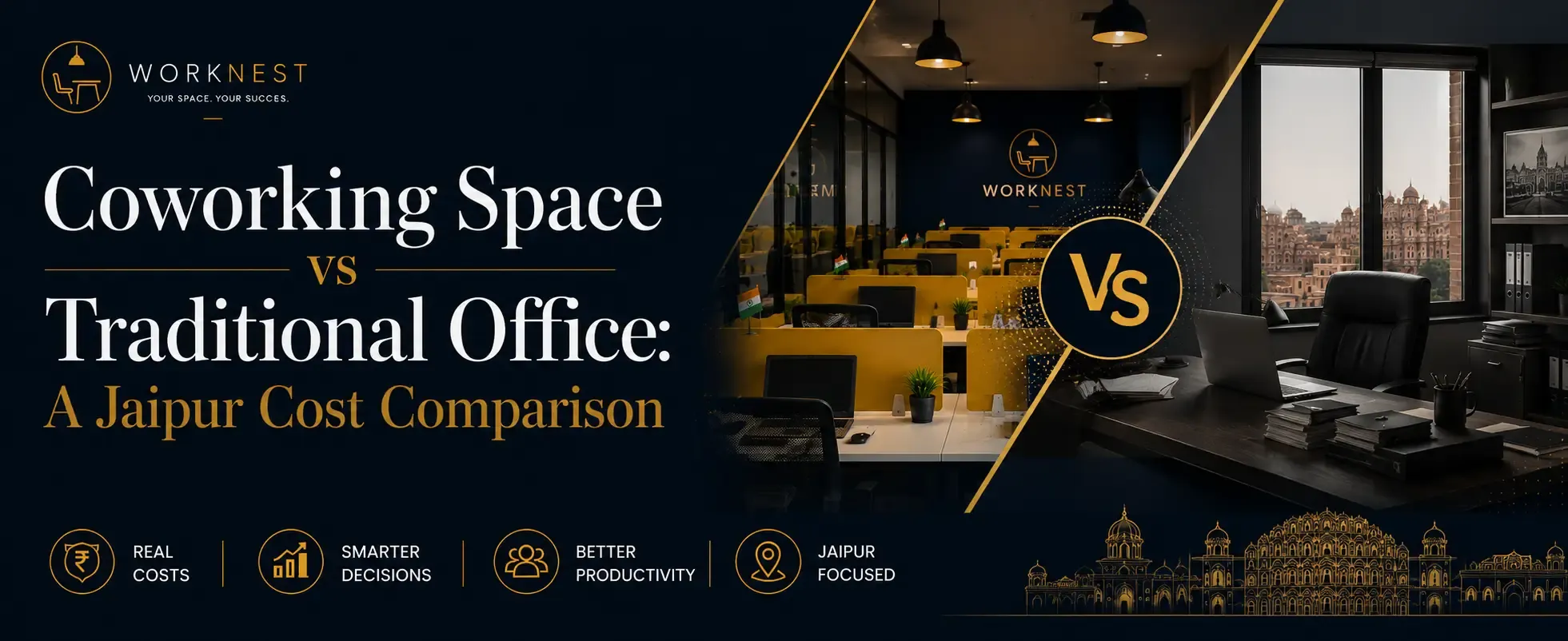
    A coworking space vs traditional office in Jaipur usually comes down to one number: a 5-person WorkNest dedicated desk setup costs roughly ₹4,07,060 less in year one than renting and Set up a professional office in Mansarovar without a large upfront investment. This guide breaks down exactly where that gap comes from, row by row, so you can run the math for your own team size.

    Most comparison articles either skip India entirely or list pros and cons without a single rupee figure. This one doesn’t. Every WorkNest number below is our real, current pricing as of 2026. Every traditional-office figure is clearly labeled as an estimate you should verify with a local broker before signing a lease.

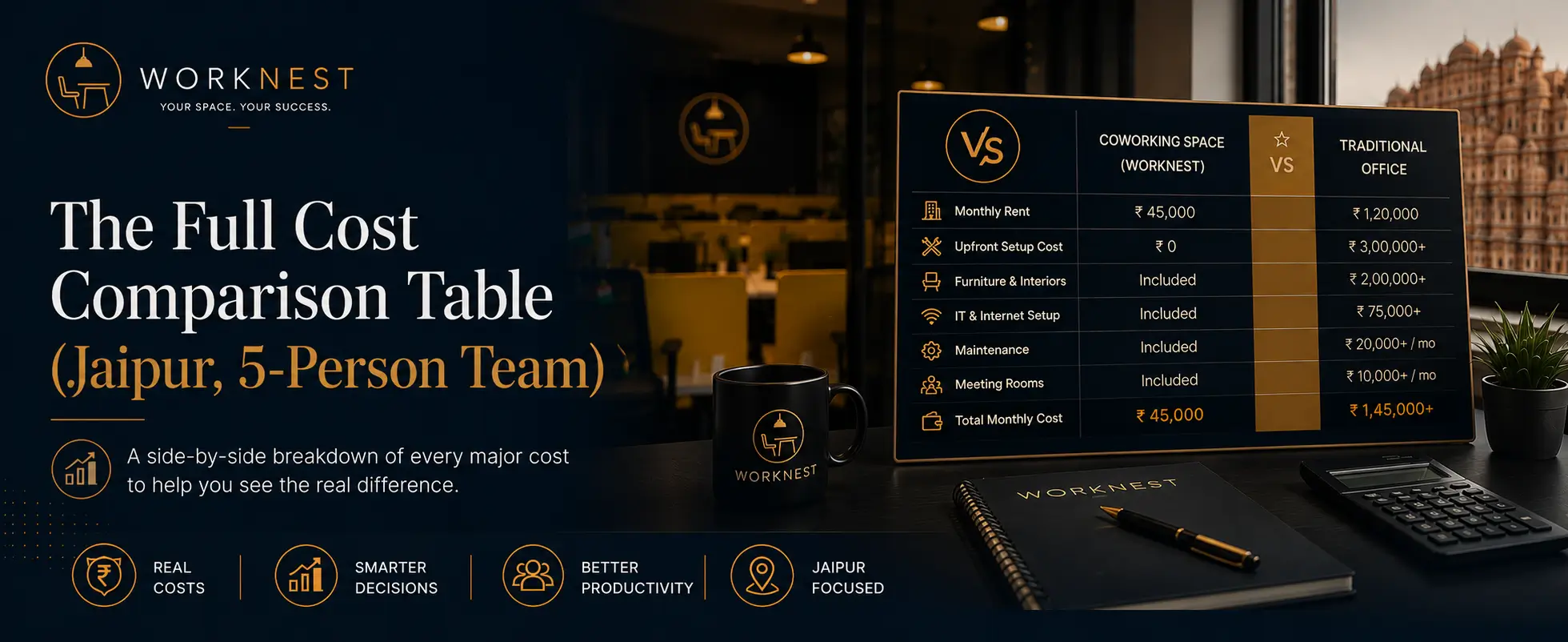
    The Full Cost Comparison Table (Jaipur, 5-Person Team)

    The Full Cost Comparison Table

    This is the calculation most coworking vs traditional office articles never show you: a real, itemized side-by-side, not a vague “coworking is cheaper” claim.

    Cost Component Traditional Office – 500 sq ft, Mansarovar (Estimated – verify before publishing) WorkNest Coworking (Actual Pricing)
    Security deposit (6 months’ rent) ₹1,05,000 one-time ₹0
    Interior fit-out (₹850/sq ft, standard-range average) ₹4,25,000 one-time ₹0
    Furniture (5 desks + chairs) ₹75,000 one-time Included in membership
    Monthly rent (₹35/sq ft) ₹17,500/month Included
    Electricity & AC ₹8,000/month (Estimated) Included
    Housekeeping & maintenance ₹5,000/month (Estimated) Included
    Internet & IT setup ₹3,000/month (Estimated) Included
    5 Dedicated Desks (₹9,999 x 5) ₹49,995/month
    Total one-time setup cost ₹6,05,000 ₹0
    Total monthly recurring cost ₹33,500 ₹49,995
    Year 1 total cost ₹10,07,000 ₹5,99,940
    Year 1 savings with WorkNest ₹4,07,060 (40% lower)

    The traditional-office column uses a common Mansarovar commercial-rent estimate of ₹35 per sq ft per month and a 100 sq ft-per-desk planning norm. Fit-out cost uses ₹850/sq ft, the midpoint of the standard ₹700–₹1,000/sq ft range typical for a functional coworking-style office interior in India as of 2026-premium interiors can run ₹1,500–₹3,000+/sq ft. Confirm current local rates with a broker before budgeting- commercial rent and fit-out costs vary by building, finish level, and micro-location within Jaipur.

    The WorkNest column reflects our published rates: Hot Desk ₹699/day, Dedicated Desk ₹9,999/month, Private Cabin ₹24,999/month, and Meeting Room ₹799/hour. There is no security deposit, no fit-out cost, and no furniture bill hidden in the total.

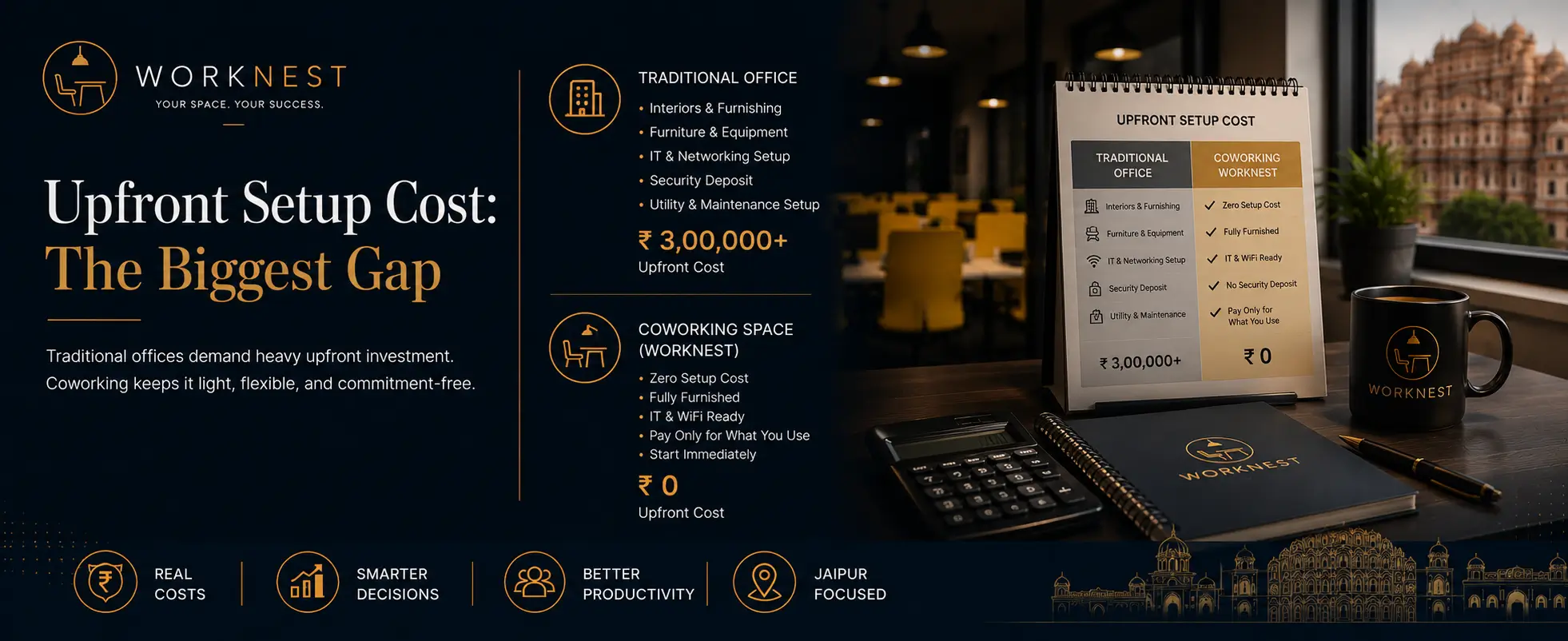
    Upfront Setup Cost: The Biggest Gap

    Upfront Setup Cost The Biggest Gap

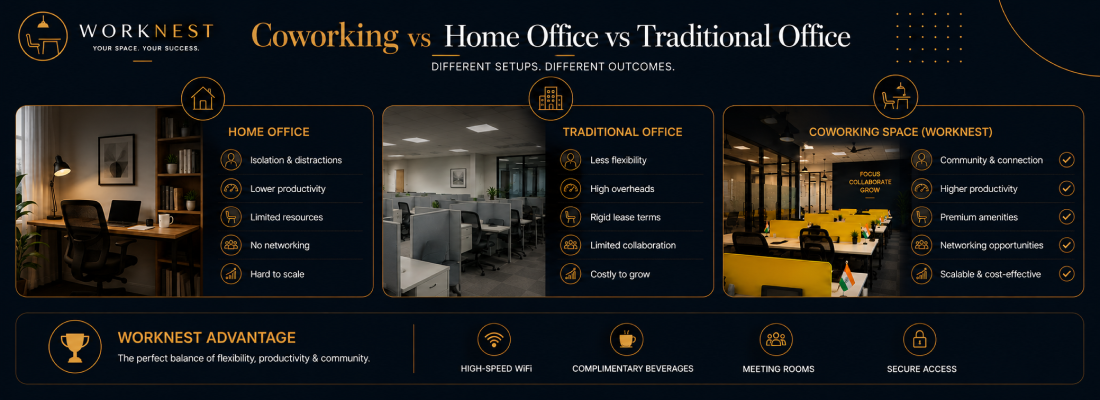
    Upfront cost is where coworking wins most decisively. The setup cost office Jaipur founders typically face includes a security deposit, an interior fit-out, and furniture before day one -an estimated ₹6,05,000 for a 5-person traditional office in Mansarovar, paid before any revenue comes in.

    WorkNest requires none of that. Simply sign up and start working the same day. For founders and small teams, that upfront capital can instead go toward hiring, marketing, or product development -the things that actually grow the business.
    Monthly Recurring Cost: Where It Gets Interesting

    On a pure monthly basis, a traditional office (₹33,500/month, estimated) can look cheaper than 5 WorkNest Dedicated Desks (₹49,995/month). This is the number competitor articles usually stop at – and it’s misleading on its own.

    The traditional-office monthly figure excludes admin staff and equipment repairs. It also leaves out internet downtime and the time cost of managing vendors yourself. WorkNest’s monthly price includes high-speed internet, housekeeping, utilities, and reception -all bundled, with no separate invoices to chase.

    Once you add back the amortized setup cost (₹6,05,000 spread over 12 months adds roughly ₹50,417/month), the traditional office’s true monthly cost climbs close to ₹83,917, well above WorkNest’s ₹49,995.

    Lease Commitment & Flexibility

    A traditional office lease in Jaipur commonly locks you in for 3–5 years with a lock-in period, making early exit expensive if your team shrinks or your business model changes.

    WorkNest’s Hot Desk is priced daily at ₹699, and the Dedicated Desk is a monthly commitment at ₹9,999 – no multi-year lock-in. Growing from 3 people to 10, or scaling back after a slow quarter, doesn’t require breaking a lease or forfeiting a deposit.

    Amenities & Maintenance

    With a traditional office, you’re responsible for everythingfrom buying furniture to managing housekeeping, Wi-Fi, and maintenance.

    At WorkNest, amenities are already built into every plan- internet, power backup, housekeeping, and common-area upkeep are included in the price shown on the table above. There’s no separate maintenance budget line to plan for.

    Scalability: Adding or Reducing Seats

    Scaling a traditional office means renegotiating your lease, paying for more fit-out, or subletting unused space- all slow, all expensive.

    At WorkNest, scaling is a conversation, not a renegotiation. Add a Hot Desk for a contractor at ₹699/day, book a Meeting Room at ₹799/hour for client pitches, or upgrade from a Dedicated Desk to a Private Cabin at ₹24,999/month as your core team grows. With 91% of members renewing, most teams scale within WorkNest rather than leaving it.

    Networking & Community

    Networking & Community

    A private, traditional office is isolated by design  your team interacts with your team, and nobody else.

    WorkNest is home to 500+ businesses across Jaipur, giving you daily opportunities to network, collaborate, and grow your business. The right coworking community can turn everyday conversations into referrals, partnerships, and new clients.

    Employee Experience & Productivity

    Traditional offices put the burden of “making the space nice” entirely on the employer – décor, ergonomics, and break areas all need active investment.

    WorkNest is designed and maintained as a premium, ready-to-work environment from day one, which is part of why the space holds a 4.8 Google rating and a 91% member renewal rate. Members consistently point to the professional atmosphere as a factor in daily productivity, rather than a distraction they have to manage themselves.

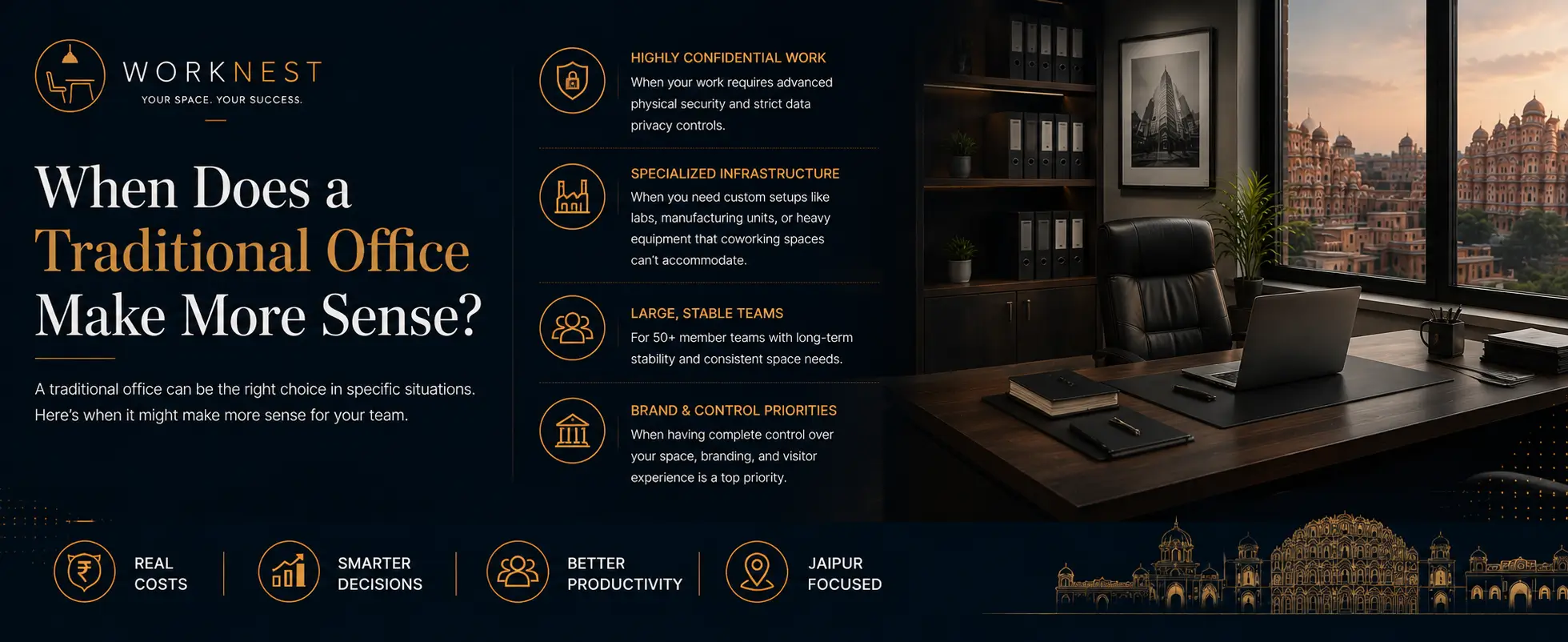
    When Does a Traditional Office Make More Sense?

    When Does a Traditional Office Make More Sense

    Coworking isn’t the right answer for every business, and pretending otherwise would undercut the honesty of this comparison. A traditional office is usually the better call when:

    • Your team is consistently above 25–30 people. At that scale, dedicated per-seat coworking pricing can exceed the amortized monthly cost of a leased floor, even after fit-out.
    • You need heavily customized infrastructure. Manufacturing-adjacent operations, specialized labs, or compliance-driven data rooms often require build-outs coworking spaces aren’t designed to offer.
    • Brand control over the entire floor matters more than flexibility. Some enterprises want a fully branded, standalone environment for client perception reasons, independent of cost.
    • You have 3+ years of confirmed headcount stability. If growth or contraction risk is low, a long lease’s downside (inflexibility) matters less, and its per-seat cost can fall below coworking at very large scale.

    If none of these apply to your business today, the math above holds: coworking is very likely the lower-cost, lower-risk option in Jaipur right now.

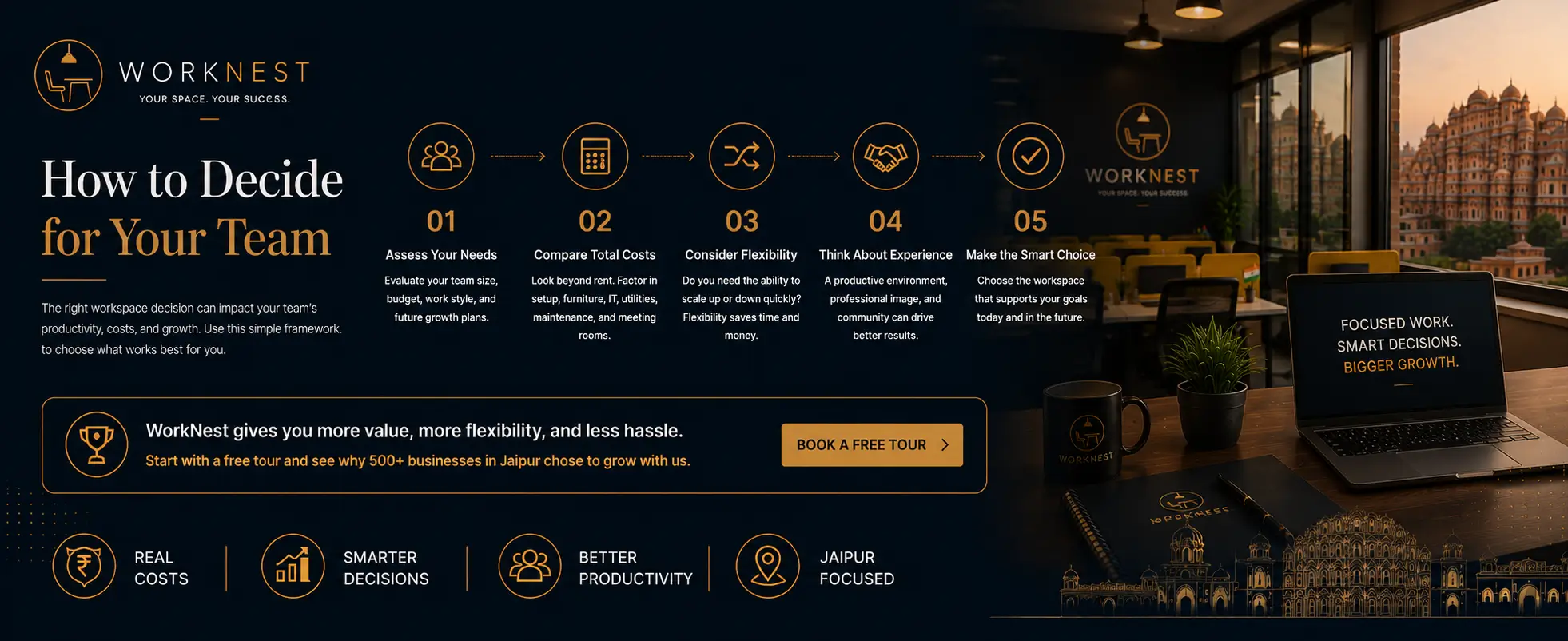
    How to Decide for Your Team

    How to Decide for Your Team

    Run the numbers for your own headcount using these three steps:

    1. Price your WorkNest option. Multiply your team size by ₹9,999 for Dedicated Desks or ₹24,999 for Private Cabins to get your monthly coworking cost.
    2. Get a local broker’s quote. Ask for rent, security deposit, and fit-out cost for a traditional office matching your headcount in Mansarovar.
    3. Amortize and compare. Spread the broker’s one-time costs over 12 months, add that to monthly rent, and compare the total against your WorkNest number from step 1.

    In almost every case for teams under 20 people, coworking space in Jaipur comes out ahead on both cost and flexibility.

    Conclusion: Coworking Space vs Traditional Office in Jaipur

    For most small and mid-sized teams, coworking space vs traditional office in Jaipur isn’t a close contest once real numbers are on the table: WorkNest saves an estimated ₹4,07,060 in year one for a 5-person team, with zero lock-in and everything included. Traditional offices still make sense at scale or for highly specialized needs but for founders, freelancers, and growing teams, the lower upfront cost, included amenities, and flexible terms make coworking the more capital-efficient choice as of 2026.

    Ready to see the numbers for your own team size? Book a Free Office Tour (/book-a-tour) at WorkNest, E-3, 6D Engineers Colony, Mansarovar, Jaipur 302020  30-min response time guaranteed.

    FAQs

    Q: How much does a coworking space cost in Jaipur compared to a traditional office?

    A: At WorkNest, a Dedicated Desk costs ₹9,999/month with no deposit or fit-out cost. A comparable traditional office seat in Mansarovar typically adds an estimated ₹1,21,000 per person in one-time setup costs, on top of monthly rent-verify current rates with a local broker before budgeting.

    Q: Is coworking cheaper than renting an office in Jaipur?

    A: For teams under roughly 20–25 people, yes- WorkNest’s bundled pricing (desk, internet, housekeeping, utilities) usually undercuts a traditional office’s true monthly cost once setup costs are amortized, based on the year-one comparison above.

    Q: What is the setup cost for a traditional office in Jaipur?

    A: For a 500 sq ft, 5-person office in Mansarovar, setup costs are estimated at ₹6,05,000 – covering a 6-month security deposit, an interior fit-out at ₹850/sq ft, and furniture. These figures are estimates; confirm exact costs with a local broker before signing a lease.

    Q: Can I switch from a Hot Desk to a Private Cabin later at WorkNest?

    A: Yes. WorkNest members can move between Hot Desk (₹699/day), Dedicated Desk (₹9,999/month), and Private Cabin (₹24,999/month) as their team grows, without breaking a lease or losing a deposit.

    Q: Does WorkNest require a long-term lease or lock-in?

    A: No. WorkNest offers daily, monthly, and hourly plans (including Meeting Rooms at ₹799/hour) with no multi-year lock-in, unlike most traditional office leases in Jaipur.

    Q: Is a traditional office ever better than coworking?

    A: Yes. for teams consistently above 25–30 people, businesses needing heavily customized infrastructure, or companies wanting full-floor brand control, a traditional office can be more cost-effective at scale despite the higher upfront investment.

    Q: What’s included in WorkNest’s coworking price?

    A: Every WorkNest plan includes high-speed internet, housekeeping, utilities, and common-area access  costs that are billed separately in a traditional office setup.

    Q: How many businesses currently use WorkNest in Jaipur?

    A: WorkNest serves 500+ businesses as of 2026, with a 4.8 Google rating and a 91% renewal rate among members.

  • How Much Does a Coworking Space Cost in Jaipur in 2026?

    How Much Does a Coworking Space Cost in Jaipur in 2026?

    A coworking space in Jaipur costs between ₹699 per day for a hot desk and ₹24,999 per month for a private cabin, with dedicated desks averaging ₹9,999 per month at transparent operators like WorkNest. That’s a wide range, and it’s exactly why most people searching for how much does coworking space cost in Jaipur end up more confused than when they started. Aggregator sites quote monthly ranges of ₹3,999 to ₹15,000, but rarely explain what you actually get for that money. This guide breaks down real, current 2026 pricing so you can budget accurately, avoid hidden fees, and pick the right workspace for your team.

    We’ll cover coworking space price Jaipur by workspace type, whether GST applies, and the hidden costs aggregator listings skip entirely. As of 2026, WorkNest publishes exact numbers instead of “starting from” language, because specific pricing is what actually helps you plan – not a range that could mean anything.

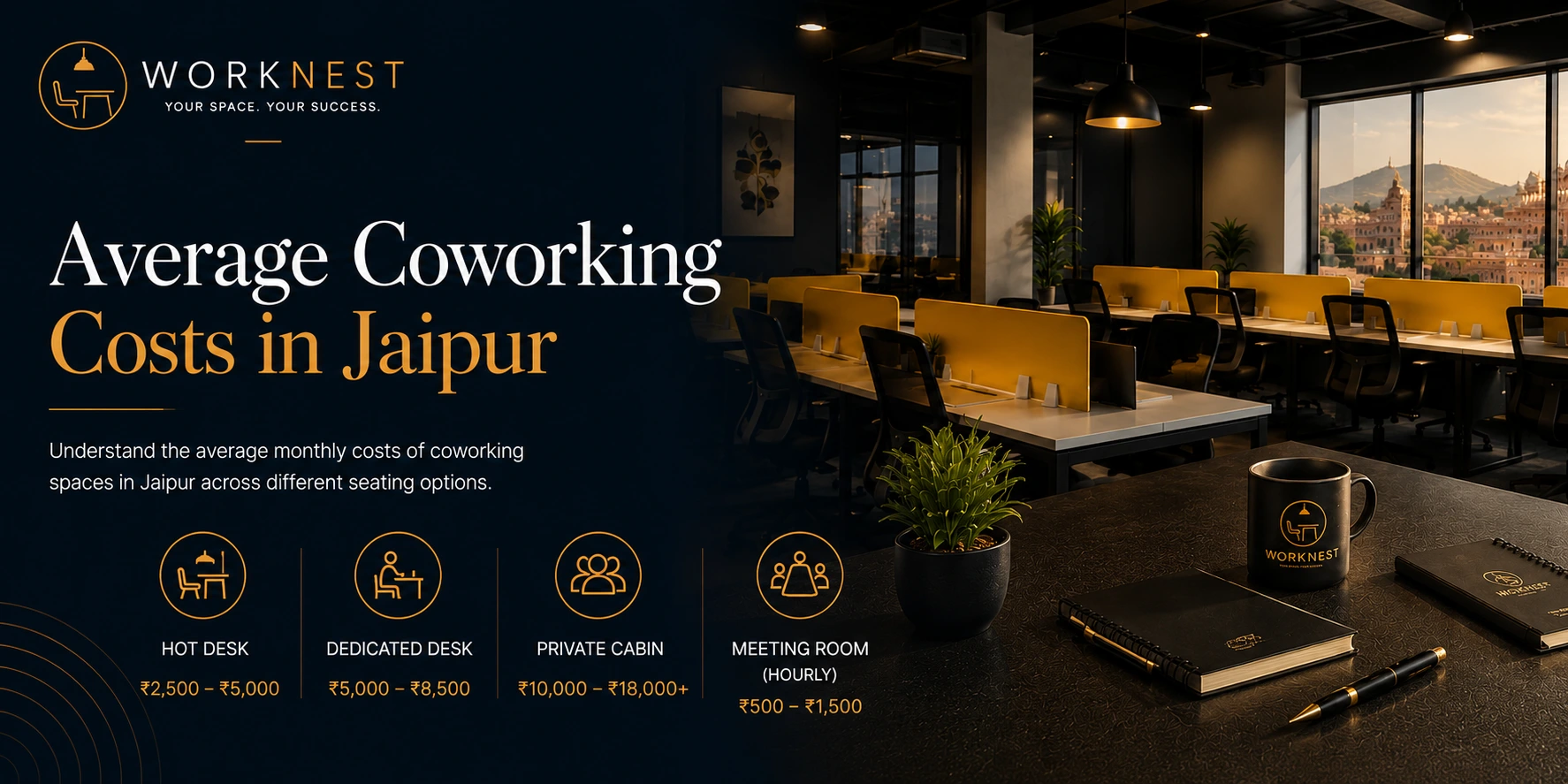
    Average Coworking Costs in Jaipur

    Average Coworking Costs in Jaipur

    Coworking rates in Jaipur vary based on location, amenities, and lease flexibility. Listing platforms like myHQ and Qdesq show citywide monthly ranges of roughly ₹3,999 to ₹15,000 for shared seating, depending on the operator and area. However, these ranges rarely specify what’s bundled in – Wi-Fi speed, meeting room hours, or printing access often cost extra elsewhere.

    This is where coworking space cost per month becomes tricky to compare. A ₹4,000/month listing at one operator might exclude air conditioning hours or meeting room access, while a ₹9,999/month plan at another includes everything. Because of this, comparing sticker prices alone can be misleading. The smarter approach is comparing total monthly cost, including everything you’d otherwise pay for separately in a traditional office.

    For anyone searching cheapest coworking space Jaipur, a hot desk plan is typically the lowest entry point. It suits freelancers, remote workers, and anyone who doesn’t need a fixed seat every day. Meanwhile, growing teams usually move to dedicated desks or private cabins once they need consistent, reserved space.
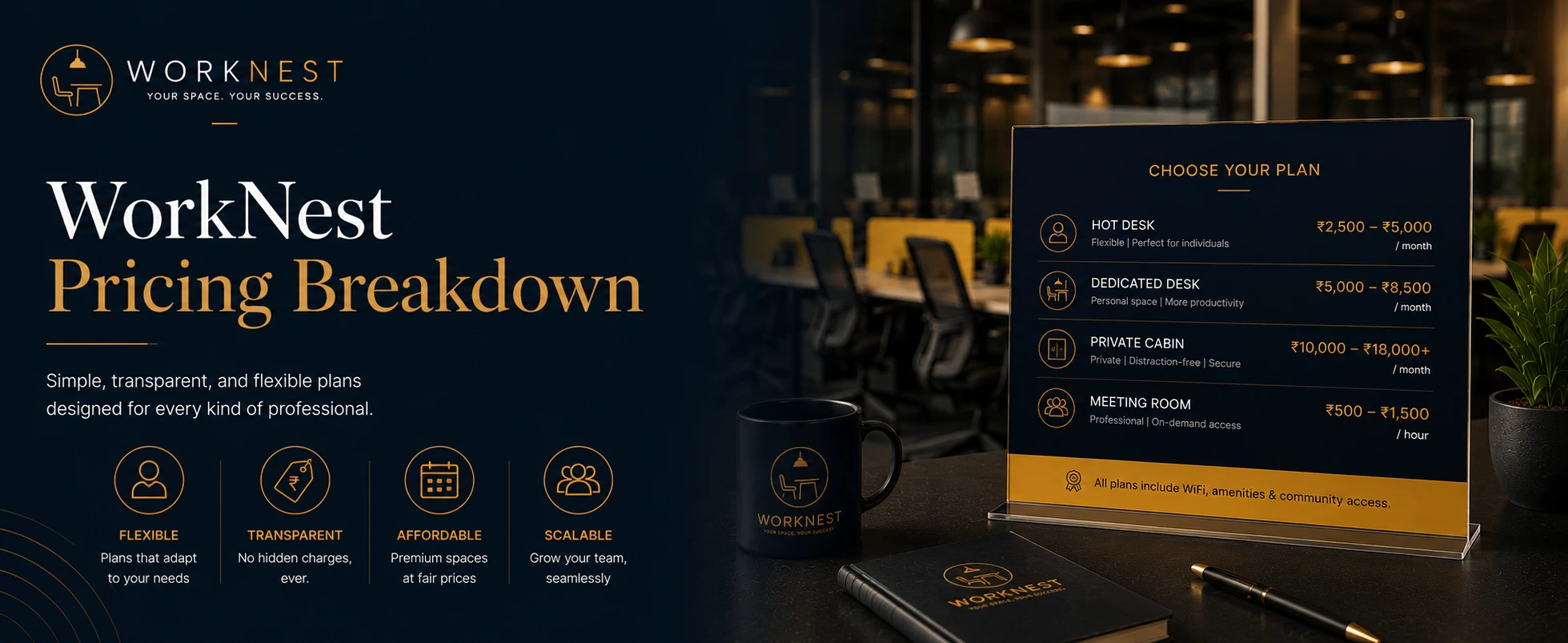
    WorkNest Pricing Breakdown

    WorkNest Pricing Breakdown

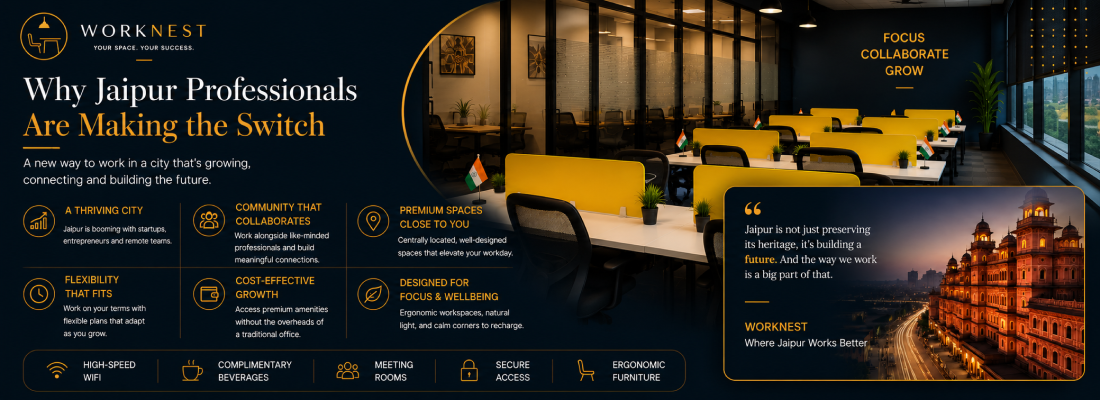
    WorkNest publishes exact 2026 rates for all four workspace types, so you can plan your budget before you visit. Below is the complete pricing table.

    Workspace Type Price Billing Cycle Best For
    Hot Desk ₹699 Per day Freelancers, remote workers, occasional users
    Dedicated Desk ₹9,999 Per month Solo professionals and small teams needing a fixed seat
    Private Cabin ₹24,999 Per month Founders and teams needing privacy and lockable storage
    Meeting Room ₹799 Per hour Client meetings, interviews, team workshops

    A dedicated desk price Jaipur search typically surfaces vague “starting from ₹6,000” listings elsewhere. WorkNest’s ₹9,999/month rate is the actual, current price – not a promotional floor that changes once you inquire. The same transparency applies to the private cabin and meeting room rates above.

    Aditi Rao, a startup founder who works from WorkNest, says the upfront pricing made her decision easier than comparing vague aggregator ranges. Karan Malhotra, a sales lead, notes that knowing the exact meeting room rate in advance helped him budget client visits without surprises.

    WorkNest has served 500+ businesses in Jaipur, holds a 4.8 Google rating, and sees a 91% renewal rate – figures that reflect pricing people trust enough to stay with, month after month.

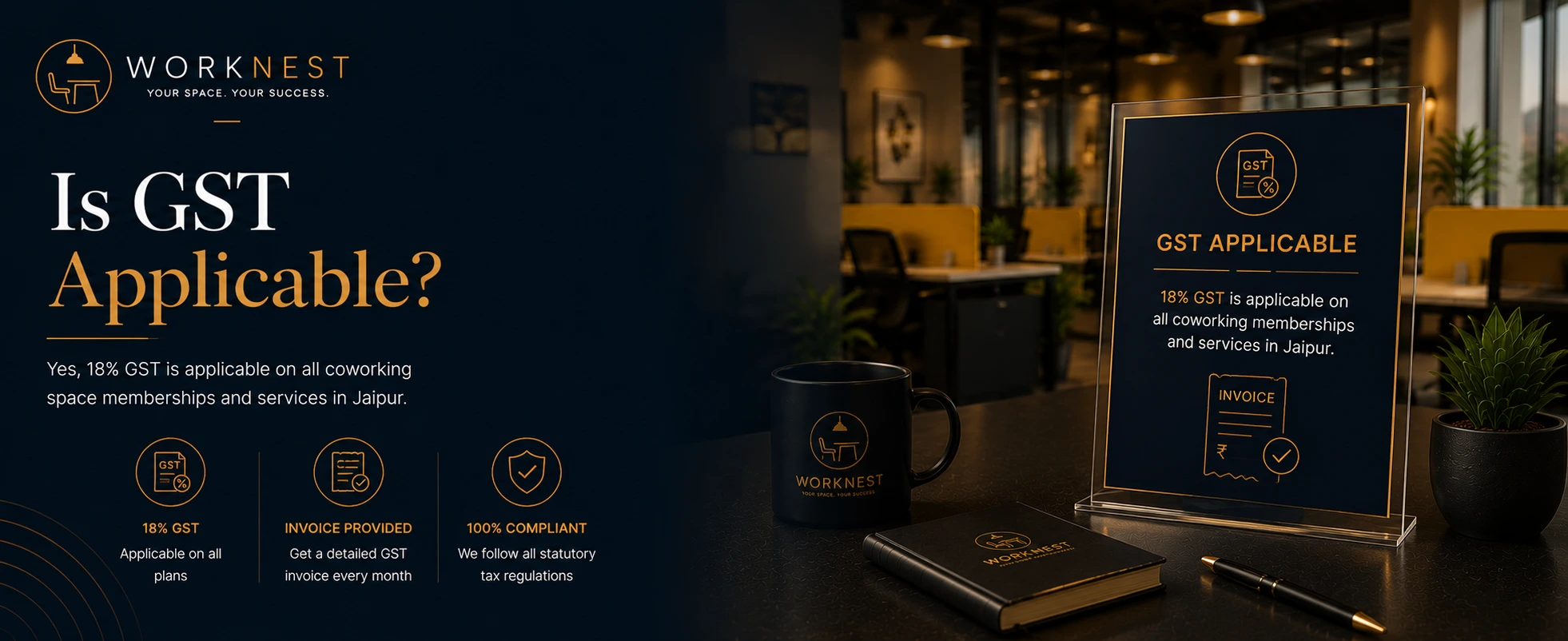
    Is GST Applicable?

    Is GST Applicable

    Yes. WorkNest charges 18% GST on all coworking services, confirmed directly with WorkNest’s chartered accountant. This applies uniformly across Hot Desk, Dedicated Desk, Private Cabin, and Meeting Room bookings, so the rate on your invoice won’t vary by plan.

    If your business is GST-registered, you can usually claim input tax credit on coworking fees, since these are considered a legitimate business expense. This is one of the details aggregator listings bury inside an FAQ accordion instead of stating plainly. Before signing up, always ask your coworking operator for a GST-inclusive invoice, so your accounting matches what you actually pay.

    Is coworking cheaper than a traditional office in Jaipur?

    In most cases, yes – coworking works out cheaper than a traditional office once you count total cost of ownership, not just monthly rent. A small 2–3 person office in Mansarovar or C-Scheme typically starts at ₹10,000/month rent alone, before electricity, water, and furniture are added on top.

    Cost Component Traditional Office (2–3 seats) WorkNest Dedicated Desk
    Monthly rent ₹10,000+ (Mansarovar/C-Scheme) ₹9,999 (all-inclusive)
    Security deposit 1 month (₹10,000+, one-time) ₹0 – no deposit required
    Interior fit-out + furniture Up to ₹1,00,000 (one-time) ₹0 – already furnished
    Electricity, water, maintenance Billed separately, varies by usage Included in monthly price
    Exit notice period Per lease agreement, often 2–3 months 30 days

    A traditional office also asks for roughly ₹1,10,000 upfront, before the first month’s electricity or water bill arrives – a one-month deposit plus fit-out and furniture. WorkNest skips all three of those, since a dedicated desk needs zero deposit and zero fit-out spend. That’s why coworking is a more affordable option for freelancers, startups, and small teams, especially during the first year .

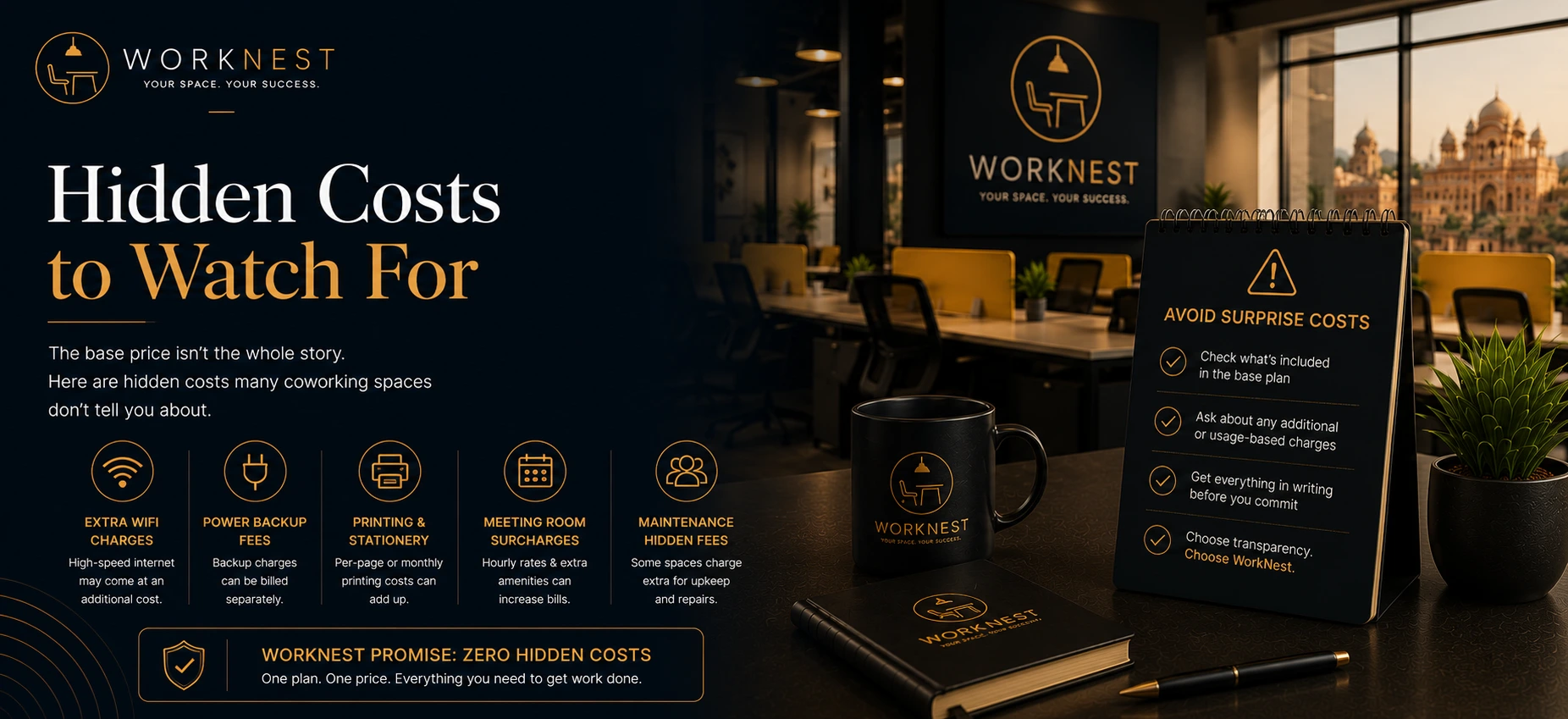
    Hidden Costs to Watch For

    Hidden Costs to Watch For

    Aggregator listings rarely mention the extra charges that show up after you’ve already signed up. Here’s exactly what to check, with WorkNest’s actual numbers for comparison.

    • Security deposits: Many operators require 2–3 months’ rent upfront. WorkNest charges zero security deposit on any plan, so nothing is locked up at signup.
    • Meeting room overage: Plans often include limited meeting room hours. At WorkNest, extra hours for dedicated desk and private cabin members cost ₹100/hour, well below the standard ₹799/hour walk-in rate.
    • Printing and scanning: Most coworking spaces don’t clearly mention the cost per page . WorkNest charges a flat ₹2 per photocopy, with no hidden per-page markup.
    • Exit notice periods: Aggregator pages rarely state this clearly. WorkNest requires 30 days’ written notice to exit any plan – no long lock-in beyond that.
    • Parking and locker fees: These are frequently billed as add-ons elsewhere; confirm this directly for your specific plan when you inquire.

    Because WorkNest publishes its deposit policy, exit notice, and overage rates upfront, you get the full cost picture before signing – not after.

    The Bottom Line

    Coworking space cost in Jaipur ranges from ₹699/day for a hot desk to ₹24,999/month for a private cabin, with WorkNest’s dedicated desk priced at ₹9,999/month and meeting rooms at ₹799/hour. As of 2026, that transparency – real numbers instead of ranges – is what separates a single-operator space like WorkNest from aggregator listings that only show “starting from” pricing. With 500+ businesses served, a 4.8 Google rating, and a 91% renewal rate, WorkNest’s pricing has already been tested by teams who chose to stay.

    If you’re comparing coworking space price Jaipur options, get exact pricing for your team size and workspace type directly, with a response typically within 30 minutes.

    Get Pricing →

    FAQs

    01. How much does a coworking space cost in Jaipur?

    Coworking space in Jaipur costs ₹699/day for a hot desk, ₹9,999/month for a dedicated desk, ₹24,999/month for a private cabin, and ₹799/hour for a meeting room at WorkNest, as of 2026.

    02. What is the cheapest coworking space option in Jaipur?

    A hot desk at ₹699/day is typically the cheapest entry point, suited to freelancers and occasional users who don’t need a fixed seat every day.
    03. Is GST applicable on coworking space charges in Jaipur?

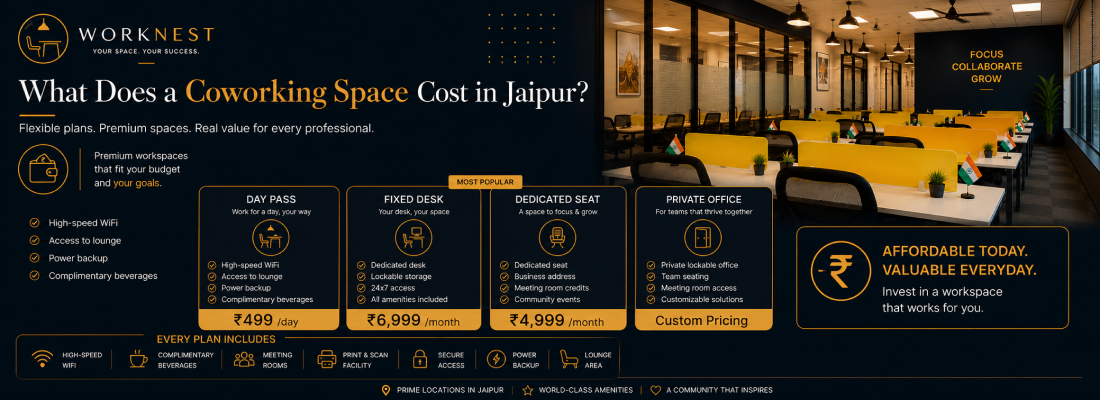
    Yes. WorkNest charges 18% GST on all workspace bookings, confirmed with WorkNest’s chartered accountant, and this rate applies uniformly across every plan.

    04. Is coworking cheaper than renting a traditional office in Jaipur?

    Yes, in most cases. A 2–3 seat traditional office in Mansarovar or C-Scheme starts at ₹10,000/month rent, plus a 1-month deposit and up to ₹1,00,000 in one-time fit-out and furniture costs. A WorkNest dedicated desk costs ₹9,999/month with zero deposit and zero fit-out spend.

    05. What’s included in WorkNest’s dedicated desk price of ₹9,999/month?

    The dedicated desk plan includes a reserved seat, Wi-Fi, common-area access, and meeting room hours, priced transparently at ₹9,999/month with no “starting from” ambiguity.

    06. Are there hidden costs in Jaipur coworking spaces?

    Common hidden costs elsewhere include security deposits and unclear overage rates. WorkNest charges zero deposit, ₹2 per photocopy, and ₹100/hour for meeting room overage beyond included hours.

    07. How much does a private cabin cost in Jaipur?

    A private cabin at WorkNest costs ₹24,999/month, suited to founders and small teams that need a lockable, private office space.

    08. How much does a meeting room cost per hour in Jaipur?

    A meeting room at WorkNest costs ₹799/hour for walk-in bookings, or ₹100/hour for dedicated desk and private cabin members using extra hours beyond their included quota.

    09. Does WorkNest charge a security deposit?

    No. WorkNest requires zero security deposit on any plan – Hot Desk, Dedicated Desk, Private Cabin, or Meeting Room.

    10. What is WorkNest’s exit or notice period?

    WorkNest requires 30 days’ written notice to exit any plan, with no long-term lock-in beyond that period.

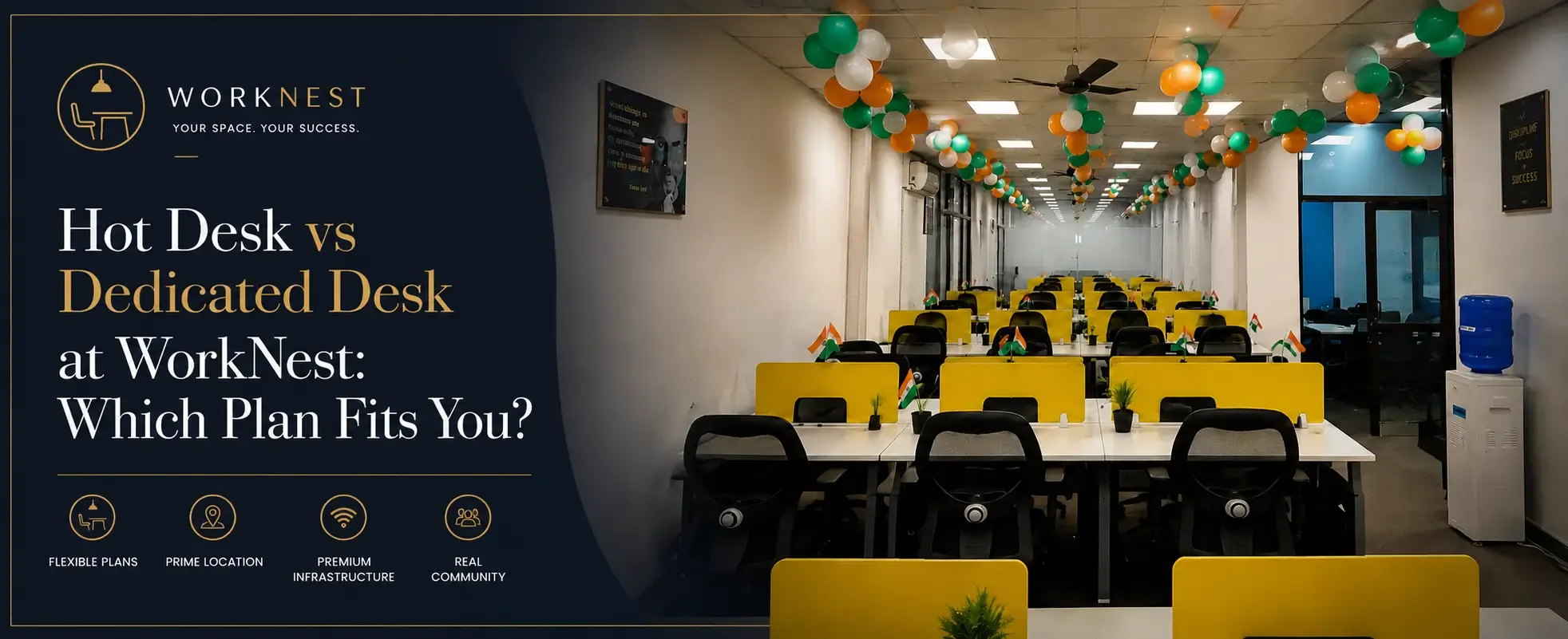
  • Hot Desk vs Dedicated Desk at WorkNest: Which Plan Fits You?

    Hot Desk vs Dedicated Desk at WorkNest: Which Plan Fits You?

    A practical, no-fluff comparison for freelancers and small teams deciding between WorkNest’s two core desk plans before booking a tour.

    By the time you’re comparing a hot desk against a dedicated desk, you’ve already made the bigger decision coworking makes sense for how you work. What’s left is the smaller, more practical question: which plan actually fits your week?

    This is exactly the kind of decision that trips up a lot of freelancers and small teams, not because the options are complicated, but because both come with a real trade-off. A hot desk keeps your costs tied to actual usage but means no guaranteed seat and nothing to leave behind overnight. A dedicated desk gives you consistency and storage but locks you into a fixed monthly cost whether you show up five days a week or two.

    Get it wrong in one direction and you’re paying every month for flexibility you never use. Get it wrong the other way, and you lose the consistency that made a fixed desk worth the money in the first place. Neither mistake is expensive to fix, but both are easy to avoid if you know what to look for.

    This guide breaks down WorkNest’s hot desk and dedicated desk plans side by side, gives you a simple way to decide between them, and walks through a real example of how one member’s needs changed over time.

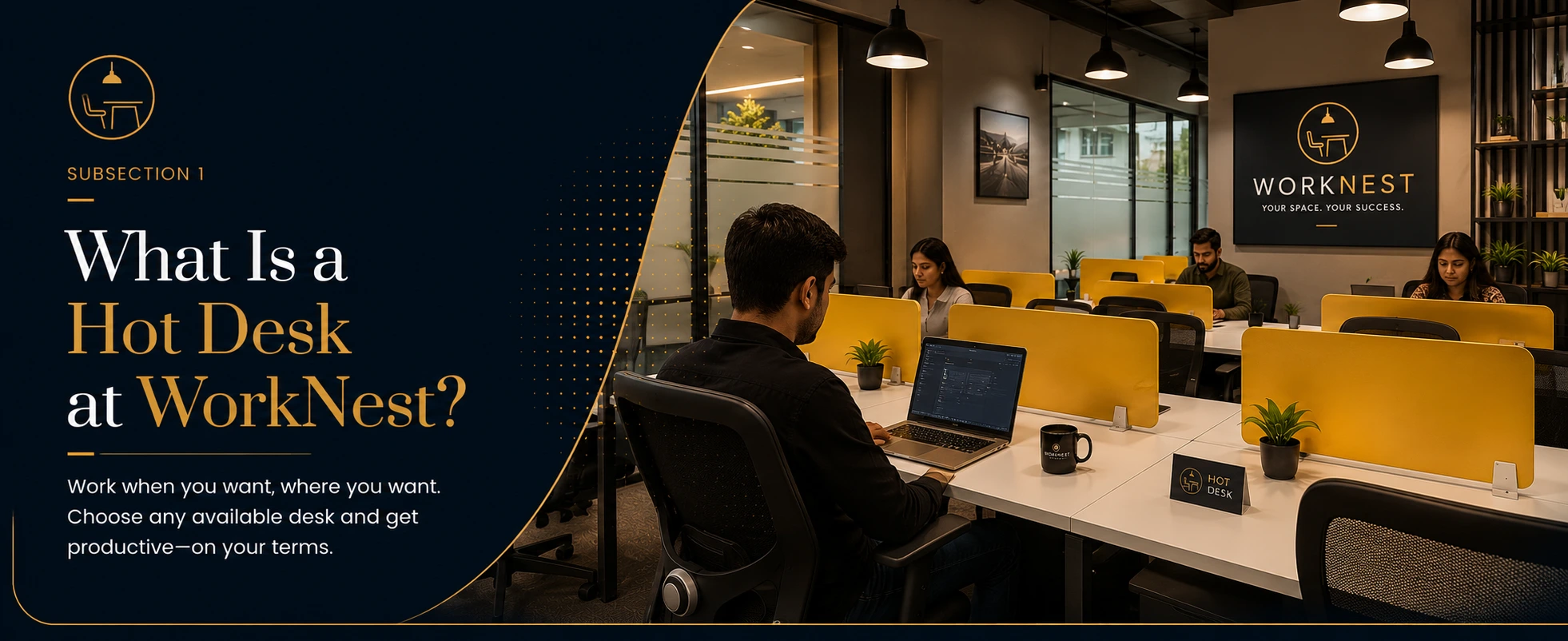
    What Is a Hot Desk at WorkNest?

    What Is a Hot Desk at WorkNest

    A hot desk is an unassigned seat. You don’t get the same desk every day instead, you book a spot and sit wherever’s free when you arrive. Some mornings you’re by the window, other days you’re in a quieter corner near the meeting rooms. Nothing is fixed except your access to the space itself.

    This works well if your week is genuinely unpredictable  some days from home, some days at WorkNest, occasional travel in between. It also works if you’re newer to coworking and want to try it out before committing to something more permanent.

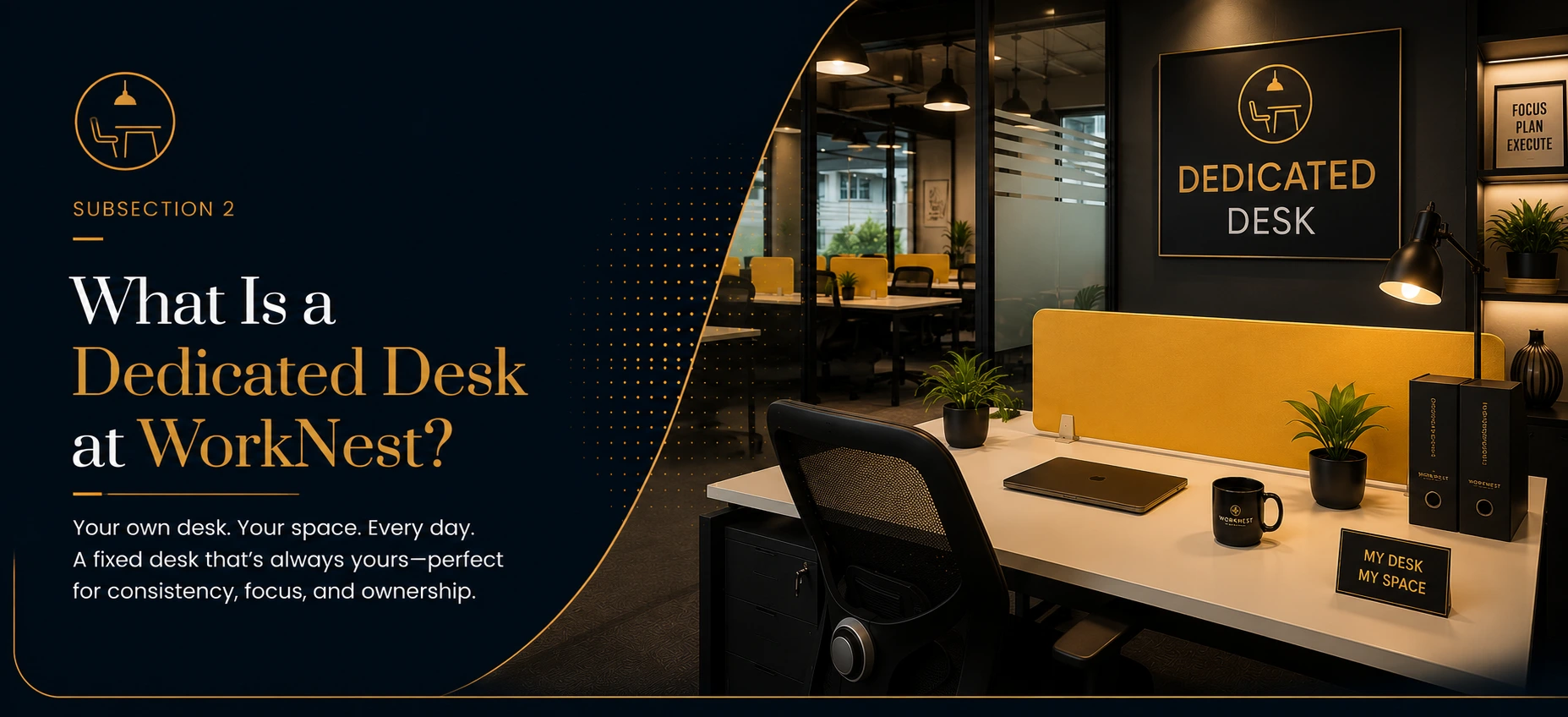
    What Is a Dedicated Desk at WorkNest?

    What Is a Dedicated Desk at WorkNest

    A dedicated desk is the opposite idea. It’s one desk, reserved for you, for the length of your membership. You still get everything the coworking space offers — high-speed internet, meeting rooms, common areas  but that one desk stays yours whether you’re at it or not.

    This is the better fit once your routine has settled into something consistent: showing up most working days, needing a second monitor or files that stay put, or being part of a small team that wants to sit together every day rather than hunting for adjacent seats each morning.

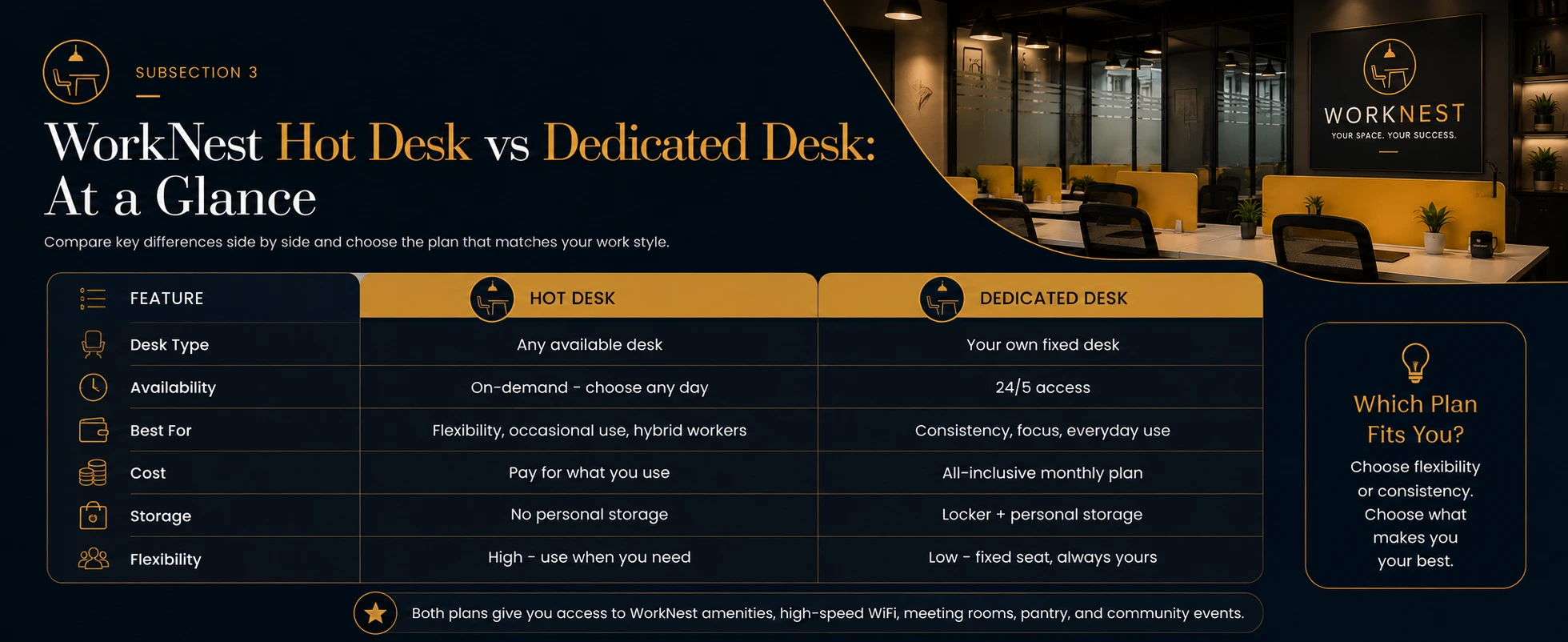
    WorkNest Hot Desk vs Dedicated Desk: At a Glance

    WorkNest Hot Desk vs Dedicated Desk At a Glance

    Factor Hot Desk Dedicated Desk
    Cost Affordable; only pay when you use it More expensive; pay a fixed fee (usually monthly) whether you use the workspace or not
    Flexibility Sit at any available desk, any day you book One fixed seat, reserved every working day
    Privacy Shared with whoever’s in that day Your desk, undisturbed
    Storage None — carry your setup in and out daily Personal drawer/locker included
    Best for Freelancers in 2–3 days/week, frequent travelers, short-term needs Daily regulars, small teams, anyone who needs to leave gear behind

    How to Decide

    Choose a hot desk if…

    • You’re at WorkNest fewer than 3–4 days a week
    • You’re still testing whether coworking fits your routine
    • You don’t need to leave anything at your desk overnight
    • You want the lowest possible monthly spend
    • You like a change of scenery and meeting new people regularly

    Choose a dedicated desk if…

    • You’re in nearly every working day
    • You need a locker, second monitor, or files to stay put
    • You’re part of a 2+ person team that sits together daily
    • Clients or collaborators visit you regularly and you want a consistent spot to host them
    • A predictable routine matters more to your focus than saving on the bill

    If you’re still unsure after reading both lists, count your actual days in the space over the last few weeks  not the days you planned to be there, the days you actually showed up. That number alone settles the decision for most people.

    A Quick Example

    Priya started at WorkNest on a hot desk plan while freelancing part-time alongside a full-time job. Two days a week, a shared desk was more than enough and far cheaper than paying for five. Six months later, once freelancing became her only income and she was showing up daily with a second monitor and a stack of client files, she switched to a dedicated desk. Same coworking space, same community just a plan that matched where her work actually was.

    That’s really the pattern worth watching for: start with what your week looks like today, and switch plans when your routine changes  not before. WorkNest members move between plans fairly often as their work evolves, and there’s no penalty for starting small.

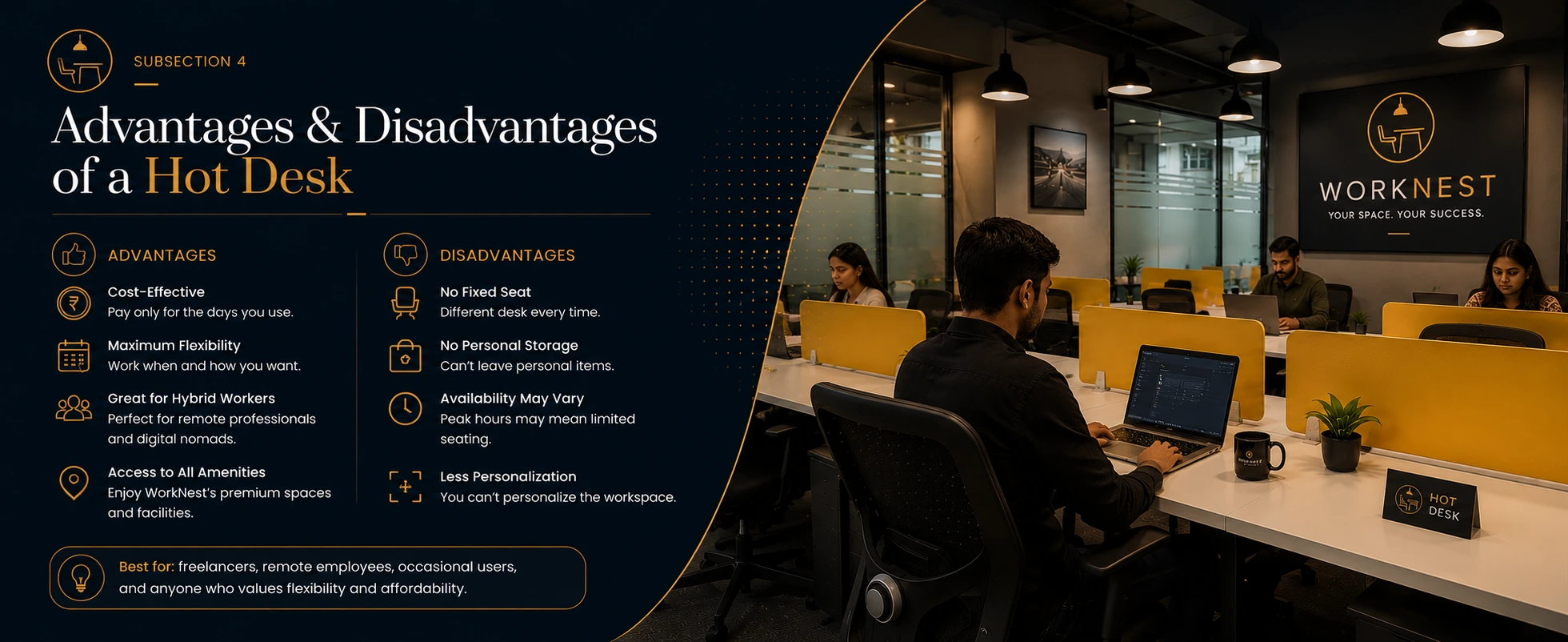
    Advantages and Disadvantages of a Hot Desk

    Advantages and Disadvantages of a Hot Desk

    A hot desk plan trades a guaranteed seat for lower cost and more freedom. Here’s how that trade-off actually plays out day to day.

    Advantages:

    • Pay only for the days you use no fixed monthly cost.
    • No long-term commitment, which makes it easy to test coworking before scaling up
    • A change of scenery most days, which can help avoid the monotony of sitting in the same spot every morning
    • Regular exposure to new people, which naturally leads to more networking and casual collaboration

    Disadvantages:

    • No guaranteed seat  on a busy day, you may have to wait or settle for whatever’s left
    • Nothing stays at the desk overnight, so you’re setting up and packing away your work every single day
    • Harder to build a consistent routine, since your surroundings change daily
    • Less practical for hosting clients or collaborators who expect a fixed spot to meet you

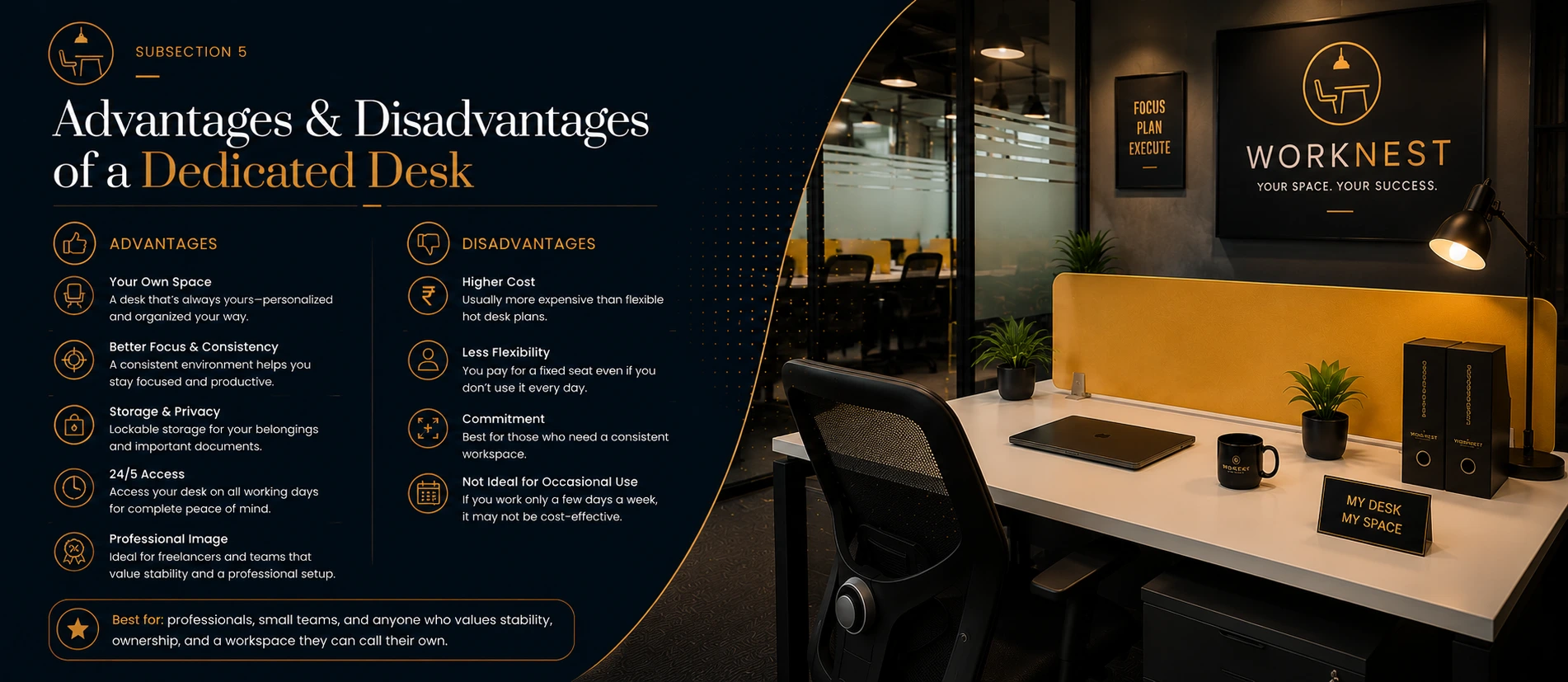
    Advantages and Disadvantages of a Dedicated Desk

    Advantages and Disadvantages of a Dedicated Desk

    A dedicated desk flips that trade-off: you give up some day-to-day flexibility in exchange for consistency, storage, and a guaranteed spot.

    Advantages:

    • A guaranteed seat every working day, with no risk of showing up to a full space
    • Personal storage a drawer or locker for files, equipment, or anything you’d rather not carry home
    • A consistent setup that many people find helps with focus and deep work
    • Easier to build familiarity with the same neighbours, which often turns into a stronger sense of community over time
    • A more professional, stable spot for hosting clients or teammates regularly

    Disadvantages:

    • A fixed monthly cost, regardless of how many days you actually show up
    • Less flexibility to roam between locations or change your environment day to day
    • Typically requires a more defined ongoing commitment compared to a pay-as-you-go hot desk

    Laid side by side, neither list makes one option universally “better” a hot desk’s disadvantages are simply a dedicated desk’s advantages, and vice versa. What matters is which set of trade-offs fits how your week actually looks right now, not which one sounds more impressive on paper.

    Frequently Asked Questions

    Is a hot desk cheaper than a dedicated desk at WorkNest?

    Generally, yes  a hot desk is priced around how often you actually use it, while a dedicated desk carries a fixed monthly rate regardless of attendance. For anyone in the space fewer than 4 days a week, a hot desk plan is usually the lower-cost option.

    Can I switch from a hot desk to a dedicated desk later?

    Yes. It’s common for members to start on a hot desk while their routine is still settling and move to a dedicated desk once they’re showing up consistently or need extra storage.

    Does a dedicated desk come with storage?

    Yes  WorkNest dedicated desk plans include a personal drawer or locker, so you’re not carrying files and equipment back and forth daily.

    What’s best for a small team of two or three people?

    A dedicated desk setup usually works better for small teams who want to sit together every day and need a consistent spot for informal check-ins, rather than coordinating hot desks for the whole group each morning.

    How do I know which plan is right for me?

    Track how many days a week you’re actually at WorkNest over a typical month. If it’s 4 or more, a dedicated desk usually makes more financial and practical sense. If it’s fewer, a hot desk plan keeps your costs matched to your actual usage.

    Can I book a hot desk at more than one WorkNest location?

    Most flexible hot desk plans allow this, letting members use different WorkNest branches depending on where they’re working from that day worth confirming at the specific location you’re touring, since availability can vary by branch.

    Is there a minimum commitment period for a dedicated desk?

    Dedicated desk plans are typically billed monthly, though exact minimum terms can vary by location and season. Ask your WorkNest advisor for the current terms before signing, since these details are updated periodically.

    Can I upgrade mid-month if my routine changes?

    Most WorkNest locations can accommodate a mid-cycle switch from a hot desk to a dedicated desk, prorated to your current billing period. It’s worth asking your location’s team directly, since the exact process can vary slightly branch to branch.

  • What Is a Coworking Space? A Complete Guide (Jaipur Edition)

    What Is a Coworking Space? A Complete Guide (Jaipur Edition)

    If you’re searching “what is a coworking space,” you’re probably at one of a few points: working from your kitchen table and losing focus, running a small team out of a cafe and tired of unreliable Wi-Fi, or an HR or ops lead scouting real office options for a team that’s outgrown remote work. A coworking space is a shared, professionally managed office where individuals and businesses rent desks, cabins, or meeting rooms  splitting the cost of infrastructure like internet, furniture, and community, without signing a rigid, multi-year lease.

    At WorkNest, we’ve built exactly that for Jaipur which is why over 500 businesses currently work out of our floors, and why members rate us 4.8 out of 5. This guide walks through what a coworking space actually includes, what it costs, how it compares to working from home or a traditional office, and how to tell if it’s the right fit for your stage of business.

    What Is a Coworking Space?

    A coworking space is a shared workspace where professionals from different companies work under one roof, each paying only for the desk, cabin, or plan they use. You’re not renting an entire office you’re renting access to one, along with everything that comes with it.

    What makes it different from a regular rented office is simple: you share the building, but never your work, your clients, or your team. Think of it less like renting an apartment and more like a serviced hotel room for your business  full amenities, none of the maintenance headaches.

    The model isn’t a fad. It grew out of a real problem: traditional office leases were expensive, rigid, and completely impractical for a two-person startup or a solo consultant. Coworking removed that barrier, and it’s now one of the fastest-growing segments of commercial real estate in India, with Tier-2 cities like Jaipur increasingly part of that growth.

    What’s Actually Included in a Coworking Membership?

    What's Actually Included in a Coworking Membership

    This is usually the first question first-time searchers have, and the honest answer is: it depends on the operator, so always ask for a full breakdown before signing. At a typical well-run coworking space (including WorkNest), your monthly plan covers:

    • High-speed Wi-Fi, usually with a backup connection so a single outage doesn’t stop your workday
    • A desk or cabin — hot desk, dedicated desk, or a private lockable cabin, depending on your plan
    • Meeting rooms, usually with a set number of free hours included per month
    • Power backup, ideally across the whole floor, not just common areas
    • Pantry access, from basic tea and coffee to a full cafe-style setup
    • Community and networking, since you’re working alongside founders, freelancers, and small teams from other industries
    • Reception and basic admin support, so you’re not answering your own front door

    What’s usually billed separately: extra meeting room hours, dedicated parking, courier handling, and premium food and beverage service. Ask for this list in writing before you sign anything.

    Step Inside: What a Coworking Floor Actually Looks Like

    What a Coworking Floor Actually Looks Like

    [Image placeholder — swap in an existing WorkNest gallery photo here, with alt text like “WorkNest coworking floor, Jaipur, showing open desks and meeting room”]

    Picture an open floor with natural light coming in through floor-to-ceiling windows, rows of clean desks with ergonomic chairs, and a scatter of laptops, coffee cups, and sticky notes. Off to one side, a glass-walled meeting room is booked for a 10 a.m. client call. Near the pantry, two founders from unrelated businesses are comparing notes over coffee. Somewhere behind them, a phone booth is occupied by someone taking a call they’d never risk in a cafe corner. It’s quieter than a cafe, less isolating than a home office, and far less sterile than a typical corporate floor  that combination is usually what convinces a first-time visitor to switch.

    Coworking vs Home Office vs Traditional Office

    Coworking vs Home Office vs Traditional Office

    The comparison that actually matters for most first-time searchers isn’t “coworking vs managed office”  it’s whether to leave the kitchen table or the cafe corner altogether. Here’s how the three stack up:

    Factor Coworking Space Home Office Traditional Office Lease
    Upfront cost Minimal — move in same week None, but you supply everything yourself High (deposit, fit-out, furniture)
    Contract length Month-to-month or short minimum None Typically 3+ years
    Internet & power backup Included Your responsibility Your responsibility to set up
    Meeting rooms for clients Included, bookable by the hour Not available Must be built in
    Professional address Yes No Yes
    Work-life separation Strong — dedicated space away from home Weak — blurred boundarie Strong
    Networking & community Built in None Limited to your own team

    If  home or cafe work has started costing you focus, client credibility, or hours lost to unreliable Wi-Fi, that’s usually the signal it’s time to move into a proper workspace

    Is Your Team the Right Fit for a Coworking Space?

    Coworking plans aren’t one-size-fits-all. A solo consultant and a 15-person startup need very different setups:

    • Hot Desk: Best for freelancers and consultants who don’t need the same seat every day.
    • Dedicated Desk: A fixed seat on a shared floor  ideal for solo founders or 2–3 person teams.
    • Private Cabin: A lockable room for roughly 4–15 people who need confidentiality without a fully managed floor.

    If you’re an HR or ops lead scouting options on behalf of a team, it’s worth mapping headcount against growth plans before you shortlist anything. A plan that fits a 6-person team today can get cramped fast if you’re hiring aggressively over the next two quarters ask any operator whether you can add seats mid-contract without renegotiating the whole agreement.

    Why Jaipur Professionals Are Making the Switch

    Why Jaipur Professionals Are Making the Switch

    Jaipur’s coworking scene has grown quickly, and it’s not just a local trend. According to Cushman & Wakefield’s Global Trends in Flexible Office 2025 report, India now scores a perfect 100 on the firm’s flexible-office maturity index ahead of markets like the UK, France, and the US and the report points to demand increasingly spreading beyond metros into Tier-2 cities, Jaipur included. In plain terms: this isn’t a niche experiment anymore, it’s a mainstream way of working, and Jaipur is very much part of that shift.

    Locally, three things are driving the move: operational costs well below metro cities like Mumbai or Bengaluru, a steady stream of talent from Jaipur’s engineering and business colleges, and growing government support for business activity outside the traditional metro hubs.

    What Does a Coworking Space Cost in Jaipur?

    What Does a Coworking Space Cost in Jaipur

    Pricing varies by location and plan, but as a general reference, most coworking seats in Jaipur fall between ₹5,000 and ₹15,000 per seat per month, excluding GST. Hot desks sit at the lower end, dedicated desks in the middle, and private cabins cost more per head though they typically stay more cost-efficient than a fully managed office until a team grows past 30–40 seats.

    Ask any operator, including us, for a written breakdown of what’s included versus billed separately that’s the single best way to avoid surprise costs at renewal time. Hidden costs are usually the biggest source of frustration for first-time coworking members, and almost all of them trace back to a plan that was never fully explained upfront  not to the coworking model itself.

    Frequently Asked Questions

    1. What is a coworking space in simple terms?

    It’s a shared office where people from different companies each pay only for their own desk, cabin, or plan, while splitting the cost of shared amenities like Wi-Fi, meeting rooms, and community space.

    2. Is coworking cheaper than renting a traditional office?

    For teams under roughly 30–40 people, yes  you avoid the upfront fit-out cost, long lease commitment, and facility management overhead that come with a traditional office.

    3. Do I need a long contract to join a coworking space?

    No. Most coworking memberships, including WorkNest’s, run month-to-month or on a short minimum term  one of the biggest advantages over a traditional lease.

    4. What’s usually NOT included in the monthly price?

    Extra meeting room hours beyond your plan’s allowance, dedicated parking, courier handling, and premium food and beverage service are typically billed separately. Always ask for this list before signing.

    5. How do I know if my team is the right size for coworking?

    Roughly 1–30 people fits comfortably into a coworking plan  solo freelancers and small teams usually start with a hot desk or dedicated desk, while teams needing more privacy move into a private cabin. Beyond 30–40 people, a managed office usually makes more sense. If you’re scaling quickly, ask upfront whether your plan can flex with you rather than locking you into a fixed seat count.

    Ready to See It in Person?

    Reading about a coworking space only gets you so far — the fastest way to know if it fits is to sit at a desk for an afternoon. Book a free tour of WorkNest’s Jaipur workspace →