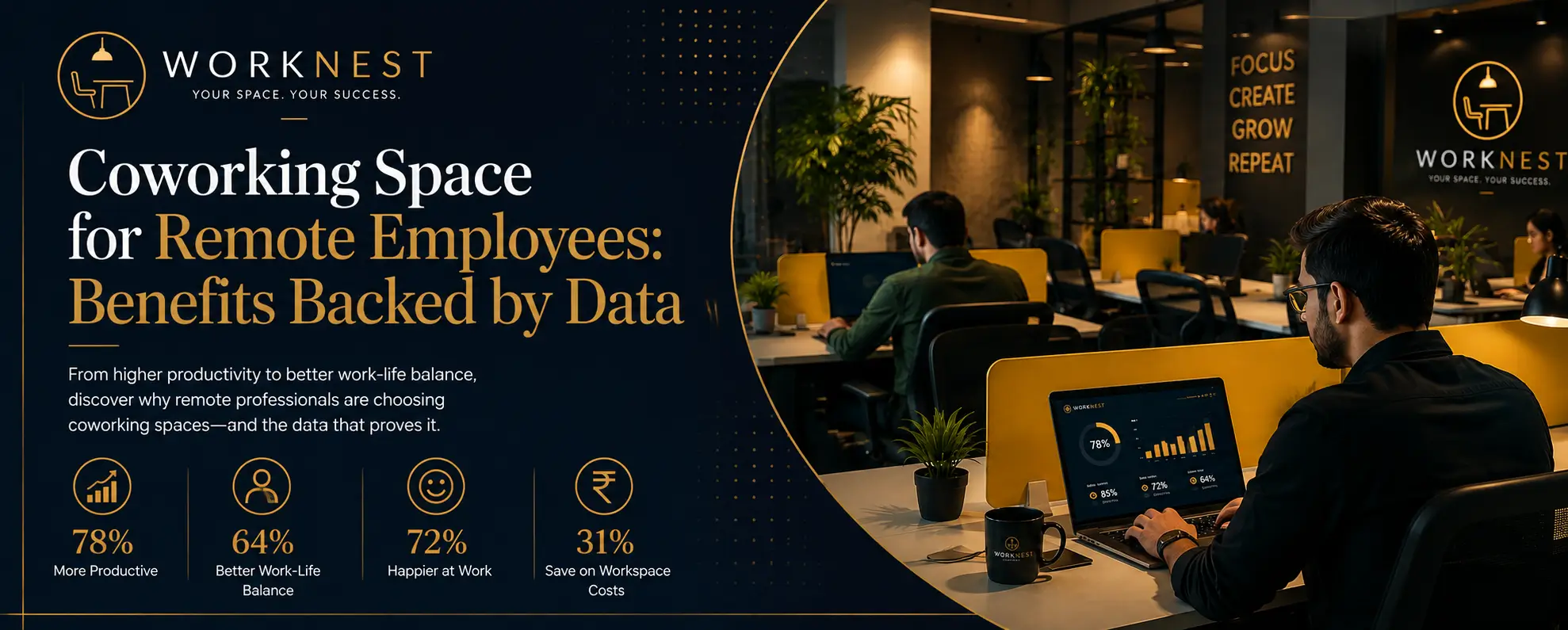
A coworking space for remote employees solves the three biggest problems of working from home: distraction, isolation, and the missing line between “office” and “home.” As of 2026, remote and hybrid employees who work from a dedicated coworking space report higher focus, more social connection, and measurably better output than those working from a kitchen table or bedroom desk.
This isn’t opinion – it’s backed by global research and India-specific market data, and it comes with a concrete way to get your employer to pay for it.
Remote work itself isn’t going anywhere. Government labour data shows telework rates have held steady or climbed since 2022, well past the pandemic-era spike most headlines still reference. What’s changed is where remote employees actually choose to sit and increasingly, that’s not the kitchen table. It’s a professional space built for focused, uninterrupted work, close to home but separate from it.
Why Remote Employees Choose Coworking
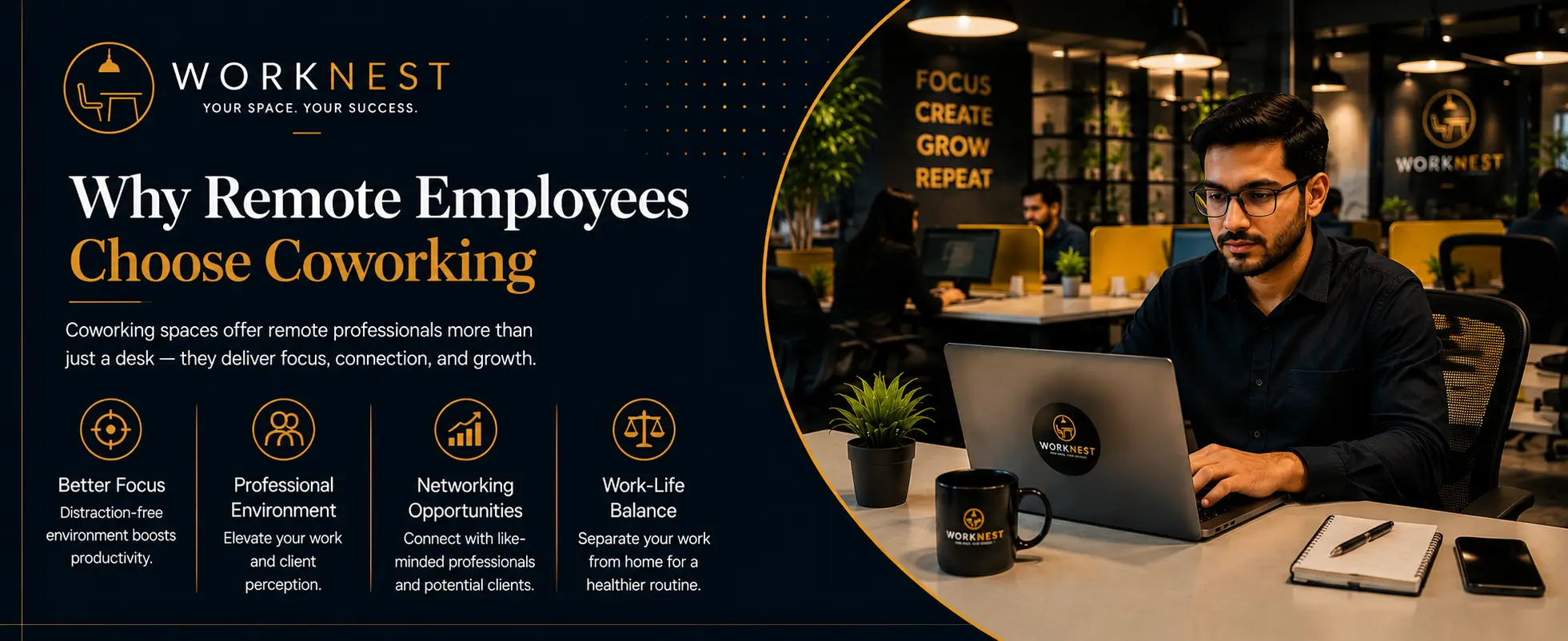
Working from home sounds convenient until the internet drops during a client call, or a family member walks in mid-meeting. Remote employees choose coworking spaces to fix exactly this a home office rarely has the infrastructure a full workday actually needs.
Jaipur’s remote workforce faces a specific version of this problem. Power cuts, shared family spaces, and unreliable residential broadband make consistent video calls harder than they should be. A coworking space removes all three variables in one move, which is why demand for flexible workspace in Tier 1 and Tier 2 Indian cities keeps climbing year over year.
A dedicated coworking desk gives you three things a home office rarely can:
- Separation. Leaving the house to “go to work” resets your brain into focus mode, the same way commuting once did.
- Infrastructure. Business-grade Wi-Fi, ergonomic seating, and meeting rooms remove the daily friction of video calls and deep work.
- Community. Sitting near other professionals even quietly reduces the loneliness that remote work is known to cause.
Karan Malhotra, a Sales Lead who works remotely for a company headquartered outside Jaipur, put it simply: working from a coworking space gave his day structure that his home office never could.
This is also where the remote work coworking benefits go beyond comfort. They show up in the numbers.
The Data
Here are the verified statistics behind coworking’s productivity and wellbeing claims, with sources you can check yourself.
| Statistic | Detail | Source |
|---|---|---|
| 13% performance increase | Randomized controlled trial of remote employees found gains from both longer work time and more calls handled per minute | Stanford University / NBER (Bloom et al., Ctrip experiment) |
| 23.7% of U.S. employees teleworked on an average day (early 2025) | Up from 17.9% in October 2022, showing remote work has stabilized, not reversed | U.S. Bureau of Labor Statistics |
| 0.08–0.09 percentage-point rise in total factor productivity | For every 1 percentage-point increase in remote work adoption, holding pre-pandemic trends constant | BLS/NBER research, October 2024 |
| 85% of coworking members | Report feeling more motivated working from a coworking space than from home | Coworking industry data, 2026 |
| 88% of coworking members | Say coworking meaningfully reduces the isolation associated with remote work | Coworking industry data, 2026 |
| 74% of coworking members | Report feeling more productive than when working from home or a traditional office | Research and Markets, Coworking Spaces Market Forecast 2026–2032 |
| India’s coworking market: USD 4.53 billion (2026) | Up from USD 3.98 billion in 2025, growing at 13.94% CAGR through 2031; 73% of occupiers cite hybrid work as the driver | Mordor Intelligence, India Co-working Office Spaces Market Report |
| India ranks 2nd globally in coworking spaces | The country holds roughly 10% of the world’s coworking locations | Next Move Strategy Consulting |
As of 2026, these figures represent the most recent published data. India market-size figures sourced from the Mordor Intelligence India Co-working Office Spaces Market Report (mordorintelligence.com/industry-reports/india-coworking-office-spaces-market) – always confirm current numbers before citing them in board decks or funding pitches, as market data moves quarter to quarter.
Two things stand out. First, remote employee productivity stats consistently favor structured environments over unstructured ones coworking, not the couch, delivers the productivity remote work promised. Second, India’s own coworking market is growing faster than most global averages, meaning employers here have more affordable, more available options than ever for supporting remote staff.
On the coworking vs home office remote workers question, the pattern is consistent: home offices win on convenience, coworking spaces win on focus, connection, and measurable output. For most remote employees, the productivity gap outweighs the five-minute commute.
It’s worth separating correlation from causation here. The Stanford/NBER study is a genuine randomized controlled trial, not a survey, which is why it carries more weight than self-reported motivation numbers. Employees didn’t just say they felt more productive their call volume and completed work hours were independently measured. That distinction matters if you’re presenting this data to a skeptical manager: cite the controlled study first, then use the member-satisfaction numbers to round out the picture.
India adds a second, distinct layer to this story. A market growing at nearly 14% a year, with enterprise occupiers increasingly driving demand rather than only freelancers, signals that coworking has moved from “nice-to-have perk” to “standard infrastructure decision” for companies managing distributed teams. For a remote employee in Jaipur, that shift means better facilities, more competitive pricing, and more employers who already understand the ask.
Coworking vs. Home Office: A Side-by-Side Look
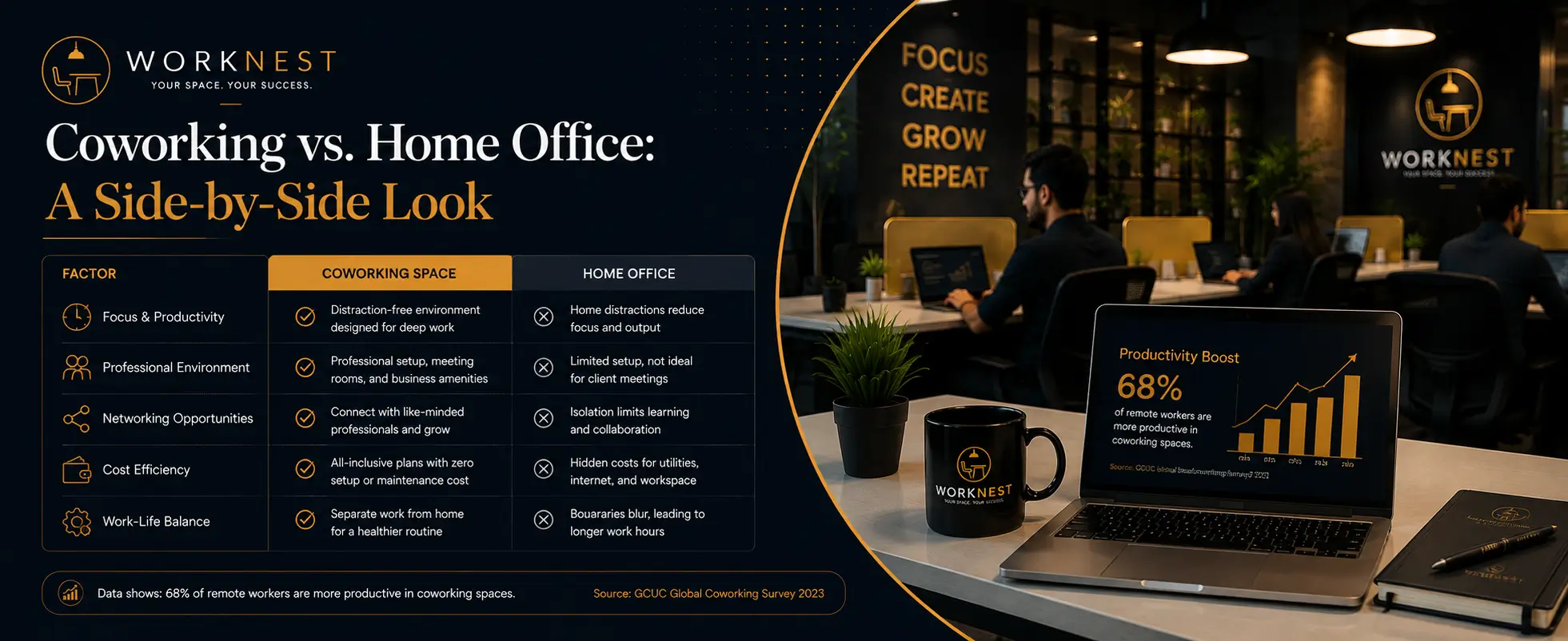
The choice usually comes down to four factors. Here’s how they compare directly for remote employees.
| Factor | Home Office | Coworking Space |
|---|---|---|
| Cost | Low fixed cost, but hidden costs in electricity, chai, snacks | ₹699/day at WorkNest, predictable and expense-friendly |
| Distractions | Family, chores, deliveries, TV – hard to control | Dedicated work zones, quiet cabins, and meeting rooms |
| Internet reliability | Dependent on residential broadband and local power supply | Business-grade Wi-Fi and backup power as standard |
| Social contact | Minimal – isolation risk documented at 88% among remote-only workers | Passive daily contact with other professionals reduces isolation |
This is the clearest way to answer the coworking vs home office remote workers debate: home wins on flexibility, coworking wins on consistency and consistency is what drives the productivity numbers above.
How to Ask Your Employer to Cover It

Most companies already save on real estate by letting employees work remotely. Redirecting a fraction of that saving into a coworking stipend is a low-risk ask if you frame it right.
Step 1: Lead with the business case, not the personal one. Cite the productivity data above. A 13% performance gain or a documented rise in focused output matters more to a manager than “I’d be happier.”
Step 2: Bring exact numbers, not estimates. Vague requests get vague answers. WorkNest’s current published rates:
| Plan | Price | Best for |
|---|---|---|
| Hot Desk | ₹699/day | Occasional remote work days |
| Dedicated Desk | ₹9,999/month | Full-time remote employees |
| Private Cabin | ₹24,999/month | Client calls, confidential work |
| Meeting Room | ₹799/hour | Team syncs, client meetings |
Step 3: Propose a trial, not a permanent commitment. Ask for one month at the Dedicated Desk rate, framed as a productivity pilot with a before/after check-in.
Step 4: Offer proof of ROI in India-specific terms. Note that flexible workspace stipends are a standard, budget-friendly line item , cheaper than most companies’ per-employee real estate cost, and far cheaper than turnover caused by burnout or isolation.
Priya Singh, a Freelance Designer who works with multiple remote-first companies, negotiated her coworking cost into her project retainer by presenting it as a productivity investment rather than a perk the same approach works for salaried employees.
WorkNest has helped over 500 businesses in Jaipur make this exact case to employers and clients, backed by a 4.8 Google rating and a 91% renewal rate that shows members stay because the arrangement works.
If you’re ready to see it for yourself, book a free office tour at WorkNest, E-3, 6D Engineers Colony, Mansarovar, Jaipur- our team responds to enquiries in under 30 minutes.
FAQs
Q1: Is a coworking space actually better than working from home for remote employees?
Data suggests yes for most people: 74–85% of coworking members report higher productivity and motivation compared to working from home, largely due to fewer distractions and better infrastructure.
Q2: Can I ask my employer to pay for a coworking membership?
Yes. Frame it as a productivity investment backed by data, request a one-month trial, and provide exact pricing most companies already save on office real estate by allowing remote work, so a modest stipend is an easy approval.
Q3: What is a coworking stipend?
A coworking stipend is a recurring allowance an employer pays a remote employee to cover a coworking desk or membership, similar to a home-internet or phone allowance.
Q4: How much does a coworking space cost in Jaipur?
At WorkNest in Mansarovar, Jaipur, a Hot Desk costs ₹699/day, a Dedicated Desk is ₹9,999/month, a Private Cabin is ₹24,999/month, and a Meeting Room is ₹799/hour.
Q5: Does coworking really reduce loneliness for remote workers?
Industry data shows 88% of coworking members report reduced isolation compared to working alone at home, since coworking spaces provide passive social contact even without formal networking.
Q6: Is coworking worth it for a single remote employee, not a whole team?
Yes , individual hot desk and dedicated desk plans are designed exactly for solo remote employees who need infrastructure and separation from home, without paying for a private office.
Q7: How is coworking different from a traditional office for remote employees?
Remote employees choose their coworking hours and location freedom while still getting office-grade Wi-Fi, meeting rooms, and printing without a long-term lease or daily commute obligation tied to one employer.
Q8: Are there tax benefits for coworking expenses in India?
Estimated – verify before publishing. Salaried remote employees generally cannot claim a coworking desk as a personal tax deduction, but if an employer pays or reimburses it as a documented business expense, it may be treated as a deductible business cost for the company check current Income Tax rules or consult a chartered accountant before relying on this for a specific filing.