Blog

  • Private Office vs Coworking Space: Which Fits Your Team?

    Private Office vs Coworking Space: Which Fits Your Team?

    Choose a private office if your team needs dedicated desks, a lockable workspace, and privacy for meetings or calls. Choose a coworking space if you prefer flexible seating without the commitment of a long-term lease. In Jaipur, WorkNest’s Private Cabin starts at ₹24,999/month, its Dedicated Desk at ₹9,999/month, and its Hot Desk at ₹699/day. This guide compares private office space vs coworking space using real Jaipur pricing, not vague global ranges, so you can match the right format to your team size and budget, as of 2026.

    Most guides on this topic use US pricing and skip a concrete sizing rule. They compare “private office” and “coworking” as abstract categories, then leave you to translate the advice into your own city and currency. This one gives you both: Jaipur numbers and a clear headcount rule, plus a bookable product you can actually price today, not a generic recommendation to “call for a quote.”

    What Is a Private Office?
    what is a private office

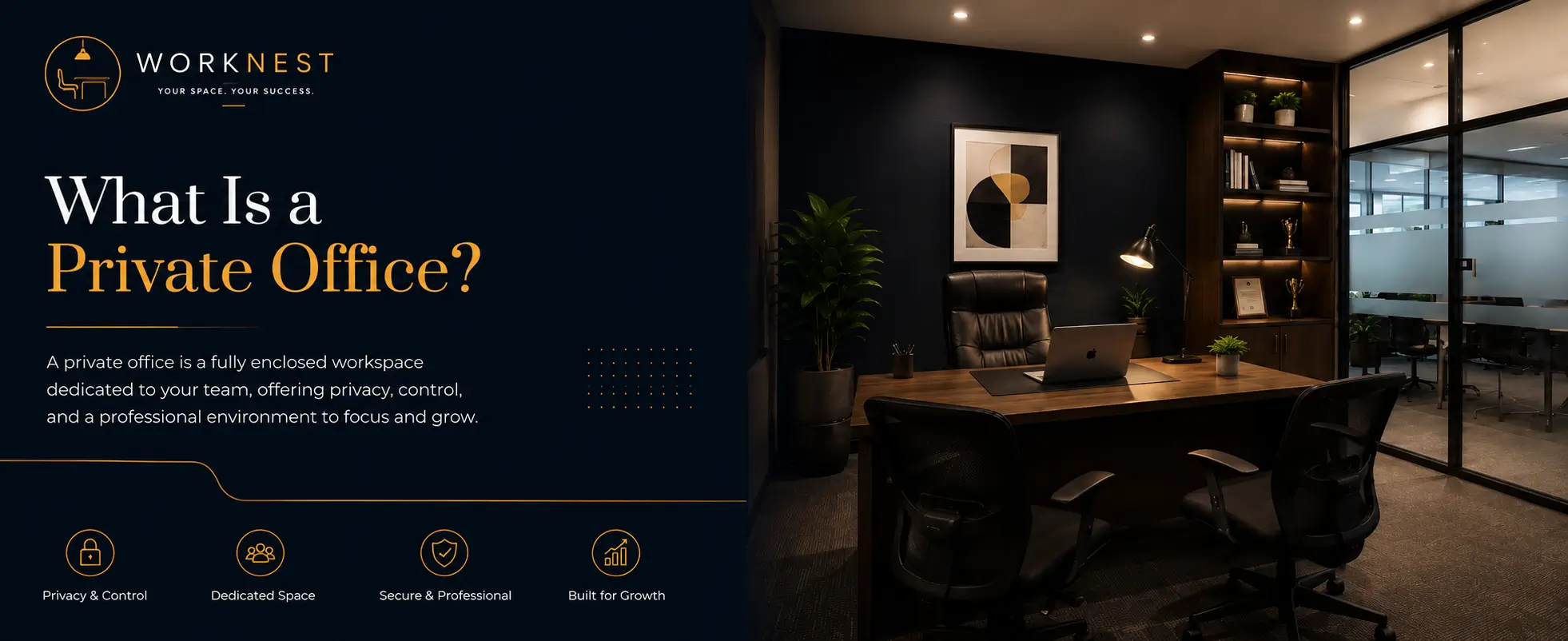
    A private office space is a lockable, enclosed room reserved only for your team. Nobody else uses your desks, and you control who enters.

    At WorkNest, this format is the Private Cabin. It costs ₹24,999/month and functions as a lockable office space in Jaipur rather than an open desk area. It’s sized for a small team of around 3 people who need daily privacy (seat count is a working estimate; confirm the exact number before publishing).

    A private office jaipur setup like this includes:

    • A locked door and dedicated storage for confidential files
    • Fixed desks that stay set up between visits
    • Access to WorkNest’s shared meeting rooms, reception, and pantry
    • The same high-speed WiFi, power backup, and housekeeping included across all WorkNest plans

    Because the room is yours alone, a private cabin works well for client calls, HR conversations, or any work that needs a closed door. Arjun Nair, a Founder and WorkNest member, said his team “started with four desks and expanded to a cabin without changing address,” a common path for growing teams.

    Unlike a traditional office lease, though, a private office at WorkNest doesn’t lock you into years of commitment. You keep the monthly flexibility of coworking while gaining the privacy of a traditional office, which is the actual advantage buyers are searching for when they compare “private office jaipur” options against a standalone commercial lease.

    What Is Coworking?
    what is coworking

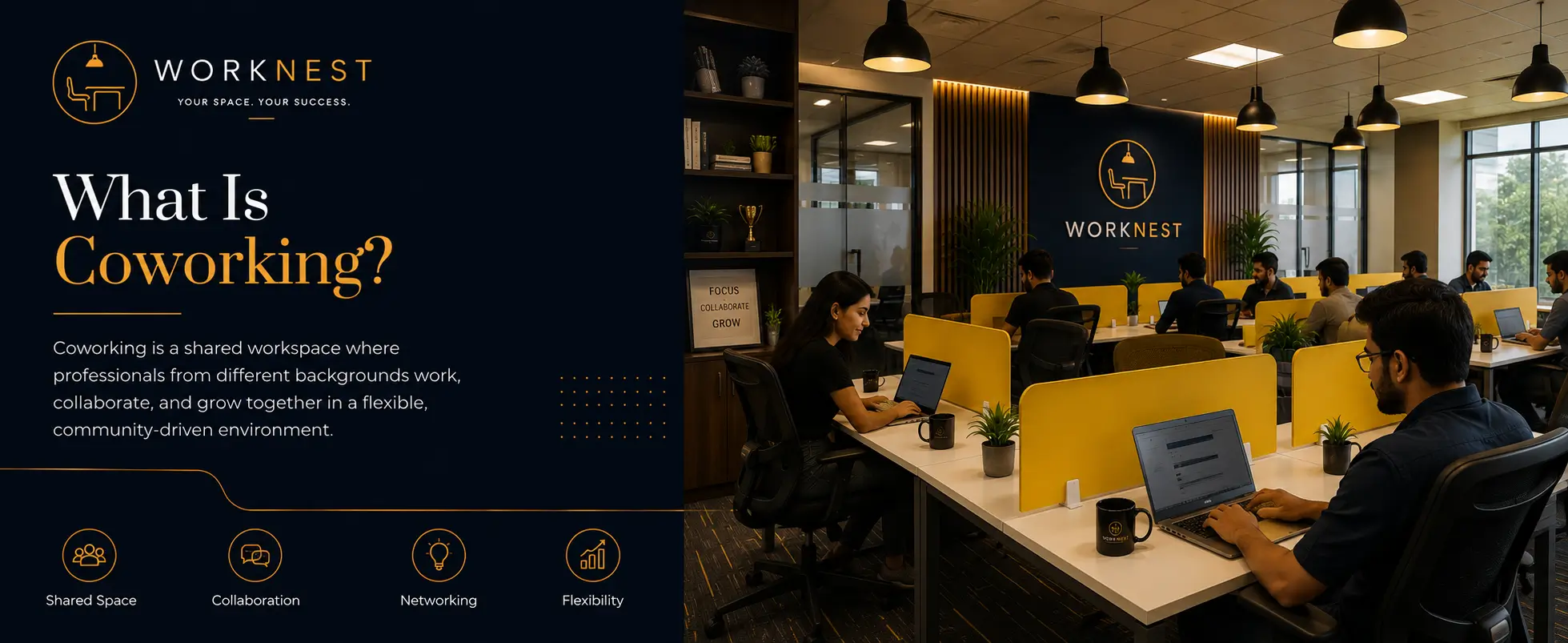
    Coworking is shared, flexible workspace. You use available desks alongside other professionals and pay only for the seats or days you need.

    WorkNest offers two coworking formats:

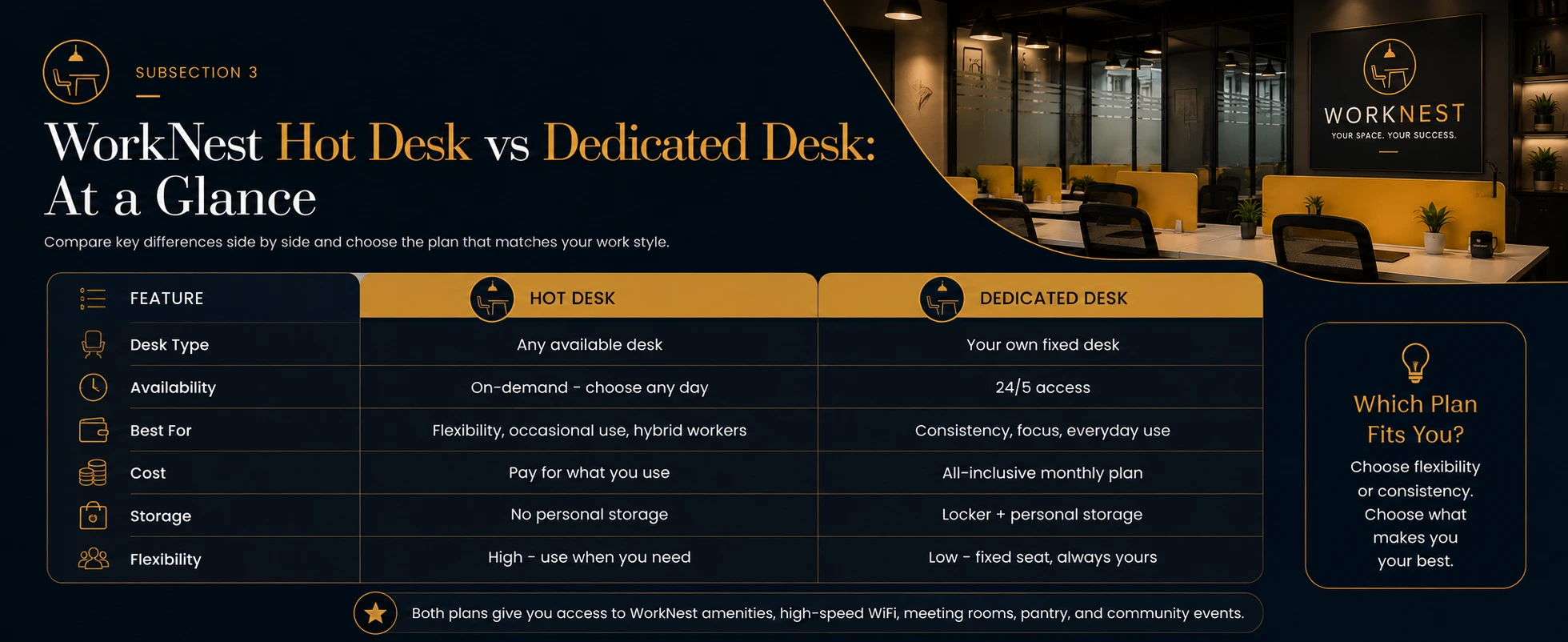
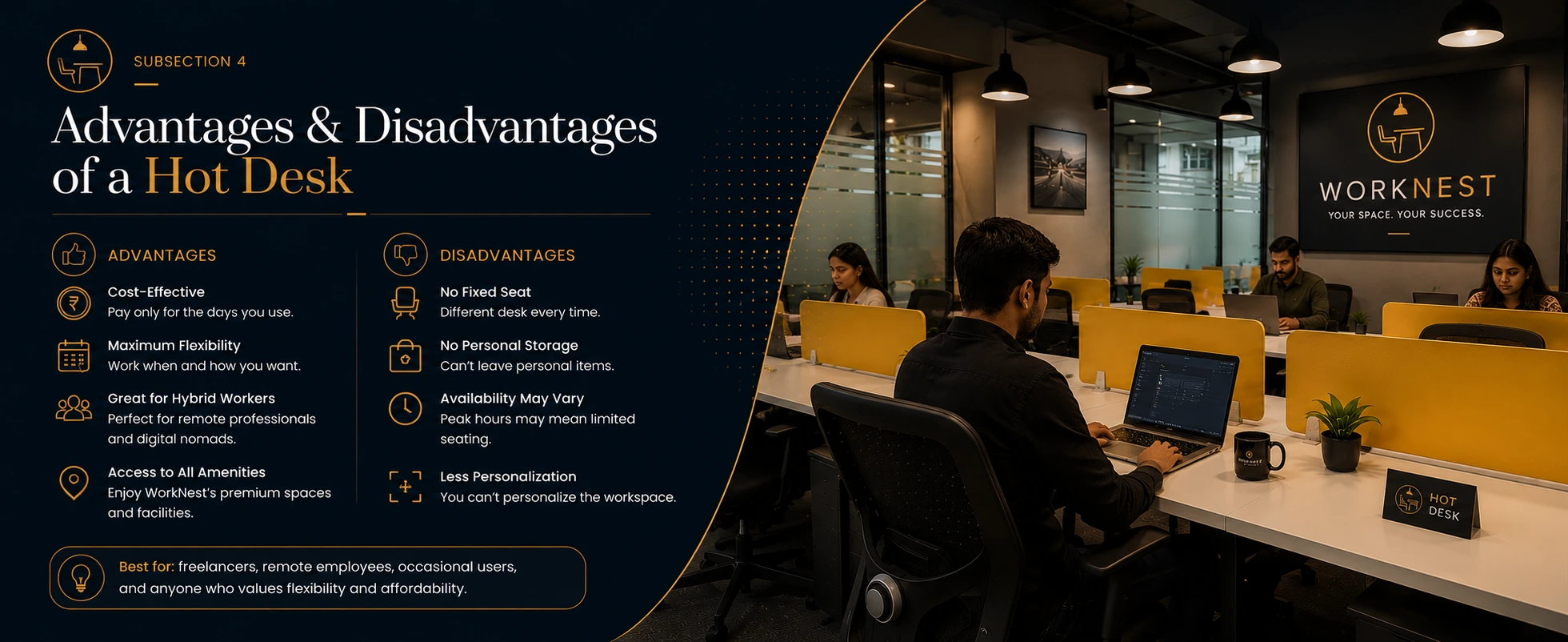
    • Hot Desk (₹699/day): any open desk, booked daily. Ideal for remote workers, business travelers, or anyone who needs a workspace in Jaipur for a day. 
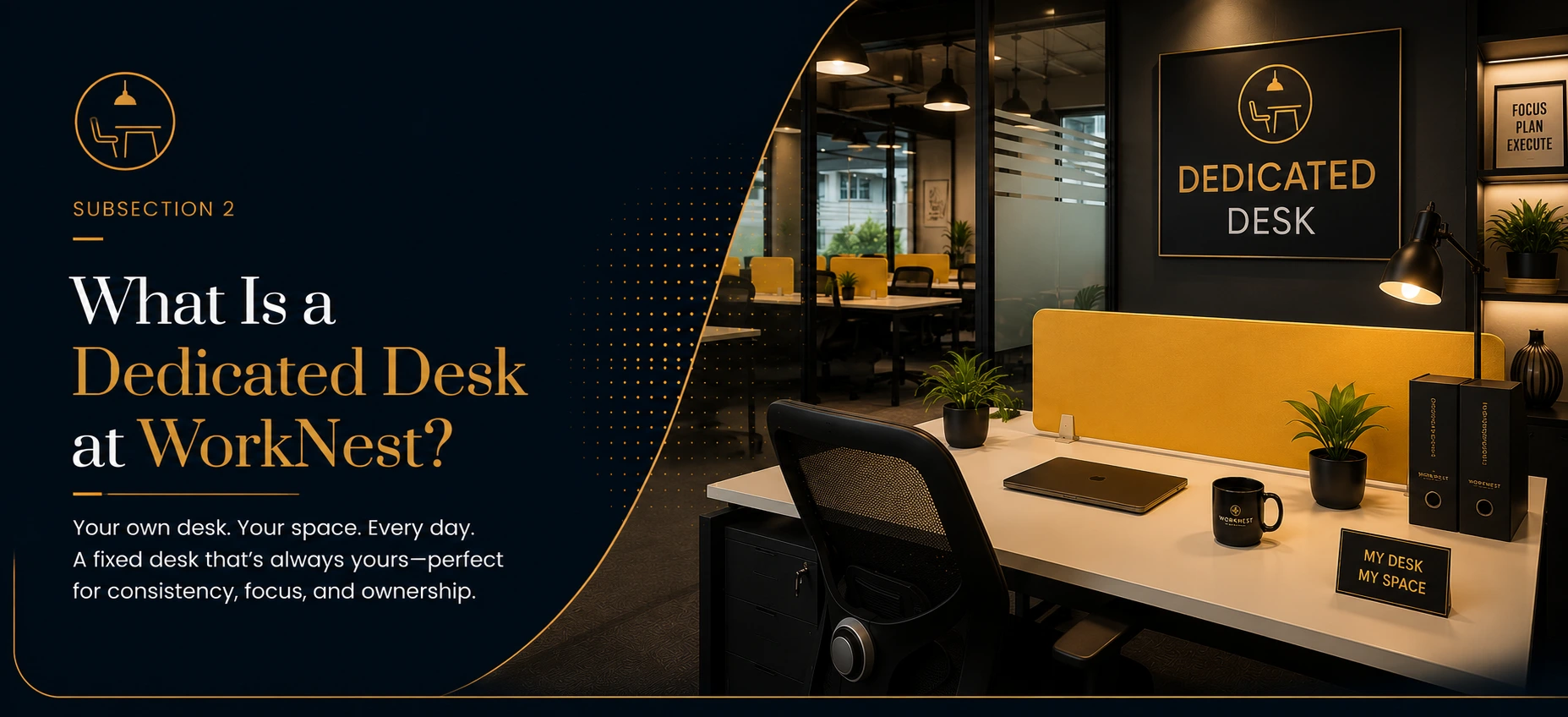
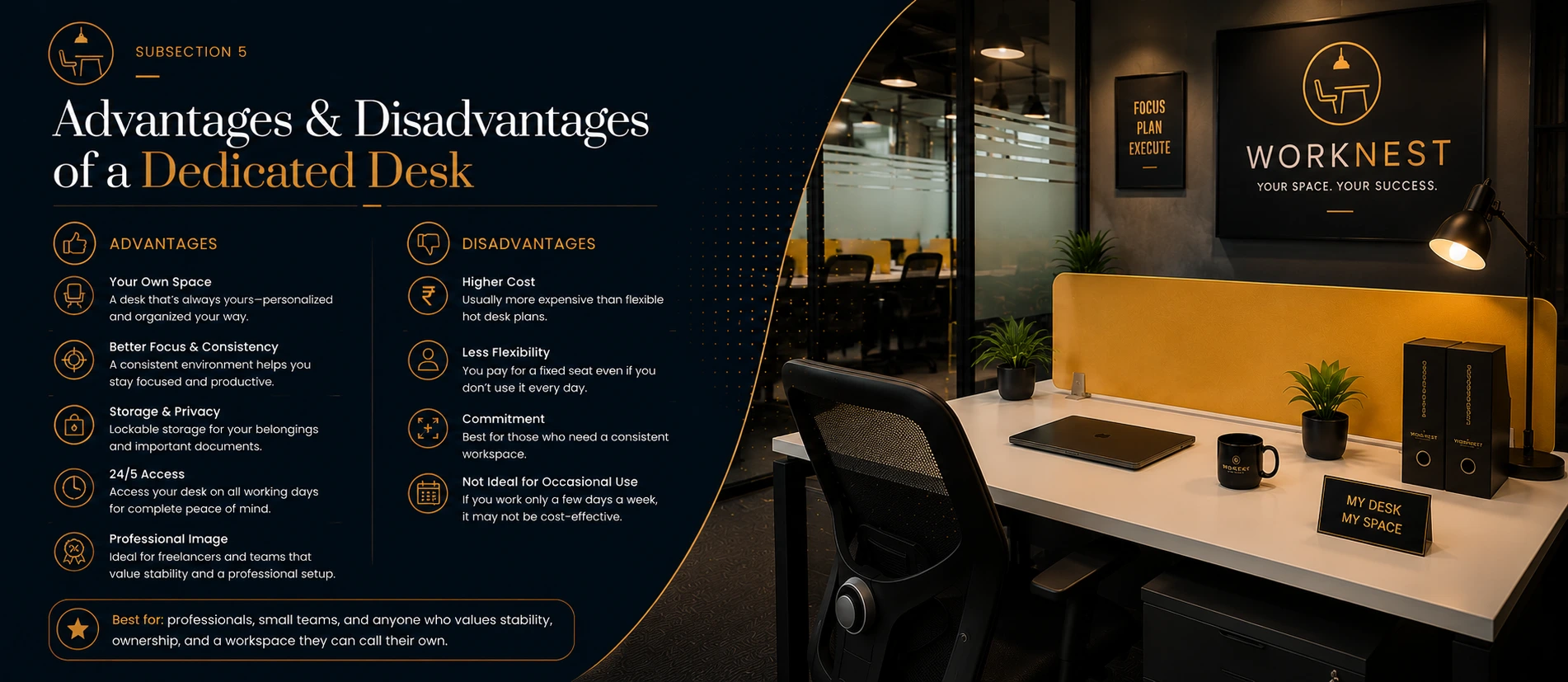
    • Dedicated Desk (₹9,999/month): your own fixed seat with 24/5 access, a personal locker, and an ergonomic chair, inside the shared coworking floor.

    Neither format includes a lockable room. That’s the core private cabin vs coworking trade-off: coworking gives you flexibility and a lower entry cost, while a private office gives you a closed door and permanent space.

    Freelance designer Priya Singh described the shift this way: “having a real business address changed how clients see me,” a benefit coworking delivers without the cost of a private room.

    Coworking also gives you built-in community. WorkNest hosts monthly founder meetups, industry mixers, and skill-sharing sessions, so the desk next to yours can turn into your next client or hire. A private cabin doesn’t remove this benefit: cabin members still walk through the same shared floor and can join the same events. Open coworking desks simply put you in the middle of it every day by default.

    If you’re weighing private cabin vs coworking purely on networking, know that both formats keep you inside WorkNest’s community. The real trade-off is privacy and permanence, not access to other members.

    Comparison Table

    Feature Hot Desk Dedicated Desk Private Cabin
    Price ₹699/day ₹9,999/month ₹24,999/month
    Lockable room No No Yes
    Seating Any open desk Fixed personal desk Fixed team desks
    Best team size 1 person 1 person ~3 people (estimated)
    Personal storage No Yes, personal locker Yes, in-room storage
    Meeting room access Member rates Member rates Included/priority
    Contract Daily, no lock-in Monthly, no lock-in Monthly, no lock-in
    Best for Testing coworking, occasional visits Freelancers, solo professionals Small teams needing privacy

    WorkNest also offers a Meeting Room at ₹799/hour, bookable separately by anyone, with capacity for 4–12 people, a screen or projector, video conferencing, and a whiteboard.

    Cost Per Person: Do the Math Before You Decide

    Sticker price alone can mislead you. Divide the monthly cost by headcount instead.

    • A 3-person team on Dedicated Desks: 3 × ₹9,999 = ₹29,997/month, with no locked room and no shared storage.
    • The same 3-person team in a Private Cabin: ₹24,999/month flat, regardless of headcount, plus a locked door and shared team storage.

    For teams of three or more, a private cabin is often more cost-effective than paying for separate dedicated desks, while also providing added privacy. This is the calculation both Venture X’s and Workbox’s guides skip, since neither ties its advice to an actual priced product.

    For solo professionals or teams of two, dedicated desks are often the more practical and affordable choice. Two Dedicated Desks (₹19,998/month total) still cost less than one Private Cabin (₹24,999/month), so coworking remains the better value until the third seat.

    Which Should You Choose?
    which should you choose

    Use this framework instead of guessing:

    • Choose a Hot Desk if you work in Jaipur occasionally or want to try coworking before committing to a plan.
    • Choose a Dedicated Desk if you’re a solo freelancer or consultant who wants a fixed personal seat and a business address, but doesn’t need a locked room.
    • Choose a Private Cabin if your team has grown past 2 people, you handle confidential client work, or you need a space you can lock at the end of the day.
    • Choose a Meeting Room booking if you only need a professional room occasionally for interviews or client pitches, without any ongoing membership.

    A Simple Sizing Guide

    Here’s when to upgrade to a private office, based on team headcount:

    • 1 person: Hot Desk or Dedicated Desk. A private cabin is unnecessary overhead at this size.
    • 2–4 people: Private Cabin (sized for around 3 people). You’ve likely outgrown shared desks and need a locked room.
    • 5–10 people: Multiple linked cabins or a custom private office configuration; contact WorkNest for a tailored quote.
    • 10+ people: A custom floor plan. WorkNest has helped startup founders scale from 2 to 20 seats without changing address, so this transition doesn’t require a new lease.

    Sales lead Karan Malhotra put it simply: his team finally has “a reliable base for calls, reviews, and client pitches” after moving from scattered desks into a defined space.

    Cost Signals That Point to Upgrading

    Watch for these signs that a private office now makes more financial sense than coworking:

    1. You’re booking meeting rooms almost daily for confidential conversations.
    2. Your team has grown to 3 or more people sharing hot desks.
    3. Clients or candidates visit often, and you need a consistent, closed-door space to meet them.
    4. You’re storing physical files or equipment that needs to stay locked.

    If two or more of these apply, a Private Cabin at ₹24,999/month is usually cheaper than the lost time and awkwardness of managing confidential work in an open coworking area.

    Cost Signals That Point to Staying in Coworking

    Coworking still wins when:

    1. Your team is 1–2 people and mostly remote.
    2. Budget flexibility matters more than privacy.
    3. You’re still validating your business model and don’t want a fixed monthly cost above ₹10,000.

    Ultimately, the private office space vs coworking space choice depends on headcount and privacy needs, not on which option sounds more premium.

    Making the Switch at WorkNest
    making the switch at workNest

    Whichever format fits, WorkNest keeps the move simple. Book a free tour and choose your plan on the spot. Sign digitally, and move in within 24 hours, with no long-term lock-in either way.

    WorkNest has onboarded 500+ businesses in Jaipur, holds a 4.8 Google rating, and keeps a 91% member renewal rate. Its team responds to enquiries within 30 minutes during business hours, at E-3, 6D Engineers Colony, Mansarovar, Jaipur 302020.

    Conclusion

    The private office space vs coworking space decision comes down to team size and privacy needs. Solo professionals and small teams testing the market do well with a Hot Desk or Dedicated Desk. Teams of 2 or more handling confidential work benefit from a lockable Private Cabin at ₹24,999/month. Either way, WorkNest lets you switch formats without moving addresses as your team grows.

    Ready to see which format fits your team? [Get Pricing] from WorkNest today.

    FAQs

    Q1: What is the main difference between a private office and a coworking space?

    A private office is a lockable, enclosed room used only by your team, while coworking is shared, open seating used alongside other professionals.

    Q2: How much does a private office cost in Jaipur?

    At WorkNest, a Private Cabin costs ₹24,999/month, including standard amenities like WiFi, power backup, and housekeeping.

    Q3: How many people fit in WorkNest’s Private Cabin?

    It’s built for a small team of around 3 people (working estimate; confirm exact seating during a tour before publishing this figure).

    Q4: Is coworking cheaper than a private office?

    Yes. A Hot Desk starts at ₹699/day and a Dedicated Desk at ₹9,999/month, both well below the ₹24,999/month Private Cabin, but neither offers a lockable room.

    Q5: When should a startup upgrade from coworking to a private office?

    Upgrade once your team reaches roughly 3 people, or once you regularly need a closed-door space for confidential work or client meetings. See the full sizing guide above for a headcount-by-headcount breakdown.

    Q6: Does WorkNest require a long-term lease for a private office?

    No. Private Cabins, Dedicated Desks, and Hot Desks are all available on flexible monthly or daily plans with no long-term lock-in.

    Q7: Can I book a meeting room without a coworking membership?

    Yes. WorkNest’s Meeting Room is bookable at ₹799/hour by anyone, with no membership required.

    Q8: Is a private cabin in Jaipur good for client meetings?

    Yes. A private cabin offers a locked, professional room that’s more suitable for client work and interviews than open coworking desks.

    Q9: How much does a meeting room cost at WorkNest, and how many people does it seat?

    WorkNest’s Meeting Room costs ₹799/hour and seats 4–12 people, with a screen or projector, video conferencing, and a whiteboard included.

  • Benefits of Coworking Space for Freelancers

    Benefits of Coworking Space for Freelancers

    Coworking spaces give freelancers a professional address, daily structure, and a built-in network, solving the three biggest problems of working from home. For freelancers in Jaipur, that translates into faster GST registration, fewer distractions, and real client trust, all for less than the cost of a private office lease.

    Imagine you’re on an important client call when the doorbell rings for a delivery mid-conversation. If you’ve worked from home, you already know the problem. Freelancing gives you freedom. But it quietly taxes your productivity, your credibility, and sometimes your sanity. As of 2026, more freelancers in Jaipur are solving this by working from coworking spaces like WorkNest in Mansarovar, and the benefits go well beyond “nice chairs and free coffee.”

    This guide breaks down each benefit on its own, so whether you’re comparing options or just want a quick answer, you can find exactly what you need without reading the whole article.

    Benefit 1: A Verifiable Professional Address (Including GST Support)

    a verifiable professional address

    A coworking membership gives freelancers a real, verifiable business address, something most competitor articles skip entirely. This matters more in India than almost anywhere else, because a professional address directly affects how you register your business.

    Most freelancers who work from home face two recurring problems:

    • Clients and vendors hesitate to send payments or sign contracts against a residential address.
    • GST registration for a home address often invites extra scrutiny, delays, or landlord objections if you’re renting.

    At WorkNest, freelancers can use the workspace address (E-3, 6D Engineers Colony, Mansarovar, Jaipur 302020) for business correspondence and, where applicable, GST registration support, a service competitors like Mindspace and Workland don’t specifically call out for freelancers in their benefit lists. That’s a genuine business advantage not just a matter of convenience.

    Independently citable takeaway: A coworking address gives Indian freelancers a documented, verifiable business location that supports GST registration, closing a gap that generic “coworking benefits” content usually leaves open.

    Benefit 2: Higher Productivity Through Structure and Fewer Distractions

    higher productivity through structure and fewer distractions

    Working from a dedicated space, away from home distractions, is one of the most consistently reported benefits of coworking among freelancers. The mechanism is simple: a coworking space creates a physical boundary between “home” and “work.” That boundary removes the friction of unplanned chores, family interruptions, and the temptation to nap between tasks, three things no productivity app can fix.

    Karan Malhotra, a sales lead who works from WorkNest, describes the shift directly: sitting among other working professionals every day gave him a routine and accountability that working alone at home never did. That’s a structural benefit, not a mood boost. It shows up in deadlines met and calls actually taken on time.

    At WorkNest, freelancers get:

    • A Hot Desk for ₹699/day when you need a distraction-free day without a monthly commitment.
    • A Dedicated Desk at ₹9,999/month for freelancers who want the same seat, same setup, every day.
    • A Private Cabin at ₹24,999/month for those who need full focus and confidentiality for client calls.

    Benefit 3: Real Networking, Not Just Small Talk

    real networking, not just small talk

    Coworking spaces put freelancers in daily contact with other independent professionals, agencies, and small teams, creating organic referral and collaboration opportunities that don’t happen at home. This is one of the most cited freelancer benefits, and it’s also one of the easiest to verify from real member stories rather than statistics.

    Meera Jain, an agency partner who works out of WorkNest, put it simply: her agency has picked up project referrals directly from conversations with other members in the space. That’s the kind of networking a spare bedroom simply can’t replicate.

    For freelancers specifically, this benefit compounds. A freelance designer sitting two desks away from a consultant or a sales lead becomes a warm introduction, not a cold pitch.

    Benefit 4: Cost Efficiency Compared to a Private Office

    cost efficiency compared to a private office

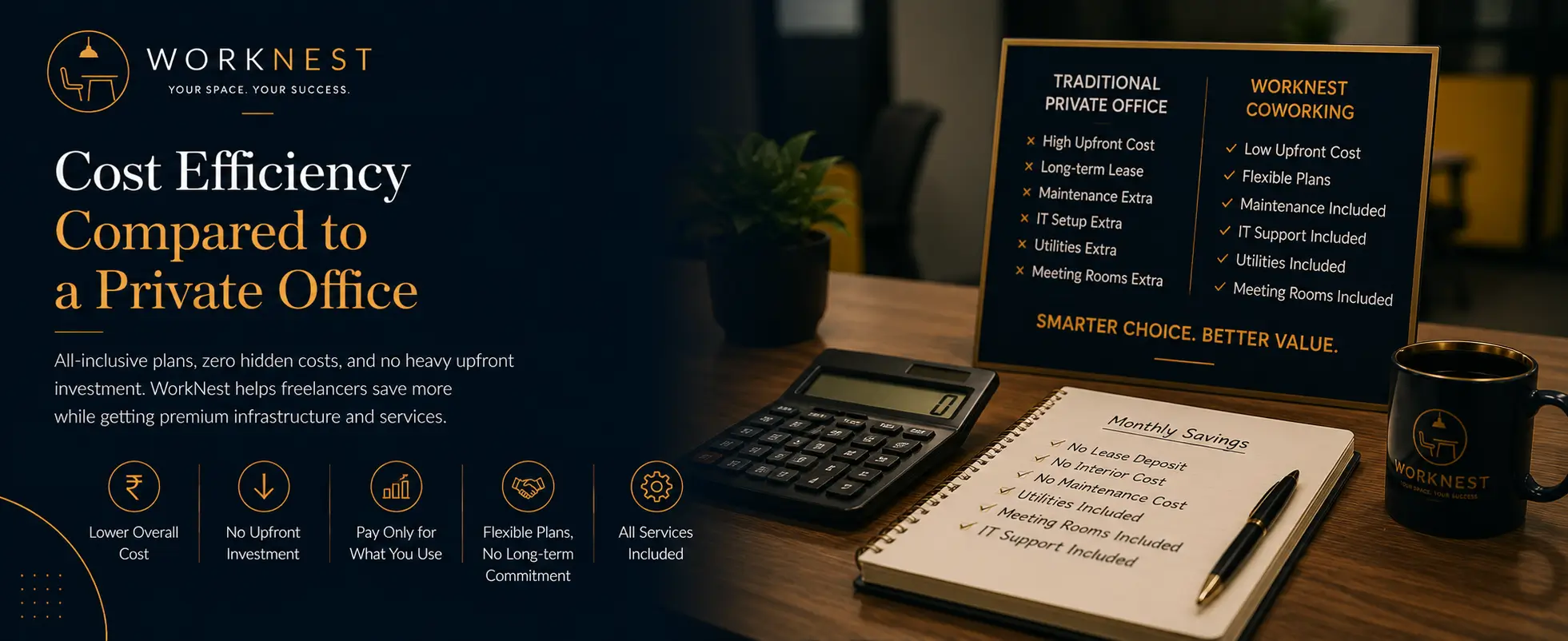
    Renting a private office in Jaipur typically requires a security deposit, furniture, internet setup, and a long lease, costs most freelancers can’t justify for one or two client meetings a month. Coworking removes nearly all of that upfront cost.

    Option Cost Best for
    Hot Desk ₹699/day Occasional or trial use
    Dedicated Desk ₹9,999/month Daily solo work
    Private Cabin ₹24,999/month Confidential client work
    Meeting Room ₹799/hour Client pitches and calls

    Pricing accurate as of 2026.

    Rohan Mehta, a consultant at WorkNest, books a meeting room only when he needs to pitch clients. Instead of paying for a full-time office he would rarely use, he simply pays by the hour.

    Benefit 5: Credibility That Wins Client Trust

    Meeting a client in a well-designed, professional space signals that you run a serious operation, something a coffee shop or home office rarely conveys. This is a softer benefit, but freelancers consistently report it shifts how prospects perceive them before a single word is spoken.

    WorkNest has served 500+ businesses and holds a 4.8 Google rating, with a 91% renewal rate among members, a strong signal that freelancers and small teams who try it, stay. Priya Singh, a freelance designer at WorkNest, has said client meetings booked in the space consistently move faster to a signed agreement than meetings held elsewhere.

    A Freelancer’s Experience

    a freelancer's experience

    Aditi Rao, a founder who started as a solo freelancer before scaling her team, describes her first few months at WorkNest as the turning point where her business ” started feeling like she was running a real business not because of the desk itself, but because of the professional address, access to meeting rooms for client pitches, and the daily structure the space provided.

    Arjun Nair, another founder at WorkNest, points to the same pattern from a different angle: having a fixed desk and a professional room to meet in changed how prospects treated his pitch, well before he had built a big team.

    These aren’t polished marketing lines. They’re the same three benefits freelancers ask about most: a real address, a productive routine, and a network that actually generates work.

    How to Choose the Right Coworking Plan as a Freelancer

    how to choose the right coworking Plan as a freelancer

    If you’re deciding which plan fits, match it to your work pattern rather than your budget alone:

    Plan Best For Price
    Hot Desk Occasional deep work or trial runs ₹699/day
    Dedicated Desk Daily solo work with a consistent seat ₹9,999/month
    Private Cabin Confidential calls or a stable business address ₹24,999/month
    Meeting Room Client-facing meetings, added to any plan ₹799/hour

    WorkNest’s 30-minute response time means you can get a plan finalized and start working the same day, without waiting on a slow sales process.

    Frequently Asked Questions

    See the FAQ section below for direct, quotable answers to the questions freelancers ask most.

    Conclusion: Are the Benefits of Coworking Space Worth It for Freelancers?

    For most freelancers, yes: the benefits of coworking space go beyond a desk. A verifiable professional address, GST support, higher productivity, real networking, and lower cost than a private office. As of 2026, WorkNest in Mansarovar, Jaipur offers all five in one membership, starting at ₹699/day.

    If you want to see whether it fits your workflow before committing, the fastest way is to walk through the space yourself.

    Book a Free Office Tour at WorkNest, Mansarovar, Jaipur, and get a same-day response within 30 minutes.

     FAQs

    Q1: What is the biggest benefit of a coworking space for freelancers?

    A: The single biggest benefit is a verifiable professional address. It supports GST registration, builds client trust, and solves a problem home offices can’t fix.

    Q2: Do coworking spaces actually improve freelancer productivity?

    A: Freelancers consistently report better focus in coworking spaces because a dedicated desk removes home distractions and builds a daily routine. WorkNest members like Karan Malhotra credit this structure for staying on top of deadlines.

    Q3: Can freelancers use a coworking address for GST registration in Jaipur?

    A: Many coworking spaces, including WorkNest in Mansarovar, support GST registration documentation using the workspace address. Freelancers should confirm exact document requirements with the WorkNest team before applying.

    Q4: How much does a coworking space cost for a freelancer in Jaipur?

    A: At WorkNest, a Hot Desk costs ₹699/day, a Dedicated Desk is ₹9,999/month, and a Private Cabin is ₹24,999/month, depending on how often you need the space.

    Q5: Is a coworking space better than working from home for freelancers?

    A: For most freelancers, yes. Coworking adds structure, a professional address, and networking that home offices lack, though occasional home days can still work for low-focus tasks.

    Q6: Do coworking spaces help freelancers get more client referrals?

    A: Yes. Daily proximity to other professionals and agencies creates informal referral opportunities. WorkNest members like Meera Jain report project referrals coming directly from in-space conversations.

    Q7: What is WorkNest’s renewal rate, and why does it matter for freelancers?

    A: WorkNest has a 91% renewal rate, indicating most freelancers and businesses who join continue their membership, a signal of consistent day-to-day value.

    Q8: Can a freelancer book just a meeting room instead of a full membership?

    A: Yes. WorkNest offers Meeting Rooms at ₹799/hour, so freelancers can book only for client pitches or calls without committing to a desk plan.

  • Is a Coworking Space Worth It for Startups?

    Is a Coworking Space Worth It for Startups?

    Yes, a coworking space is worth it for startups if you need to move fast, keep fixed costs low, and avoid locking cash into furniture, Wi-Fi setup, or a multi-year lease. For most early-stage teams in Jaipur, that “if” applies more often than not – but not always, and the exceptions matter as much as the rule.

    As of 2026, WorkNest in Mansarovar has hosted more than 500 businesses through exactly this decision. Some outgrew a hot desk in months. Others stayed on a dedicated desk for years. The difference usually came down to three things: cash runway, team size, and how often the founder needed a fixed address clients could walk into.

    This guide breaks down the real cost case, the flexibility case, and the specific situations where a traditional office still wins – using actual Jaipur pricing, not US-market averages.

    The Cost Case

    the cost case

    A coworking space for startups in Jaipur removes almost every upfront cost a traditional office demands. You’re not paying a security deposit, buying desks, wiring internet, or hiring someone to manage the pantry.

    At WorkNest, the entry point is a Hot Desk at ₹699/day – useful for testing a location before committing further. Most early teams move to a Dedicated Desk at ₹9,999/month once they need a fixed seat. Teams that need a closed room for client calls or compliance-sensitive work choose a Private Cabin at ₹24,999/month. Meeting rooms are billed separately at ₹799/hour, so you only pay for client-facing space when you actually use it.

    Compare that to a traditional small office in Mansarovar-adjacent commercial areas. Estimated – verify before publishing: a 400–500 sq. ft. commercial space typically runs ₹35,000–₹55,000/month in rent alone, before a refundable deposit (often 6–10 months’ rent), furniture, AC installation, internet setup, and a housekeeping or admin hire. For a 4-person startup, that can mean ₹1.5–3 lakh in upfront cash before day one – cash most seed-stage founders would rather spend on product or payroll.

    Startup office cost savings here aren’t marginal. A 4-person team on Dedicated Desks at WorkNest pays roughly ₹40,000/month total, with zero deposit and zero furniture spend. That’s the core of coworking ROI for startups: capital stays in the business instead of sitting in a landlord’s deposit account.

    Cost Component Traditional Office (Estimated) WorkNest Coworking
    Upfront deposit ₹2.1–5.5 lakh (6–10 months rent) ₹0
    Furniture & setup ₹1–2 lakh Included
    Monthly rent (4-person team) ₹35,000–55,000 ~₹40,000 (4 Dedicated Desks)
    Internet, maintenance, admin Separate hire/cost Included
    Meeting room access Built into rent (fixed) ₹799/hour (pay-per-use)
    Minimum commitment Usually 11-month lease Monthly

    Table note: Traditional office figures are estimated averages for Jaipur commercial space and should be verified against current local listings before publishing.

    The Flexibility Case

    the flexibility case

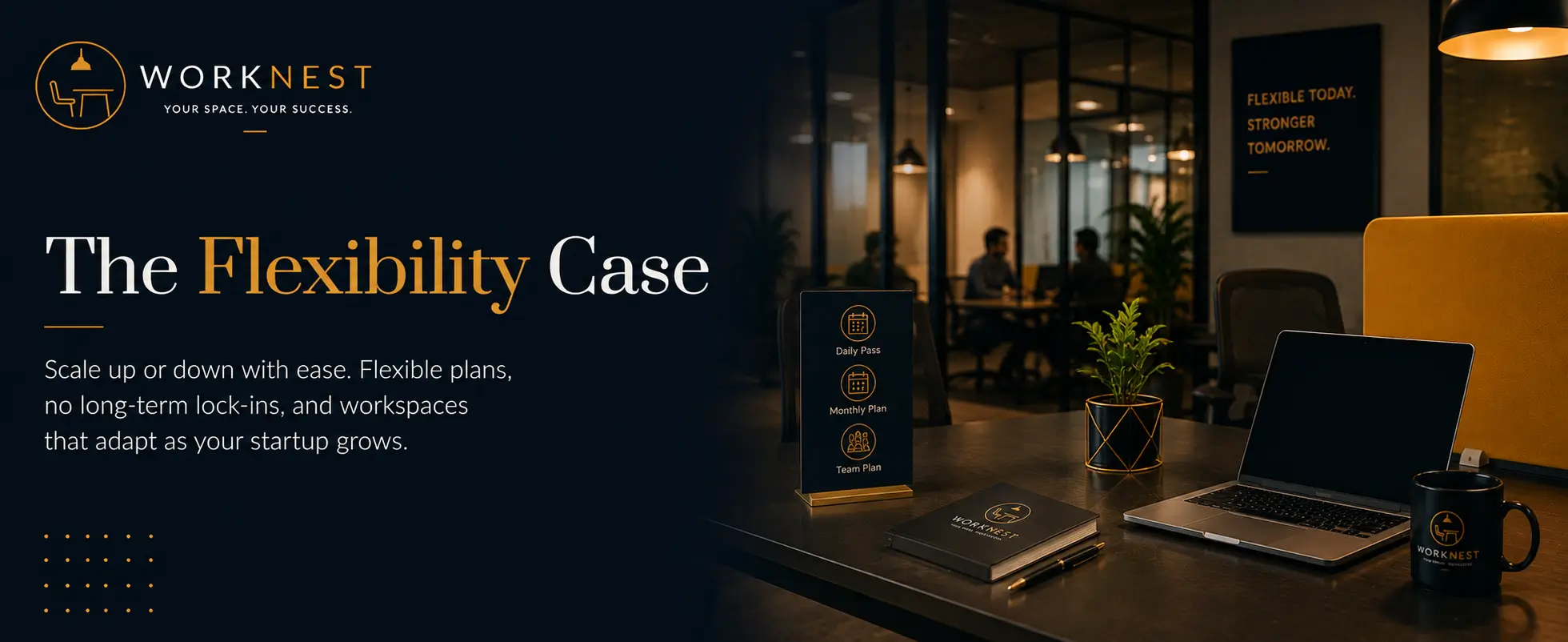
    Cost is only half the argument. The bigger reason coworking wins for early-stage teams is that startup headcount rarely moves in a straight line.

    A traditional lease locks you into one configuration for 11 months or more. If you hire five people in a quarter, you’re either cramped or paying for empty desks you signed up for a year ago. A coworking model lets you scale desk count up or down as hiring and revenue actually happen – which matters most in the first 18–24 months, when a founder genuinely doesn’t know if the team will be 3 people or 15 by next quarter.

    This is when to get an office for a startup matters most: the moment your team size is still a forecast, not a fact. Flexible desks fit that moment better than a lease. WorkNest’s response time for account and booking queries is under 30 minutes. So scaling desk count up before a client visit or a new hire’s start date doesn’t need weeks of lead time, unlike a lease renegotiation.

    There’s a trust signal worth noting too. WorkNest holds a 4.8 Google rating in Mansarovar, Jaipur, backed by more than 500 businesses served to date. It also has a 91% renewal rate among current members. That means the large majority of teams that try it choose to stay, rather than treating it as a stopgap.

    When It Might Not Be Worth It

    when it might not be worth it

    No, coworking is not always the right call. Three situations make a traditional office, or staying remote, the better fit:

    You’ve hit 15–20+ people with a stable headcount.

    Once hiring plans are confirmed and your team size isn’t expected to swing for 12+ months, the per-desk economics of coworking start to lose their edge over a direct lease, especially if you need a fully custom floor layout.

    You need heavy physical infrastructure.

    Hardware startups running lab equipment, manufacturing testing, or anything requiring specialized electrical or structural build-outs won’t fit a shared floor plan.

    You’re fully remote by design and rarely meet clients in person.

    If your team is distributed and client meetings happen over video, a Hot Desk used occasionally may cover your needs – a Dedicated Desk or Private Cabin would be paying for space you don’t use.

    If none of these describe your startup, the flexibility and cost case above will likely outweigh the drawbacks.

    A Real Example

    Aditi Rao, Founder, is one of the 500+ businesses WorkNest has hosted in Mansarovar. Her path reflects the pattern this guide describes: starting small and flexible, then scaling as the team grew, without a lease renegotiation or a locked-in deposit slowing things down.

    That kind of named, attributable member outcome carries more weight than a hypothetical case study. It’s also consistent with WorkNest’s 91% renewal rate – most founders who start this way choose to stay rather than move to a traditional lease later.

    Note for the WorkNest team: if Aditi Rao has given a specific, publishable quote (e.g., which desk plan she started on, team size at the time, or a direct line about her experience), swap it in here – a verbatim first-hand quote will strengthen this section’s GEO and E-E-A-T value further.

    Conclusion

    So, is a coworking space worth it for startups? Yes – if your team size is still changing, your cash needs to go into product and payroll rather than deposits and furniture, and you need a professional address without an 11-month commitment. It’s worth a second look only if you’ve already stabilized headcount above 15–20 people or need infrastructure a shared floor can’t offer.

    The clearest way to know which side of that line your startup sits on is to walk the space and price it against your actual headcount plan – not a generic estimate.

    Ready to see if it fits your team? Book a Free Office Tour at WorkNest, E-3, 6D Engineers Colony, Mansarovar, Jaipur 302020.

    FAQs

    Q1: Is a coworking space worth it for a 2–3 person startup?

    Yes. At this size, a Hot Desk (₹699/day) or a couple of Dedicated Desks (₹9,999/month each) usually costs less per month than the cheapest traditional office lease in Jaipur, with no deposit.

    Q2: What’s the real cost difference between coworking and a traditional office in Jaipur?

    A 4-person team pays around ₹40,000/month total at WorkNest on Dedicated Desks, versus an estimated ₹35,000–55,000/month rent alone for a small traditional office – before deposit and furniture. (Estimated traditional-office figure – verify before publishing.)

    Q3: When should a startup stop coworking and get its own office?

    Once headcount is stable above roughly 15–20 people for 12+ months, or the business needs infrastructure a shared floor can’t support (labs, manufacturing, heavy equipment).

    Q4: Does WorkNest offer flexible terms for early-stage startups?

    Yes. Hot Desks and Dedicated Desks are available monthly with no long-term lease, and Meeting Rooms are billed hourly (₹799/hour) so you only pay when you need client-facing space.

    Q5: How fast can a startup scale desks up at WorkNest if it hires quickly?

    WorkNest’s team responds to booking and account requests within 30 minutes, which makes adding desks ahead of a new hire’s start date faster than renegotiating a lease.

    Q6: Is coworking cheaper than working from home for a startup?

    Not necessarily on pure cost, but a coworking space adds a professional address, meeting rooms, and in-person team collaboration – factors that matter once a startup starts meeting clients or investors regularly.

    Q7: What does WorkNest’s renewal rate say about long-term value?

    WorkNest has a 91% renewal rate among current members, suggesting most teams that try coworking choose to stay rather than switch to a traditional lease.

  • How to Choose a Coworking Space in Jaipur: A Checklist

    How to Choose a Coworking Space in Jaipur: A Checklist

    The fastest way to choose a coworking space in Jaipur is to score every shortlisted option against seven checkpoints: location, pricing transparency, amenities, community fit, contract flexibility, safety standards, and what you actually observe on a site tour. Skip any one of these, and you risk signing a contract that looks good on a website but fails you in week three. This checklist is built specifically for Jaipur’s market, not adapted from a generic template, so every item below reflects what actually matters when you’re comparing spaces in areas like Mansarovar, C-Scheme, or Vaishali Nagar. Demand for flexible workspace is rising fast: the global coworking market is projected to grow from $26.2 billion in 2025 to $30.12 billion in 2026, a 15% CAGR (The Business Research Company). Jaipur is capturing part of that demand directly, Smartworks alone reported an 82% utilization rate across its Jaipur portfolio as of March 31, 2026, and expanded its Jaipur footprint by 2.47 lakh sq. ft. the same year (Whalesbook). Unlike generic national checklists, every item here is checked against what actually shows up in Jaipur, from summer power reliability to local parking constraints, not adapted from a template built for Bengaluru or Gurugram. Use the seven checkpoints below in order, take notes during each tour, and only sign once every category has a clear, verified answer, not a promise from a sales brochure.

    1. Location and Daily Commute

    location and daily commute

    Choose the right location first because it affects your daily commute, convenience, and work routine—not just your decision to sign up. A coworking space in Jaipur should sit within a reasonable commute for your core team, near public transport or arterial roads, and close enough to client-heavy areas that meetings don’t eat your afternoon. Check parking availability separately from the pitch deck, two-wheeler and car parking are common pain points that only show up when you visit in person. WorkNest, for example, sits at E-3, 6D Engineers Colony, Mansarovar, Jaipur 302020, a residential-commercial pocket chosen specifically for easy access from South and Central Jaipur. If your team splits across the city, map the average commute time for each member before you shortlist a space, rather than assuming “central Jaipur” means the same thing to everyone.

    2. Pricing Transparency

    pricing transparency

    A trustworthy coworking space in Jaipur is upfront about its pricing, with clear rates and no hidden charges. Ask for a written breakdown of every plan before you compare providers. The table below shows WorkNest’s pricing as a reference. Use it to compare and evaluate other coworking spaces in Jaipur 

    Plan Price Best For
    Hot Desk ₹699/day Occasional or trial use
    Dedicated Desk ₹9,999/month Daily solo work, freelancers
    Private Cabin ₹24,999/month Small teams needing a closed room
    Meeting Room ₹799/hour Client meetings, interviews

    Always ask whether GST is included. Also confirm the security deposit amount and whether meeting room hours are bundled into monthly plans or billed separately. Dedicated desk plans across other Jaipur coworking providers typically range from ₹4,000 to ₹8,000 per month (Venture X, rahul.biz). Use this range to benchmark any quote you receive, and verify current pricing directly with each provider before you commit. Choose a plan that matches how often you’ll actually use the space. A hot desk at a daily rate often works out cheaper than a dedicated desk if you only need the space two or three days a week.
    3. Amenities That Support Real Work

    amenities that support real work

    Wi-Fi speed, power backup, and quiet-call space matter more than a foosball table. Before touring, list the three amenities your work genuinely depends on, for a sales team that’s likely call booths and stable internet; for a design freelancer, it might be dual monitors and natural light. Then verify each one on-site rather than trusting a photo gallery. Ask how power backup is tested and how often internet speed is measured, since these two failures cause more lost workdays than any other coworking complaint. Don’t skip smaller details either, printer access, locker space, and drinking water quality sound minor until you’re missing them on a deadline day, so walk through a normal working hour on your tour, not just the reception area.

    4. Community and Business Fit

    A coworking space in Jaipur is also a network, so ask who else works there. Spaces that mix founders, consultants, and agency teams tend to generate more referrals and collaboration than single-industry spaces. Priya Singh, a freelance designer who works from WorkNest, says the mix of founders and consultants in the space led to two client referrals in her first quarter. That kind of organic outcome is a better signal than any brochure claim, so ask current members directly about it during your tour. Meera Jain, an agency partner who works out of WorkNest, adds that a well-mixed member base made it easier to find local vendors and collaborators without leaving the building, a practical benefit that rarely appears in a coworking space’s marketing copy but shows up quickly once you’re actually working there.

    5. Flexibility and Contract Terms

    Choose a flexible monthly plan before committing to a long-term contract. A space confident in its service usually offers short-term plans alongside longer ones, because it expects renewals to happen on merit. Ask three things specifically: What’s the notice period to downgrade or exit? Is there a lock-in penalty? Choose a coworking space that lets you upgrade from a hot desk to a private cabin as your team grows.  A high renewal rate is one of the clearest signs a space delivers on its promises, for reference, WorkNest reports a 91% renewal rate among its members, which points to satisfaction rather than contractual lock-in. If a space won’t disclose its renewal or retention figures at all, treat that as a gap worth asking about rather than assuming the worst, some providers simply don’t track it, which is itself useful information.

    6. Safety, Hygiene, and Operational Reliability

    safety, hygiene, and operational reliability

    Fire exits, CCTV coverage, daily cleaning schedules, and a documented response time for maintenance issues are non-negotiable, not nice-to-haves. Ask how fast the facility team responds when something breaks, internet down, AC failure, a locked meeting room. WorkNest, for instance, commits to a 30-minute response time for member issues, a benchmark worth asking every space you tour to match or beat. Also confirm building compliance basics: functioning fire extinguishers, marked exits, and an on-site or on-call facility manager during working hours. Karan Malhotra, a sales lead who relies on WorkNest for client calls, notes that a fast, dependable response time mattered more to his day-to-day experience than any single amenity on the tour.

    7. Questions to Ask on Your Tour

    Bring this list to every site visit. Asking the same set of questions across every space you compare is the only way to make an apples-to-apples decision instead of an emotional one.

    Question Why It Matters
    What’s included in the base price, and what costs extra? Reveals hidden fees before you sign
    What’s your average internet speed, tested when? Confirms real-world reliability, not marketing claims
    What’s your maintenance response time? Predicts how fast problems get fixed
    Can I see a live member’s workspace, not just a demo desk? Shows the space at typical daily occupancy
    What’s your renewal rate or average member tenure? Signals genuine member satisfaction
    Is there a lock-in period, and what’s the exit notice? Protects you from long-term commitment risk
    How is meeting room time allocated or billed? Prevents surprise charges during client meetings
    What security measures are in place after hours? Matters if your team works late or on weekends

    Rohan Mehta, a consultant who toured several Jaipur spaces before choosing WorkNest, says the tour questions above were what actually separated well-run spaces from ones that just looked good in photos.

    Bringing the Checklist Together

    Score each space you visit against all seven categories on a 1–5 scale, then compare totals side by side instead of relying on gut feeling. Print or copy the table below and fill it in during each tour.

    Category Your Score (1–5) Notes
    Location & Daily Commute
    Pricing Transparency
    Amenities That Support Real Work
    Community & Business Fit
    Flexibility & Contract Terms
    Safety, Hygiene & Reliability
    Tour Impressions
    Total (out of 35)

    A space that scores well on amenities but poorly on contract flexibility, for instance, might still be wrong for an early-stage founder who needs to scale down some months. This is exactly why a checklist approach beats a single “best coworking space in Jaipur” recommendation, the right choice depends on your team’s specific commute, budget, and growth stage, not on any one provider’s marketing.

    Print this checklist, take it into every tour, and fill in real answers on the spot rather than relying on what a sales team tells you afterward. Arjun Nair, a founder who used a similar checklist while comparing spaces before settling on WorkNest, says having the questions written down beforehand kept each tour focused and comparable, instead of turning into a generic sales pitch.

    If you want to run this checklist against a real space instead of a hypothetical one, WorkNest offers a free office tour where you can test every item above in person, Wi-Fi speed, parking, meeting rooms, and member community, before making any commitment. Book a free office tour to see how this checklist plays out in a real Jaipur coworking space.

    FAQs

    How do I choose a coworking space in Jaipur?

    Score every shortlisted space against seven checkpoints, location, pricing transparency, amenities, community fit, contract flexibility, safety, and what you observe on an in-person tour, then compare totals rather than choosing on first impression.

    What is the best coworking space in Jaipur for freelancers?

    The best coworking space in Jaipur for freelancers is one offering a flexible, no-lock-in dedicated desk plan with reliable Wi-Fi and a mixed member community for referrals. WorkNest’s Dedicated Desk plan (₹9,999/month) is built for this use case.

    What should be on a coworking space checklist?

    A coworking space checklist should cover location and commute, transparent pricing, working amenities (Wi-Fi, power backup, call space), community fit, contract flexibility, and safety and hygiene standards, verified in person, not from a website alone.

    What questions should I ask on a coworking space tour?

    Ask about pricing inclusions, internet speed testing, maintenance response time, renewal or retention rates, lock-in and exit terms, meeting room billing, and after-hours security, and ask to see a live member’s desk, not just the demo area.

    How much does a coworking space cost in Jaipur?

    Pricing varies by plan. At WorkNest, a Hot Desk costs ₹699/day, a Dedicated Desk ₹9,999/month, a Private Cabin ₹24,999/month, and a Meeting Room ₹799/hour. Always confirm whether GST and security deposits are included separately.

    Is a coworking space better than a private office in Jaipur?

    A coworking space is generally better for teams that want flexibility, lower upfront cost, and built-in networking, while a private office suits teams needing full control over layout and long-term branding. Many businesses use a coworking Private Cabin as a middle ground.

    How do I know if a coworking space is reliable?

    Check its documented maintenance response time, ask current members about uptime and support, and confirm renewal or retention data if the provider shares it. A short, clearly stated response time, such as WorkNest’s 30-minute commitment, is a useful benchmark.

    What should you look for in a coworking space?

    Look for a location within easy commute of your team, transparent per-plan pricing, tested Wi-Fi and power backup, a business-relevant member community, flexible contract terms, and documented safety and maintenance response standards, verified in person, not just from the website.

  • The Best Areas in Jaipur for a Coworking Space (2026 Guide)

    The Best Areas in Jaipur for a Coworking Space (2026 Guide)

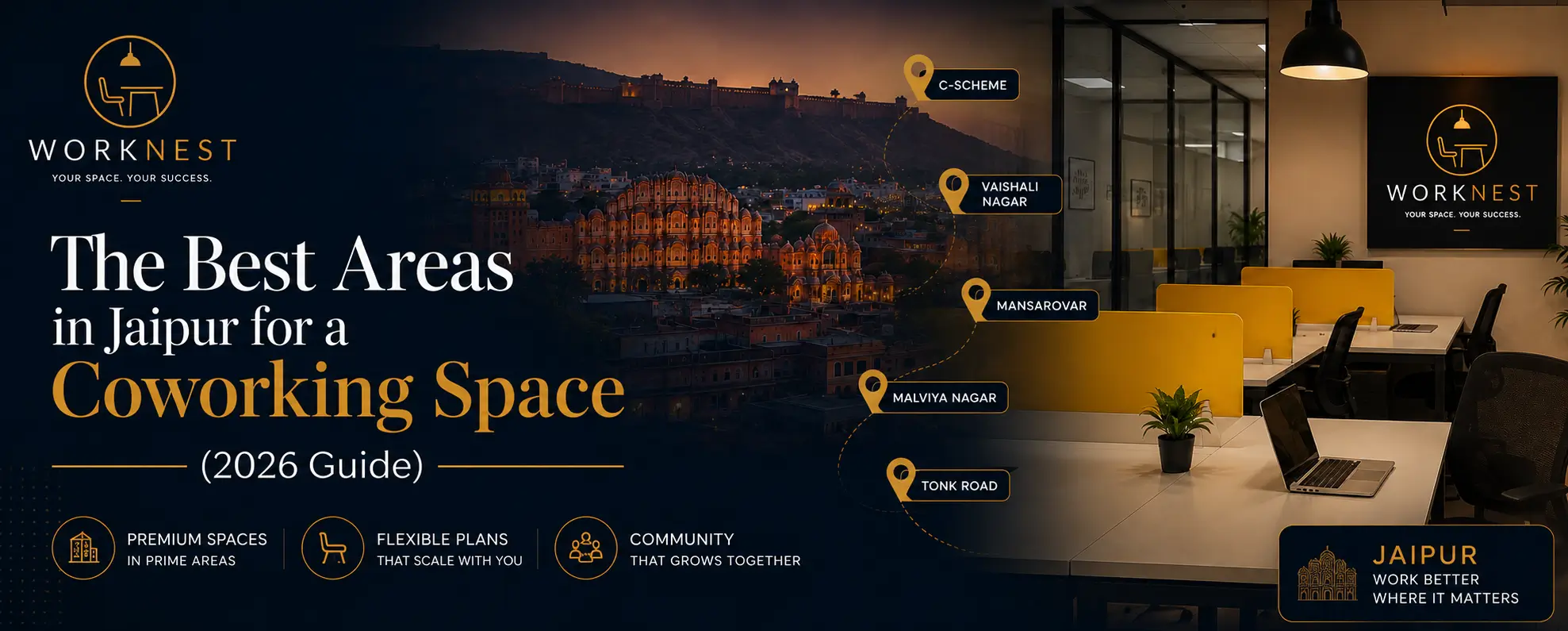
    Mansarovar, Vaishali Nagar, Malviya Nagar, C-Scheme, and Tonk Road are the five best areas in Jaipur for a coworking space in 2026, each suited to a different kind of team. Freelancers and small founders get the best value in Mansarovar. Consultants who need a central address lean toward C-Scheme. Sales teams that travel often prefer Tonk Road for highway access. This guide breaks down each locality honestly, including where options are still genuinely limited, so you can pick the right one instead of guessing.

    Most “area overview” blogs on this topic list four or five localities and stop there. They rarely tell you which area actually has working, bookable space today versus which one just sounds good on paper. We built this guide as a single, honest reference  not a directory pushing you toward five different third-party listings.

    Coworking Space Near Mansarovar Metro

    Mansarovar is Jaipur’s most residential-commercial hybrid zone, and it has quietly become one of the strongest coworking markets in the city. The Mansarovar Metro station connects it directly to C-Scheme and the railway station in approximately 20 minutes (estimated based on current metro schedules -confirm exact timing on the official Jaipur Metro route page), which matters if your team commutes from across Jaipur.

    This is WorkNest’s home base, located at E-3, 6D Engineers Colony, Mansarovar, Jaipur 302020. As of 2026, WorkNest has served 500+ businesses here, holds a 4.8 Google rating, and sees a 91% client renewal rate  a strong signal that people who try it, stay. Pricing starts at ₹699/day for a hot desk, ₹9,999/month for a dedicated desk, ₹24,999/month for a private cabin, and ₹799/hour for meeting rooms.

    Freelance designer Priya Singh and consultant Rohan Mehta are among the clients who’ve used WorkNest’s Mansarovar space for daily work and client meetings. If you want metro access, transparent pricing, and a single trustworthy operator rather than a directory of unrelated listings, Mansarovar is the strongest all-round pick in Jaipur right now.

    Coworking Space in Vaishali Nagar

    Vaishali Nagar works well for teams that want a residential-adjacent, quieter work environment with easy access to Ajmer Road. It’s popular with small agencies and edtech startups that don’t need a downtown address.

    The honest gap: Vaishali Nagar has fewer dedicated coworking operators than Mansarovar or C-Scheme. As a result, inventory turns over fast during peak leasing months. Estimated verify before publishing: typical seat rates in this micro-market run close to ₹5,000–₹6,000 per seat/month. However, this locality genuinely has limited coworking supply compared to the other four areas in this guide, so confirm current availability directly with any operator before committing.

    Coworking Space in Malviya Nagar

    Malviya Nagar sits near Jaipur’s IT and commercial corridor, making it a natural fit for tech teams, recruitment firms, and companies running client-facing sales operations. Proximity to Gopalpura Bypass and the Malviya Nagar Metro corridor keeps commute times short for staff living in the southern part of the city.

    This area tends to attract mid-size teams rather than solo freelancers. That’s because several spaces here are built around private cabins and small offices rather than single hot desks. If your team is 5–15 people and needs a semi-permanent setup, Malviya Nagar is worth shortlisting alongside Mansarovar.

    Coworking Space in C-Scheme

    C-Scheme is Jaipur’s central business district. It’s home to corporate offices, government buildings, and premium retail. A C-Scheme address carries real prestige. That matters for consulting firms, legal practices, and businesses meeting out-of-town clients regularly.

    The tradeoff is cost and traffic. Commercial rents here run meaningfully higher than in Mansarovar or Vaishali Nagar. Peak-hour congestion around MI Road and Ashok Marg also adds real time to any commute. So if your priority is address prestige over daily convenience, C-Scheme fits well. But if you want the same central-Jaipur connectivity without the premium, Mansarovar’s metro link gets you there in approximately 20 minutes anyway.

    Coworking Space on Tonk Road

    Tonk Road is Jaipur’s logistics and highway-access corridor. It connects the city toward Sanganer, the airport, and Jaipur-Kota traffic. That makes it ideal for field sales teams, logistics coordinators, and anyone needing frequent airport runs.

    Sales lead Karan Malhotra’s experience reflects a common pattern here. Teams pick Tonk Road specifically for travel convenience, not for a downtown feel. However, coworking inventory along this stretch skews toward larger floor-plate offices rather than flexible daily hot desks. So confirm short-term booking options are actually available before you commit.

    Which Area Is Right for You?

    Which Area Is Right for You

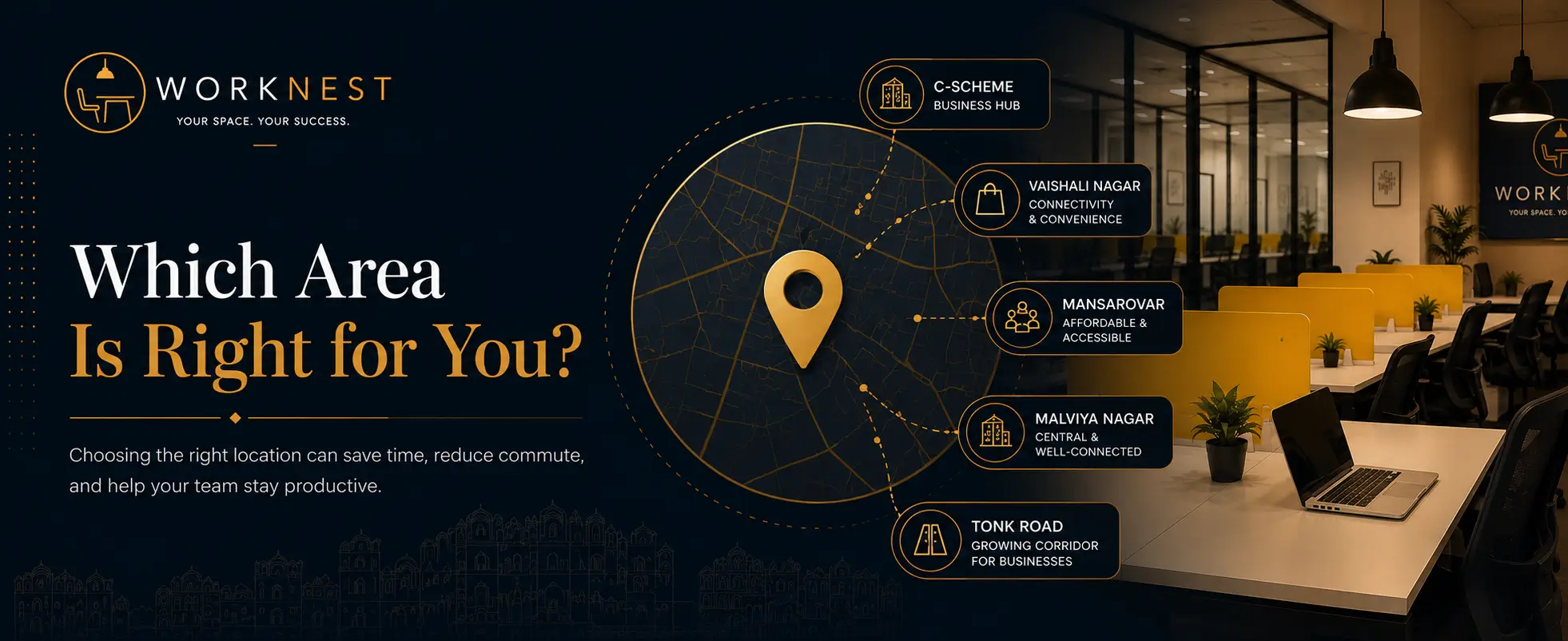
    Use this table to match your work pattern to the right Jaipur locality, then compare it against WorkNest’s Mansarovar pricing below.

    Locality Best For Commute Highlight Coworking Supply (2026)
    Mansarovar Freelancers, founders, small teams Direct metro to C-Scheme & station Strong — established operators
    Vaishali Nagar Quiet, residential-adjacent teams Ajmer Road access Limited — verify availability
    Malviya Nagar Mid-size teams (5–15 people) Gopalpura Bypass, Metro corridor Moderate — cabin-focused
    C-Scheme Client-facing, prestige-driven firms Central, but high traffic Strong — premium pricing
    Tonk Road Sales, logistics, frequent travelers Airport & highway access Moderate — larger offices

    WorkNest Mansarovar Pricing (as of 2026):

    Plan Price
    Hot Desk ₹699/day
    Dedicated Desk ₹9,999/month
    Private Cabin ₹24,999/month
    Meeting Room ₹799/hour

    If you’re comparing the best areas in Jaipur for a coworking space and want metro connectivity, transparent pricing, and a proven 91% renewal rate, Mansarovar and WorkNest specifically  is the area to shortlist first. Founder Aditi Rao and agency partner Meera Jain both cite the same reason for choosing WorkNest: predictable pricing with no hidden add-ons, in a location their teams can actually reach quickly.

    Book a free office tour at WorkNest’s Mansarovar space to see the desks, cabins, and meeting rooms before you decide.

    FAQS

    Q1: What is the best area in Jaipur for a coworking space in 2026?

    Mansarovar is the best overall choice for most teams in 2026, thanks to direct metro access, established coworking operators like WorkNest, and pricing starting at ₹699/day for a hot desk.

    Q2: Is there a coworking space near Mansarovar Metro?

    Yes. WorkNest operates at E-3, 6D Engineers Colony, Mansarovar, Jaipur 302020, a short distance from Mansarovar Metro station, with hot desks from ₹699/day and dedicated desks from ₹9,999/month.

    Q3: Is Vaishali Nagar a good area for coworking in Jaipur?

    Vaishali Nagar suits quieter, residential-adjacent work setups, but it has fewer dedicated coworking operators than Mansarovar or C-Scheme, so confirm current availability before committing.

    Q4: Which Jaipur locality is best for mid-size teams that need private cabins?

    Malviya Nagar works well for teams of 5–15 people, since several spaces there are built around private cabins rather than single hot desks.

    Q5: Is C-Scheme worth the higher coworking cost in Jaipur?

    C-Scheme suits consulting and legal firms that need a prestige central address for client meetings, but it comes with higher commercial rents and heavier traffic than Mansarovar.

    Q6: Why do sales and logistics teams pick Tonk Road for coworking?

    Tonk Road offers direct highway and airport access, which matters for field sales and logistics teams, though inventory here skews toward larger offices over flexible hot desks.

    Q7: Does WorkNest have multiple locations across Jaipur?

    No. WorkNest operates from a single location in Mansarovar, Jaipur (E-3, 6D Engineers Colony, 302020). This guide compares Jaipur-wide localities for context, not additional WorkNest branches.

    Q8: How much does a private cabin cost at a Jaipur coworking space?

    At WorkNest in Mansarovar, a private cabin costs ₹24,999/month as of 2026. Pricing in C-Scheme typically runs higher due to central commercial rents  confirm current rates directly with any C-Scheme operator.

    Q9: Is Mansarovar well-connected to C-Scheme in Jaipur?

    Yes. The Mansarovar Metro station connects directly to C-Scheme in approximately 20 minutes (estimated based on current schedules  verify exact timing on the official Jaipur Metro route page), making Mansarovar a practical alternative to a costlier C-Scheme address.

  • Can You Register a Company at a Coworking Space Address?

    Can You Register a Company at a Coworking Space Address?

    Yes, you can register your company at a coworking space address in India. The Ministry of Corporate Affairs (MCA) permits any commercial address- including a coworking space  to serve as your registered office, as long as you hold valid proof of the operator’s consent to use that address.

    This single rule solves a problem thousands of founders in Jaipur face every year: you need a registered address to incorporate, but you don’t want to sign a two-year commercial lease before you’ve even opened your doors. As of 2026, a coworking address closes that gap legally, quickly, and at a fraction of the cost of a private office.

    At WorkNest in Mansarovar, Jaipur, we’ve supported over 500 businesses through exactly this process from solo consultants filing as sole proprietors to founders incorporating private limited companies and LLPs. Below is exactly what the MCA requires, what documents you’ll need, and how a coworking address compares to a traditional registered office.

    Is It Legal?

    Is It Legal

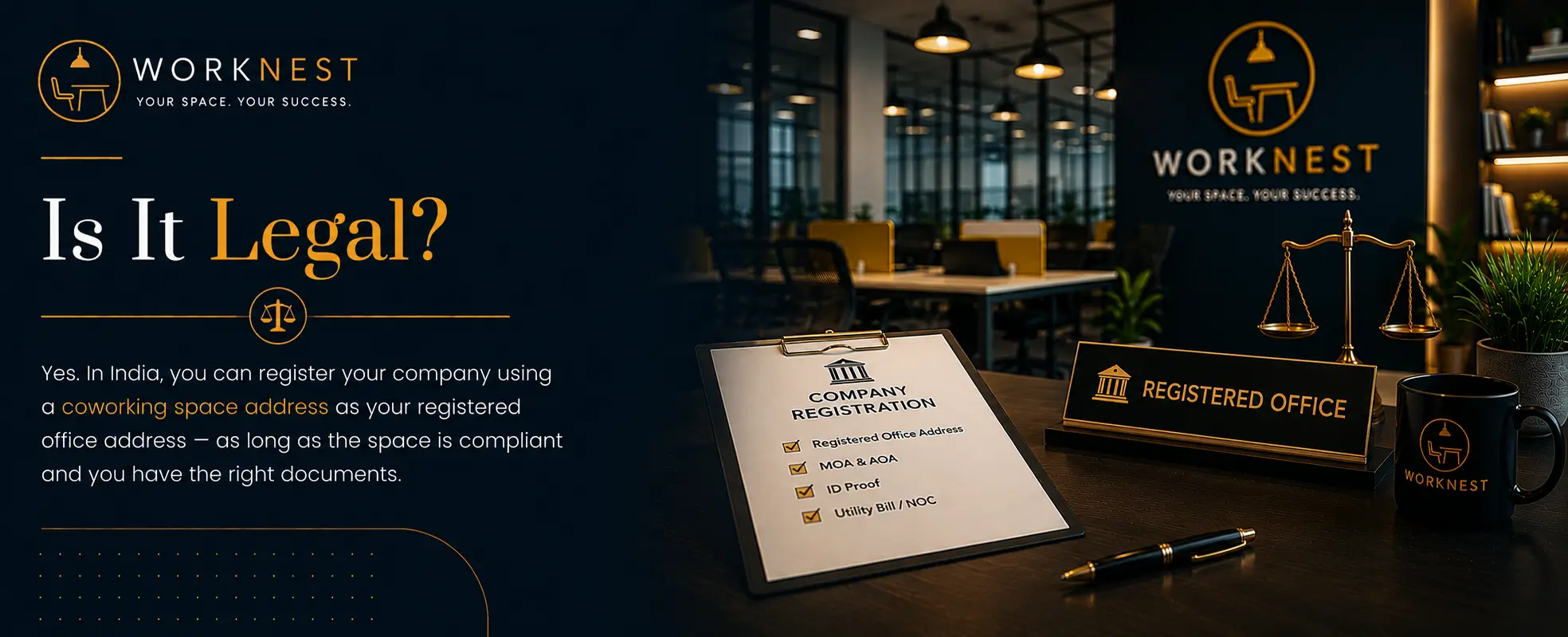
    Registering a company at a coworking space address is fully legal under the Companies Act, 2013, and MCA/ROC rules. The MCA does not require a registered office to be owned by the company or its directors – it only requires that the company has the right to use the address and can produce proof of that right during verification.

    This applies whether you’re incorporating a:

    • Private Limited Company – needs a registered office within 30 days of incorporation (or at the time of filing SPICe+)
    • LLP (Limited Liability Partnership) – needs a registered office address at the time of LLP incorporation
    • One Person Company (OPC) or Sole Proprietorship – needs a business address for GST and other registrations, though the rules are slightly less rigid than for a company or LLP

    The Registrar of Companies (ROC) verifies the address using the documents listed below. As long as the paperwork is in order, a coworking address carries the same legal standing as a rented office or a residential address used as a registered office.

    Specifically, Section 12 of the Companies Act, 2013 requires every company to establish a registered office within 30 days of incorporation and to file the address with the ROC using Form INC-22, along with proof of ownership or a lease/consent agreement. Nothing in Section 12 requires the office to be owned by the company- a coworking address with a valid NOC satisfies this requirement in full.

    Important nuance most guides skip: GST registration uses a similar but not identical process to MCA registration. If you plan to register for GST at the same coworking address  which most founders do  you’ll need a specific GST-compliant No Objection Certificate (NOC) and, in many cases, a copy of the property’s electricity bill or utility document. WorkNest issues both the MCA-compliant NOC and the GST-specific documentation as part of every virtual office package, so you don’t have to request two separate sets of paperwork from two different teams.

    Company Registration at a Coworking Space Address in Jaipur

    Jaipur founders face one added layer: local GST jurisdiction and ROC filings route through the Rajasthan Registrar of Companies, so your NOC and rent/consent documents need to match the exact address format used in your Aadhaar, PAN, and bank KYC filings. Mismatched address formatting a common but avoidable delay  is the single biggest cause of ROC query resubmissions we see with first-time founders.

    What You’ll Need

    What You'll Need

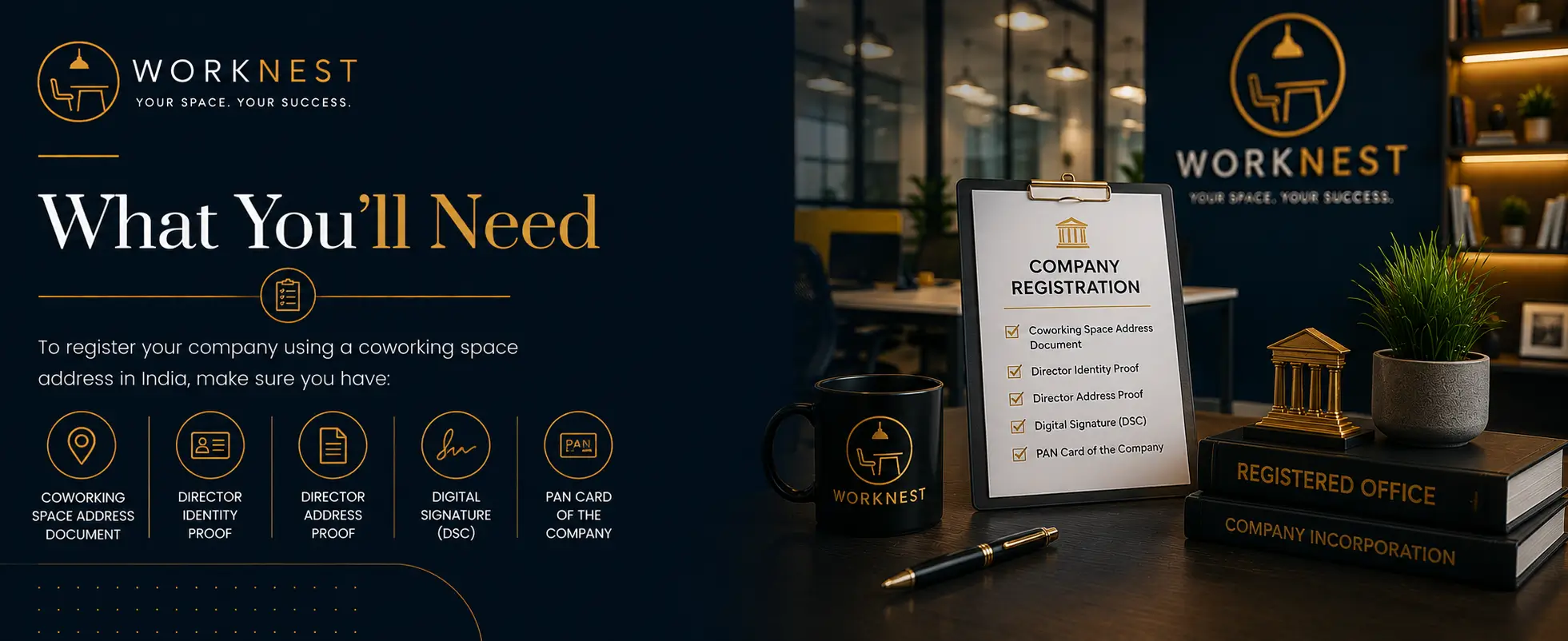
    To register your company, LLP, or GST at a coworking space address, the MCA and GST department typically ask for these five documents:

    1. No Objection Certificate (NOC) from the coworking space operator, confirming you’re allowed to use the address as your registered office
    2. Proof of address for the coworking space – a recent electricity bill, property tax receipt, or lease/rent agreement between the operator and the property owner
    3. Rent agreement or virtual office agreement between you (the company/LLP) and the coworking operator, specifying the address and the nature of use
    4. Identity and address proof of all directors/partners (PAN, Aadhaar, passport, or voter ID)
    5. Passport-size photographs of directors/partners, as required by the SPICe+ or FiLLiP incorporation forms

    At WorkNest, this full document set is prepared and handed over within 30 minutes of your inquiry – a response time we maintain across all 500+ businesses we’ve onboarded to date. Documents are provided in MCA-compliant format, so there’s no back-and-forth with the ROC over formatting errors.

    “I registered my consultancy as a Private Limited Company using WorkNest’s address. The NOC and documents were ready the same day, and my ROC filing went through without a single query.” – Rohan Mehta, Consultant

    Coworking Address vs Registered Office

    Coworking Address vs Registered Office

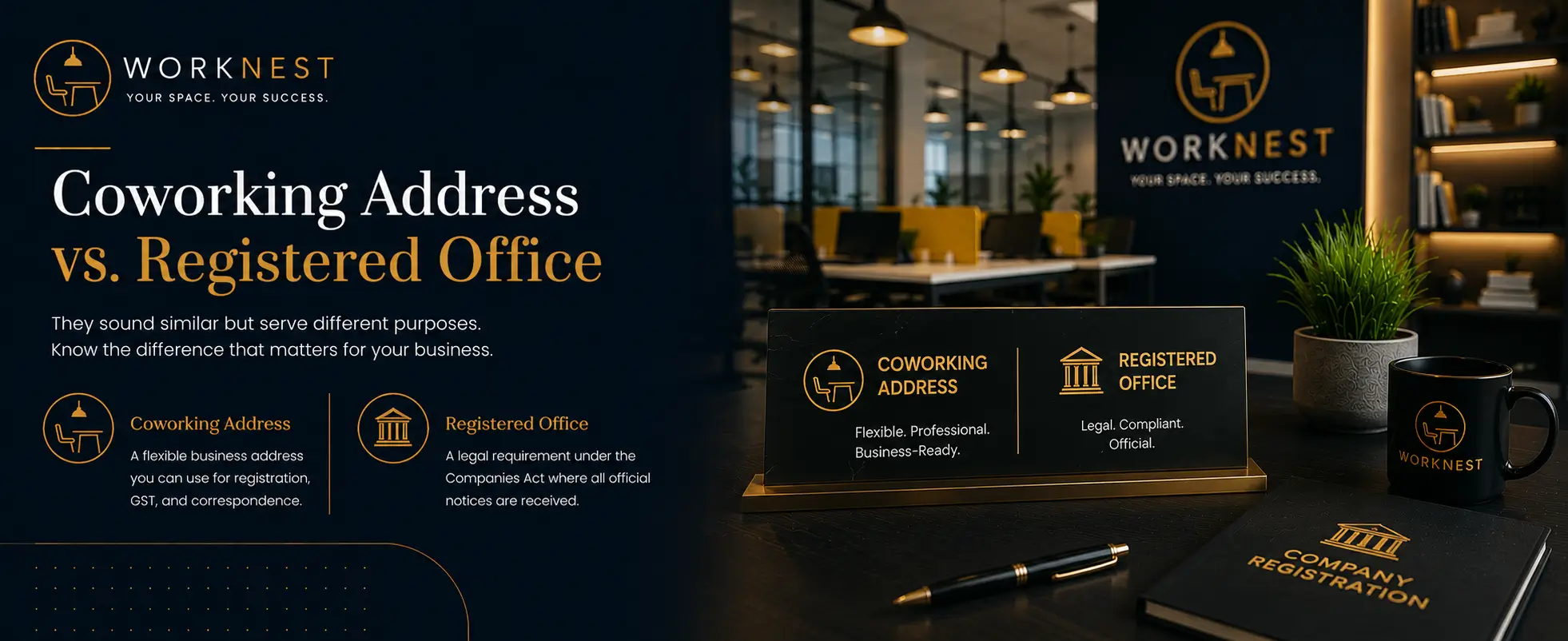
    Founders often assume a “registered office” has to be a traditional, standalone commercial lease. In practice, a coworking or virtual office address is a registered office,  it just comes with a different cost and service structure. Here’s how the two compare directly:

    Factor Coworking / Virtual Office (WorkNest) Traditional Registered Office (Commercial Lease)
    Monthly cost From ₹9,999/month (Dedicated Desk) or ₹24,999/month (Private Cabin) ₹30,000–₹51,000/month for a 400–1,000 sq ft furnished office in Mansarovar (mid-2026 listings)
    Lease commitment Monthly, no long-term lock-in Usually 11-month or 3-year lock-in, often with 10% annual escalation
    MCA/ROC compliance Fully compliant; NOC + proof of address provided by operator Compliant, but documentation is the founder’s responsibility
    GST registration support NOC + utility proof provided together, matched to GST format Founder must source utility bill and NOC separately
    Physical workspace access Yes — hot desk, dedicated desk, or private cabin included Yes, but requires separate fit-out and furnishing
    Time to get documents Same day, 30-minute average response time Typically several days to a few weeks, depending on the landlord
    Ideal for Startups, freelancers, consultants, small teams testing a market Established companies needing large dedicated floor space

    If your priority is speed, compliance, and low upfront cost, a coworking address closes the gap. If you need 50+ desks of dedicated floor space long-term, a traditional commercial lease may still make sense – but even then, many founders start with a coworking registered office and transition later.

    A Note on Pricing

    WorkNest’s current plans, as of 2026, are:

    • Hot Desk — ₹699/day
    • Dedicated Desk — ₹9,999/month
    • Private Cabin — ₹24,999/month
    • Meeting Room — ₹799/hour

    Any plan that includes a Dedicated Desk or Private Cabin comes with a registered-office-ready address package, meaning you get both workspace access and MCA/GST-compliant documentation under one monthly fee -not two separate costs.

    Why Founders Choose WorkNest for Registration

    Why Founders Choose WorkNest for Registration

    Beyond the paperwork, founders choosing a coworking address for registration are also choosing a workspace they’ll actually use. WorkNest currently supports 500+ businesses, holds a 4.8 Google rating, and has a 91% renewal rate among members- a strong signal that the address, the workspace, and the service hold up well past the first registration filing.

    If you’re incorporating in Mansarovar or anywhere in Jaipur and want your registered office, GST address, and physical workspace handled in one place, WorkNest’s team at E-3, 6D Engineers Colony, Mansarovar, Jaipur 302020 can prepare your documents same-day.

    Ready to register your company at a compliant coworking address? Get Pricing and get your MCA/GST-ready documentation started today.

    FAQs

    Q1: Can I register my company at a coworking space address in India?

    Yes. The MCA allows a coworking space to serve as a company’s registered office, provided you have a valid NOC and proof of address from the operator.

    Q2: Is a coworking address valid for GST registration too?

    Yes. GST registration accepts a coworking address, but it requires a GST-specific NOC along with a utility bill or property tax document  not just the MCA-compliant paperwork.

    Q3: What documents does the coworking operator need to give me?

    A No Objection Certificate (NOC), proof of address (electricity bill or property tax receipt), and a signed rent or virtual office agreement between you and the operator.

    Q4: Can an LLP be registered at a coworking space address?

    Yes. LLPs follow the same registered office rules as private limited companies  a coworking address with proper NOC and proof of address is accepted by the ROC.

    Q5: How long does it take to get the documents from WorkNest?

    WorkNest provides MCA and GST-compliant documentation within an average response time of 30 minutes of your inquiry.

    Q6: Does a coworking registered office cost more than a normal office?

    No, it’s typically far cheaper. WorkNest’s Dedicated Desk plan, which includes registration-ready documentation, starts at ₹9,999/month, well below the ₹30,000–₹51,000/month that a small standalone furnished office in Mansarovar commands as of mid-2026.

    Q7: Can I change my registered office address later if I move out of the coworking space?

    Yes. You can file for a change of registered office address with the ROC (Form INC-22 for companies) if you relocate. This is a standard, well-documented MCA process.

    Q8: Is a coworking address considered a “registered agent” like in the US?

    No, India doesn’t use the US concept of a registered agent. The Indian equivalent is simply a registered office address supported by an NOC and proof of address; there’s no separate agent designation required.

    Q9: Do I need a physical desk to use a coworking address for registration?

    Not necessarily for registration alone, but WorkNest bundles workspace access (hot desk, dedicated desk, or cabin) with every registered-office package, so you get a usable workspace, not just a mailing address.

    Q10: What is WorkNest’s exact address for registration purposes?

    E-3, 6D Engineers Colony, Mansarovar, Jaipur 302020.

  • Coworking Space vs Traditional Office: A Jaipur Cost Comparison

    Coworking Space vs Traditional Office: A Jaipur Cost Comparison

    A coworking space vs traditional office in Jaipur usually comes down to one number: a 5-person WorkNest dedicated desk setup costs roughly ₹4,07,060 less in year one than renting and Set up a professional office in Mansarovar without a large upfront investment. This guide breaks down exactly where that gap comes from, row by row, so you can run the math for your own team size.

    Most comparison articles either skip India entirely or list pros and cons without a single rupee figure. This one doesn’t. Every WorkNest number below is our real, current pricing as of 2026. Every traditional-office figure is clearly labeled as an estimate you should verify with a local broker before signing a lease.

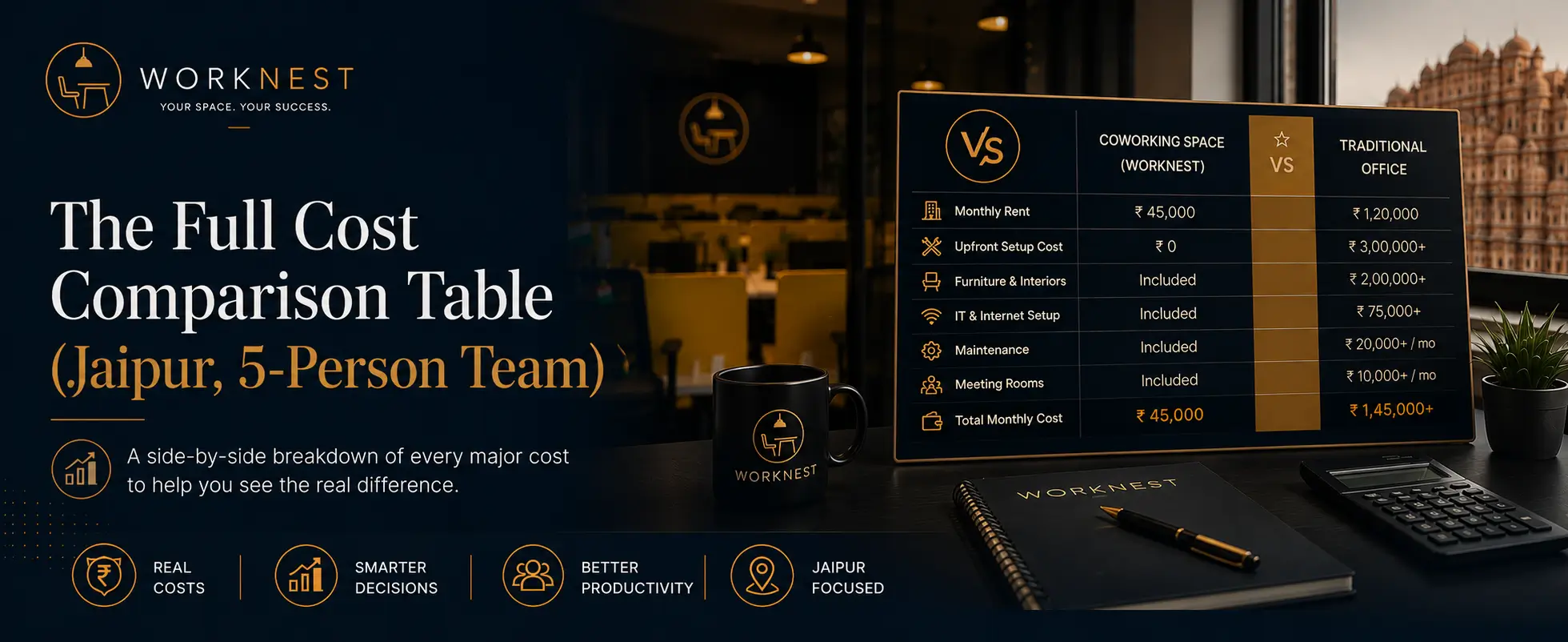
    The Full Cost Comparison Table (Jaipur, 5-Person Team)

    The Full Cost Comparison Table

    This is the calculation most coworking vs traditional office articles never show you: a real, itemized side-by-side, not a vague “coworking is cheaper” claim.

    Cost Component Traditional Office – 500 sq ft, Mansarovar (Estimated – verify before publishing) WorkNest Coworking (Actual Pricing)
    Security deposit (6 months’ rent) ₹1,05,000 one-time ₹0
    Interior fit-out (₹850/sq ft, standard-range average) ₹4,25,000 one-time ₹0
    Furniture (5 desks + chairs) ₹75,000 one-time Included in membership
    Monthly rent (₹35/sq ft) ₹17,500/month Included
    Electricity & AC ₹8,000/month (Estimated) Included
    Housekeeping & maintenance ₹5,000/month (Estimated) Included
    Internet & IT setup ₹3,000/month (Estimated) Included
    5 Dedicated Desks (₹9,999 x 5) ₹49,995/month
    Total one-time setup cost ₹6,05,000 ₹0
    Total monthly recurring cost ₹33,500 ₹49,995
    Year 1 total cost ₹10,07,000 ₹5,99,940
    Year 1 savings with WorkNest ₹4,07,060 (40% lower)

    The traditional-office column uses a common Mansarovar commercial-rent estimate of ₹35 per sq ft per month and a 100 sq ft-per-desk planning norm. Fit-out cost uses ₹850/sq ft, the midpoint of the standard ₹700–₹1,000/sq ft range typical for a functional coworking-style office interior in India as of 2026-premium interiors can run ₹1,500–₹3,000+/sq ft. Confirm current local rates with a broker before budgeting- commercial rent and fit-out costs vary by building, finish level, and micro-location within Jaipur.

    The WorkNest column reflects our published rates: Hot Desk ₹699/day, Dedicated Desk ₹9,999/month, Private Cabin ₹24,999/month, and Meeting Room ₹799/hour. There is no security deposit, no fit-out cost, and no furniture bill hidden in the total.

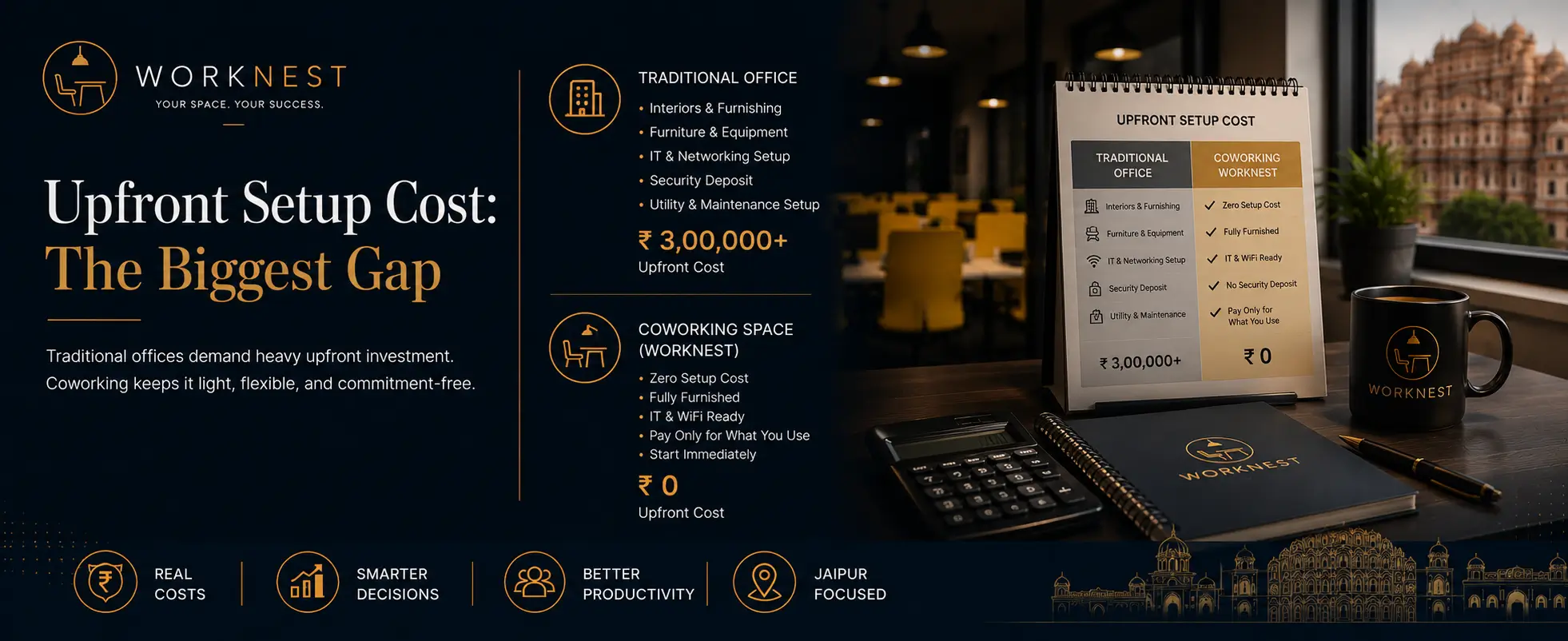
    Upfront Setup Cost: The Biggest Gap

    Upfront Setup Cost The Biggest Gap

    Upfront cost is where coworking wins most decisively. The setup cost office Jaipur founders typically face includes a security deposit, an interior fit-out, and furniture before day one -an estimated ₹6,05,000 for a 5-person traditional office in Mansarovar, paid before any revenue comes in.

    WorkNest requires none of that. Simply sign up and start working the same day. For founders and small teams, that upfront capital can instead go toward hiring, marketing, or product development -the things that actually grow the business.

    Monthly Recurring Cost: Where It Gets Interesting

    On a pure monthly basis, a traditional office (₹33,500/month, estimated) can look cheaper than 5 WorkNest Dedicated Desks (₹49,995/month). This is the number competitor articles usually stop at – and it’s misleading on its own.

    The traditional-office monthly figure excludes admin staff and equipment repairs. It also leaves out internet downtime and the time cost of managing vendors yourself. WorkNest’s monthly price includes high-speed internet, housekeeping, utilities, and reception -all bundled, with no separate invoices to chase.

    Once you add back the amortized setup cost (₹6,05,000 spread over 12 months adds roughly ₹50,417/month), the traditional office’s true monthly cost climbs close to ₹83,917, well above WorkNest’s ₹49,995.

    Lease Commitment & Flexibility

    A traditional office lease in Jaipur commonly locks you in for 3–5 years with a lock-in period, making early exit expensive if your team shrinks or your business model changes.

    WorkNest’s Hot Desk is priced daily at ₹699, and the Dedicated Desk is a monthly commitment at ₹9,999 – no multi-year lock-in. Growing from 3 people to 10, or scaling back after a slow quarter, doesn’t require breaking a lease or forfeiting a deposit.

    Amenities & Maintenance

    With a traditional office, you’re responsible for everythingfrom buying furniture to managing housekeeping, Wi-Fi, and maintenance.

    At WorkNest, amenities are already built into every plan- internet, power backup, housekeeping, and common-area upkeep are included in the price shown on the table above. There’s no separate maintenance budget line to plan for.

    Scalability: Adding or Reducing Seats

    Scaling a traditional office means renegotiating your lease, paying for more fit-out, or subletting unused space- all slow, all expensive.

    At WorkNest, scaling is a conversation, not a renegotiation. Add a Hot Desk for a contractor at ₹699/day, book a Meeting Room at ₹799/hour for client pitches, or upgrade from a Dedicated Desk to a Private Cabin at ₹24,999/month as your core team grows. With 91% of members renewing, most teams scale within WorkNest rather than leaving it.

    Networking & Community

    Networking & Community

    A private, traditional office is isolated by design  your team interacts with your team, and nobody else.

    WorkNest is home to 500+ businesses across Jaipur, giving you daily opportunities to network, collaborate, and grow your business. The right coworking community can turn everyday conversations into referrals, partnerships, and new clients.

    Employee Experience & Productivity

    Traditional offices put the burden of “making the space nice” entirely on the employer – décor, ergonomics, and break areas all need active investment.

    WorkNest is designed and maintained as a premium, ready-to-work environment from day one, which is part of why the space holds a 4.8 Google rating and a 91% member renewal rate. Members consistently point to the professional atmosphere as a factor in daily productivity, rather than a distraction they have to manage themselves.

    When Does a Traditional Office Make More Sense?

    When Does a Traditional Office Make More Sense

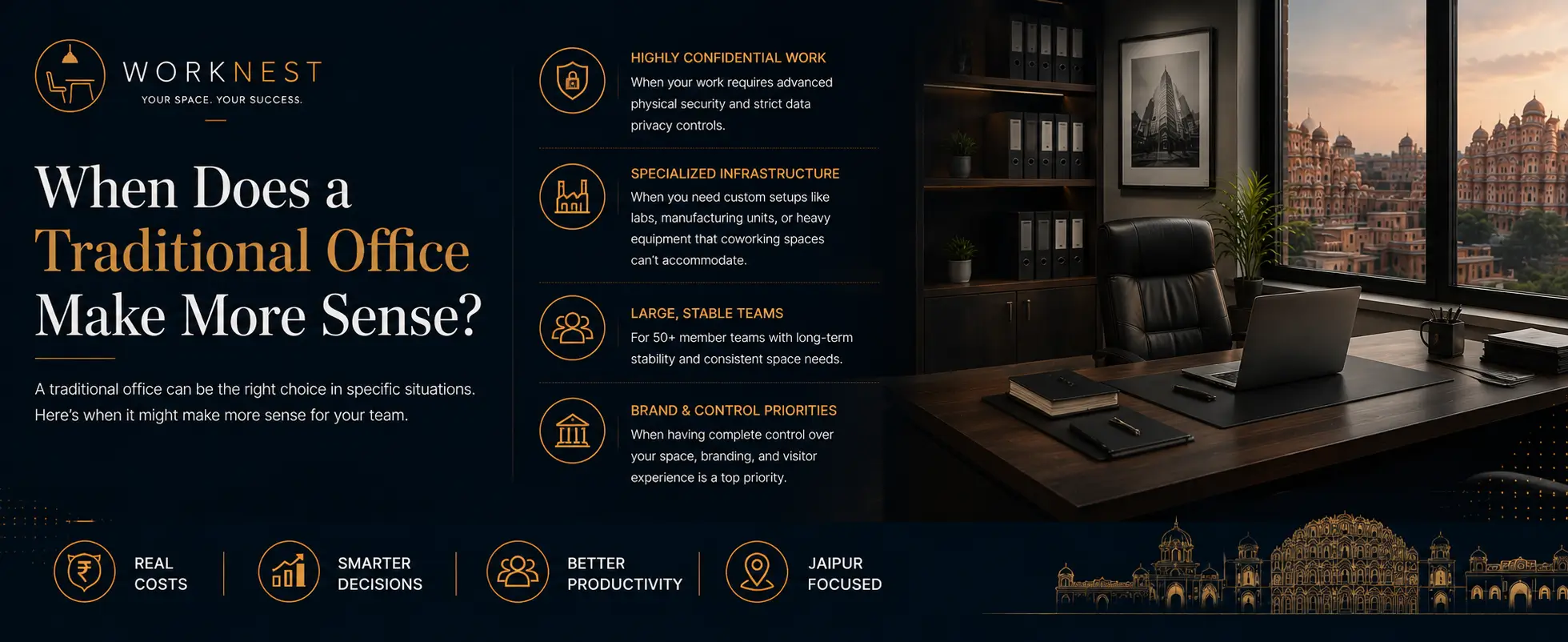
    Coworking isn’t the right answer for every business, and pretending otherwise would undercut the honesty of this comparison. A traditional office is usually the better call when:

    • Your team is consistently above 25–30 people. At that scale, dedicated per-seat coworking pricing can exceed the amortized monthly cost of a leased floor, even after fit-out.
    • You need heavily customized infrastructure. Manufacturing-adjacent operations, specialized labs, or compliance-driven data rooms often require build-outs coworking spaces aren’t designed to offer.
    • Brand control over the entire floor matters more than flexibility. Some enterprises want a fully branded, standalone environment for client perception reasons, independent of cost.
    • You have 3+ years of confirmed headcount stability. If growth or contraction risk is low, a long lease’s downside (inflexibility) matters less, and its per-seat cost can fall below coworking at very large scale.

    If none of these apply to your business today, the math above holds: coworking is very likely the lower-cost, lower-risk option in Jaipur right now.

    How to Decide for Your Team

    How to Decide for Your Team

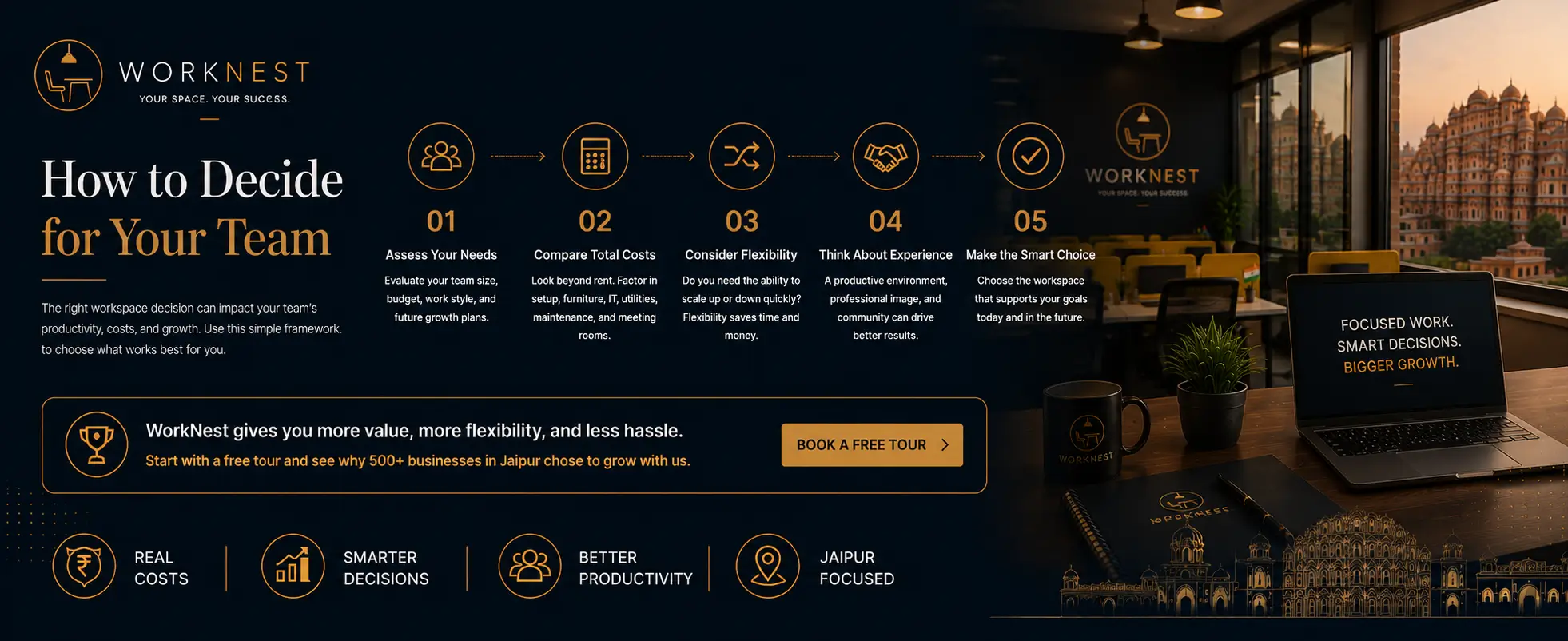
    Run the numbers for your own headcount using these three steps:

    1. Price your WorkNest option. Multiply your team size by ₹9,999 for Dedicated Desks or ₹24,999 for Private Cabins to get your monthly coworking cost.
    2. Get a local broker’s quote. Ask for rent, security deposit, and fit-out cost for a traditional office matching your headcount in Mansarovar.
    3. Amortize and compare. Spread the broker’s one-time costs over 12 months, add that to monthly rent, and compare the total against your WorkNest number from step 1.

    In almost every case for teams under 20 people, coworking space in Jaipur comes out ahead on both cost and flexibility.

    Conclusion: Coworking Space vs Traditional Office in Jaipur

    For most small and mid-sized teams, coworking space vs traditional office in Jaipur isn’t a close contest once real numbers are on the table: WorkNest saves an estimated ₹4,07,060 in year one for a 5-person team, with zero lock-in and everything included. Traditional offices still make sense at scale or for highly specialized needs but for founders, freelancers, and growing teams, the lower upfront cost, included amenities, and flexible terms make coworking the more capital-efficient choice as of 2026.
    Ready to see the numbers for your own team size? Book a Free Office Tour (/book-a-tour) at WorkNest, E-3, 6D Engineers Colony, Mansarovar, Jaipur 302020  30-min response time guaranteed.
    FAQs

    Q: How much does a coworking space cost in Jaipur compared to a traditional office?

    A: At WorkNest, a Dedicated Desk costs ₹9,999/month with no deposit or fit-out cost. A comparable traditional office seat in Mansarovar typically adds an estimated ₹1,21,000 per person in one-time setup costs, on top of monthly rent-verify current rates with a local broker before budgeting.

    Q: Is coworking cheaper than renting an office in Jaipur?

    A: For teams under roughly 20–25 people, yes- WorkNest’s bundled pricing (desk, internet, housekeeping, utilities) usually undercuts a traditional office’s true monthly cost once setup costs are amortized, based on the year-one comparison above.

    Q: What is the setup cost for a traditional office in Jaipur?

    A: For a 500 sq ft, 5-person office in Mansarovar, setup costs are estimated at ₹6,05,000 – covering a 6-month security deposit, an interior fit-out at ₹850/sq ft, and furniture. These figures are estimates; confirm exact costs with a local broker before signing a lease.

    Q: Can I switch from a Hot Desk to a Private Cabin later at WorkNest?

    A: Yes. WorkNest members can move between Hot Desk (₹699/day), Dedicated Desk (₹9,999/month), and Private Cabin (₹24,999/month) as their team grows, without breaking a lease or losing a deposit.

    Q: Does WorkNest require a long-term lease or lock-in?

    A: No. WorkNest offers daily, monthly, and hourly plans (including Meeting Rooms at ₹799/hour) with no multi-year lock-in, unlike most traditional office leases in Jaipur.

    Q: Is a traditional office ever better than coworking?

    A: Yes. for teams consistently above 25–30 people, businesses needing heavily customized infrastructure, or companies wanting full-floor brand control, a traditional office can be more cost-effective at scale despite the higher upfront investment.

    Q: What’s included in WorkNest’s coworking price?

    A: Every WorkNest plan includes high-speed internet, housekeeping, utilities, and common-area access  costs that are billed separately in a traditional office setup.

    Q: How many businesses currently use WorkNest in Jaipur?

    A: WorkNest serves 500+ businesses as of 2026, with a 4.8 Google rating and a 91% renewal rate among members.

  • GST Registration Documents Checklist for a Virtual Office in Jaipur

    GST Registration Documents Checklist for a Virtual Office in Jaipur

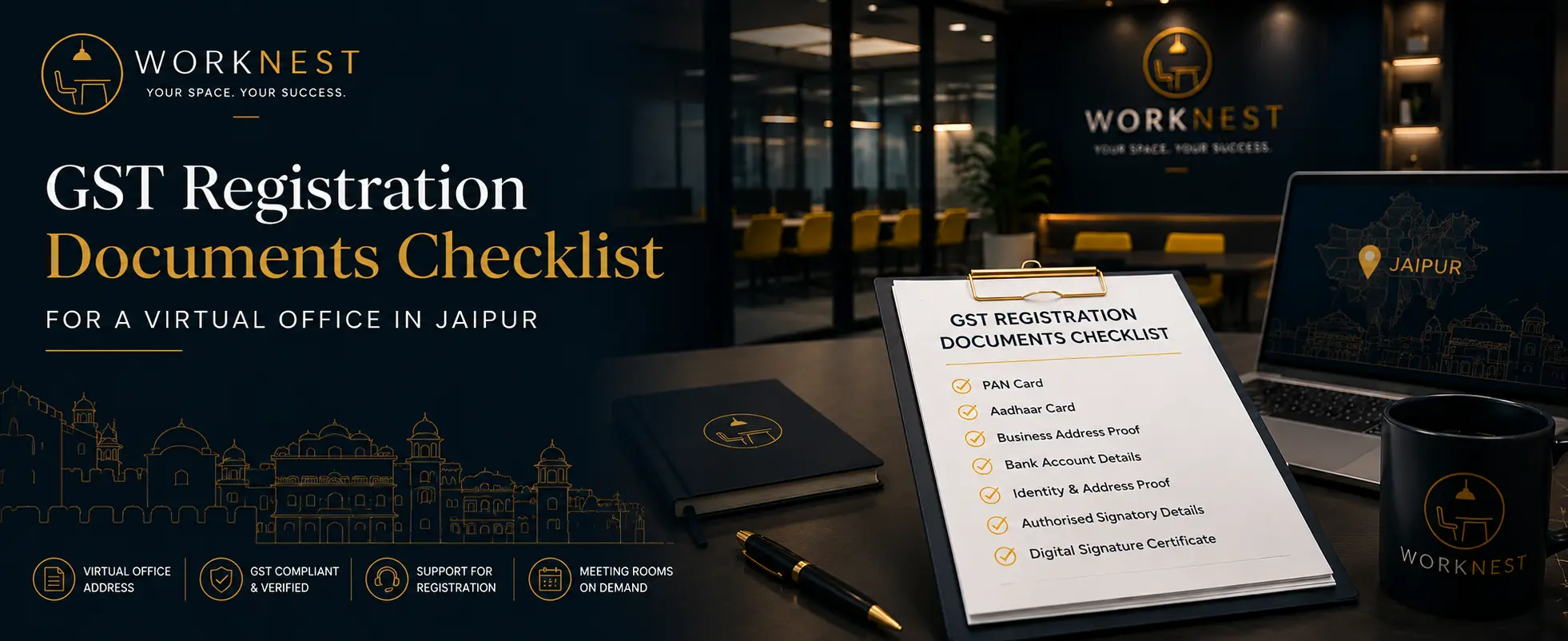
    Yes, a virtual office is legally valid for GST registration in India, as long as you submit a genuine NOC, a rent or service agreement, and a recent utility bill for the address. This one requirement trips up more Jaipur founders than any other step in the process. Get the paperwork for your virtual office for GST registration documents required right, and the rest of the application moves fast.

     Disclaimer: This article is for informational purposes only and should not be considered legal or tax advice. Please consult a chartered accountant or GST practitioner before filing.

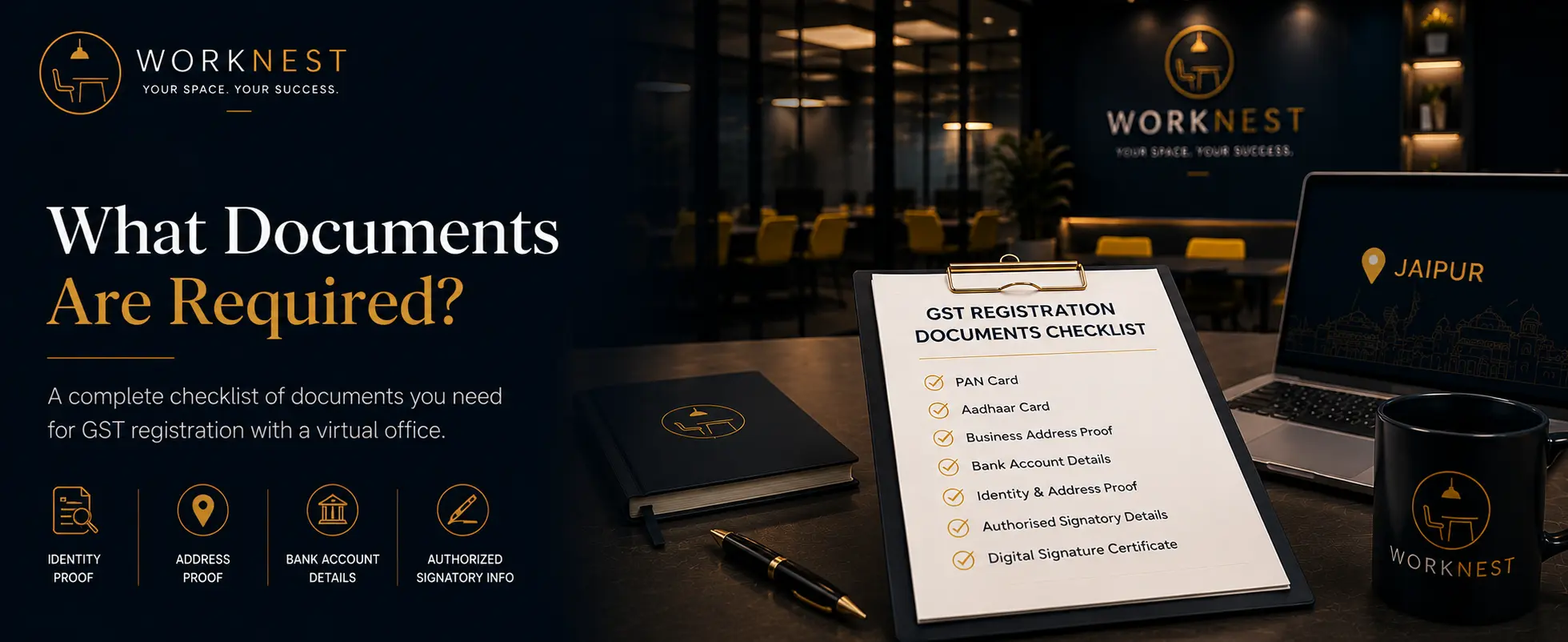
    What Documents Are Required?

    What Documents Are Required

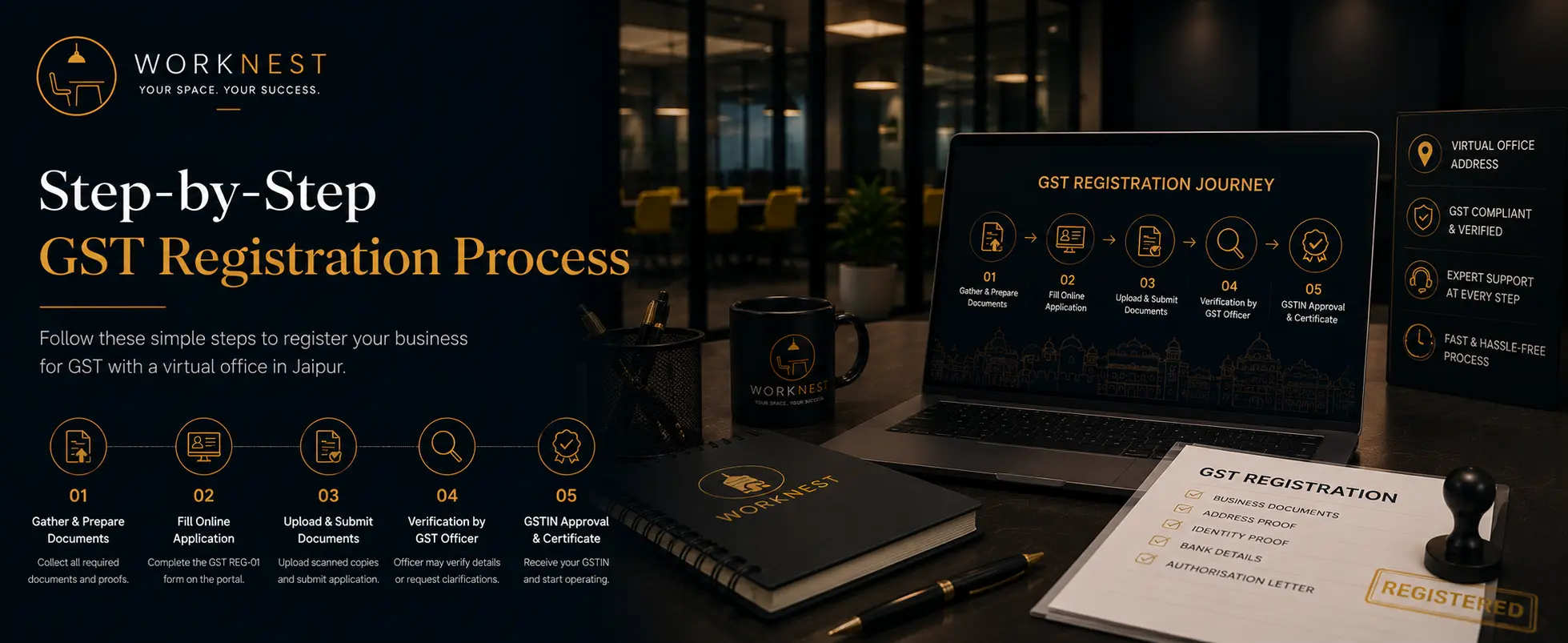
    GST officers in Rajasthan check the same core set of documents whether your business is a proprietorship, partnership, or private limited company. Here is the exact checklist, in the order most applicants submit it.

    1. No Objection Certificate (NOC) – issued by the virtual office provider or property owner, on letterhead, confirming you can use the address for GST registration.
    2. Rent agreement or virtual office service agreement -must name your business, the address, and the service period. This is your rent agreement virtual office proof.
    3. Latest utility bill – electricity or water bill for the premises, dated within the last two months.
    4. Property tax receipt or municipal khata copy – many virtual office Jaipur GST registration providers keep this on file and share it on request.
    5. PAN card – of the proprietor, or the business entity for companies and LLPs.
    6. Aadhaar card – of the authorized signatory.
    7. Certificate of Incorporation – for private limited companies and LLPs only.
    8. Board resolution or authorization letter – naming the authorized signatory for company applicants.
    9. Cancelled cheque or bank statement – first page showing account number, IFSC, and business name.
    10. Photograph of the premises with signage -increasingly requested by Jaipur GST officers before approval.

    The table below breaks down format and validity rules for each document, so nothing gets rejected at the verification stage.

    Document Format Required Validity Window
    NOC Signed original, provider letterhead No expiry, but must match current agreement dates
    Rent/service agreement Signed PDF or physical copy Matches the active billing cycle
    Utility bill Scanned copy, address visible Within last 2 months
    PAN & Aadhaar Self-attested copy Always current
    Bank proof Cancelled cheque or e-statement Within last 3 months

    Neither Tax2win’s nor JustStart’s guides give you this document-by-document validity breakdown, and neither flags the photograph-with-signage requirement that Jaipur zone officers now ask for as of 2026.

    Can You Use a Virtual Office for GST Registration?

    A virtual office is valid because GST law does not require the principal place of business to be owned by the applicant. It only requires proof of a legitimate right to use the address – which a virtual office agreement and NOC provide.

    The legal term for this setup is VPOB (Virtual Place of Business). A VPOB GST registration lets a business register at an address it does not physically occupy full-time, provided the documentation trail is complete and the space is genuinely accessible for verification.

    GST officers rely on guidance under Circular No. 71/45/2018-GST (Estimated – verify with a qualified tax professional before publishing) when conducting physical verification of registered premises. This circular covers how officers confirm that an address is real and functional, which applies directly to virtual office registrations.

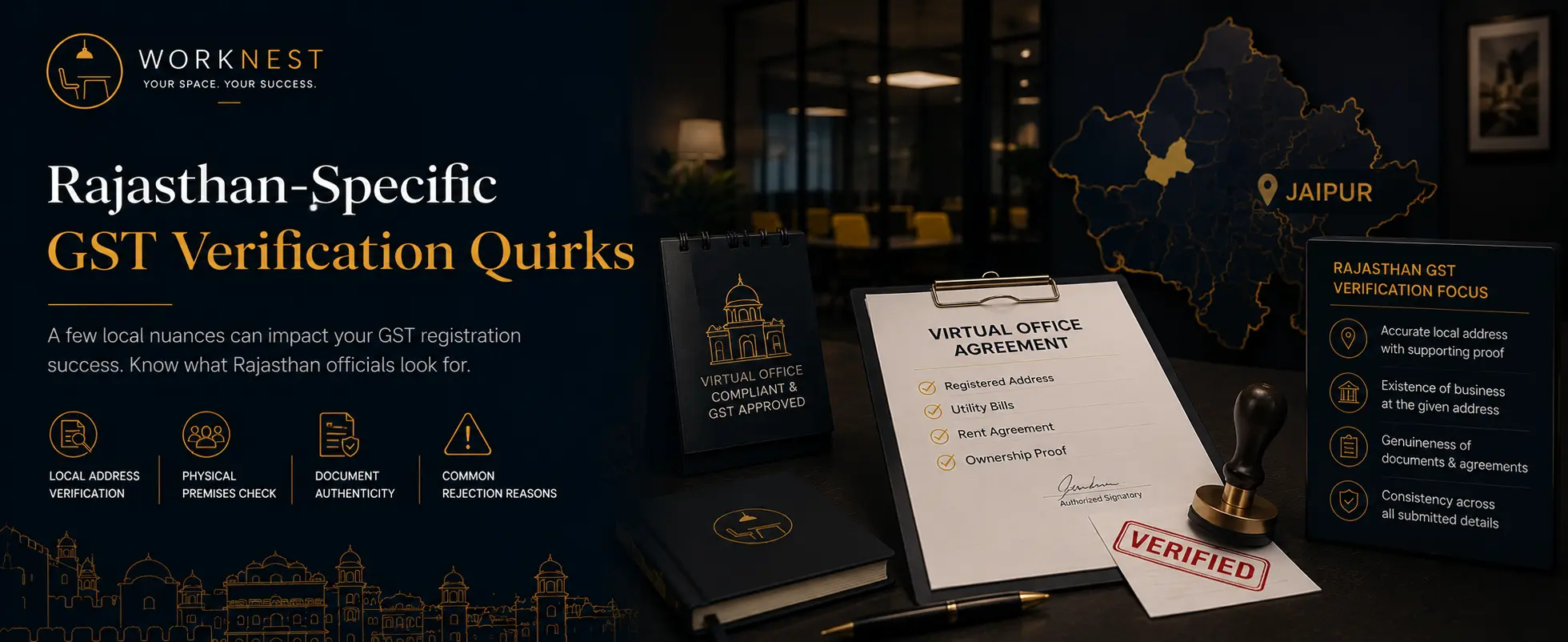
    Rajasthan-Specific GST Verification Quirks

    Rajasthan-Specific GST Verification Quirks

    • Jaipur zone officers often schedule a physical site visit before approving the address. There is no official Rajasthan GST notification fixing a set timeline – based on WorkNest’s client experience in 2026, visits typically happen within the first two to three weeks of application.
    • Some Rajasthan GST offices ask for the photograph-with-signage document upfront rather than only on request, unlike some other states.
    • A provider’s document turnaround matters here. WorkNest issues the NOC, rent agreement, and utility bill on the same business day – typically within 4 to 8 business hours after document verification and payment.

    WorkNest, located at E-3, 6D Engineers Colony, Mansarovar, Jaipur 302020, has helped over 500 businesses with GST registration documentation. As of 2026, it maintains a 4.8-star Google rating and a 91% client renewal rate.

    WorkNest helps businesses set up a compliant virtual office with complete documentation support, so the GST registration process stays smooth and hassle-free.

    We used WorkNest’s virtual office for our GST registration. The NOC and utility bill were shared within a few hours, making the process quick and hassle-free . The site verification went through without a single follow-up question.” — Rohan Mehta, Consultant

    Step-by-Step Registration Process

    Step-by-Step Registration Process

    Follow these simple steps to register for GST using a virtual office address in Jaipur.

    1. Choose a verified virtual office provider. Confirm they issue NOC, rent agreement, and utility bill documentation specifically for GST use.
    2. Collect your documents. Gather the checklist above before you start the online application -incomplete uploads are the most common cause of delay.
    3. Create your GST portal account. Create a Temporary Reference Number (TRN) on the GST portal. This starts Part A of Form REG-01.
    4. Complete Part B of REG-01. Enter business details and upload your address proof, identity documents, and bank proof.
    5. Submit and track your ARN. You get an Application Reference Number (ARN) after submission. Use it to track status.
    6. Respond to verification promptly. If a site visit is scheduled, your virtual office provider should be available to confirm signage and access.
    7. Receive your GSTIN. Approval typically follows within 7 working days of clean verification. A Rajasthan site visit can add extra time.

    Businesses that pair this checklist with a responsive virtual office provider tend to clear verification faster, since most rejections trace back to missing or mismatched documents rather than the address itself.

    If you are setting up a business presence in Jaipur and need a virtual office for GST registration, WorkNest provides the full documentation set  NOC, rent agreement, and utility bill – ready for your application.

    Get Pricing for WorkNest’s virtual office plans and start your GST registration with the right paperwork from day one.

     FAQs

    Q1: Is a virtual office valid for GST registration in India?

    Yes. GST law accepts any address where you can prove a legitimate right to use it  a virtual office agreement, NOC, and utility bill satisfy this requirement.

    Q2: What is VPOB in GST registration?

    VPOB stands for Virtual Place of Business. It refers to registering GST at an address the applicant does not physically occupy full-time, supported by a rent agreement and NOC.

    Q3: What documents does a virtual office provider need to give me for GST registration?

    At minimum, an NOC, a signed rent or service agreement, and a recent utility bill for the address. Some providers also supply a property tax receipt and a photograph of the premises with signage.

    Q4: Does GST send an officer to physically verify a virtual office in Jaipur?

    Often, yes. There is no fixed official timeline, but based on WorkNest’s 2026 client experience, site visits typically happen within two to three weeks of application , so choose a provider that can support that visit on short notice.

    Q5: Can I use a residential address instead of a virtual office for GST registration?

    Yes, a residential address can work if you own it or have the owner’s NOC. A commercial virtual office is often preferred because it signals a dedicated business presence to verifying officers.

    Q6: How long does GST registration take with a virtual office address?

    Typically about 7 working days after successful verification, though Rajasthan-specific site visits can extend this by a few days.

    Q7: Do private limited companies need different documents than proprietorships for GST registration?

    Yes. Companies additionally need a Certificate of Incorporation and a board resolution authorizing the signatory, on top of the standard address and identity proof.

    Q8: Is the rent agreement enough on its own for GST registration with a virtual office?

    No. GST officers generally require the rent agreement alongside an NOC and a recent utility bill ,the rent agreement alone is rarely accepted.

  • How Much Does a Coworking Space Cost in Jaipur in 2026?

    How Much Does a Coworking Space Cost in Jaipur in 2026?

    A coworking space in Jaipur costs between ₹699 per day for a hot desk and ₹24,999 per month for a private cabin, with dedicated desks averaging ₹9,999 per month at transparent operators like WorkNest. That’s a wide range, and it’s exactly why most people searching for how much does coworking space cost in Jaipur end up more confused than when they started. Aggregator sites quote monthly ranges of ₹3,999 to ₹15,000, but rarely explain what you actually get for that money. This guide breaks down real, current 2026 pricing so you can budget accurately, avoid hidden fees, and pick the right workspace for your team.

    We’ll cover coworking space price Jaipur by workspace type, whether GST applies, and the hidden costs aggregator listings skip entirely. As of 2026, WorkNest publishes exact numbers instead of “starting from” language, because specific pricing is what actually helps you plan – not a range that could mean anything.

    Average Coworking Costs in Jaipur

    Average Coworking Costs in Jaipur

    Coworking rates in Jaipur vary based on location, amenities, and lease flexibility. Listing platforms like myHQ and Qdesq show citywide monthly ranges of roughly ₹3,999 to ₹15,000 for shared seating, depending on the operator and area. However, these ranges rarely specify what’s bundled in – Wi-Fi speed, meeting room hours, or printing access often cost extra elsewhere.

    This is where coworking space cost per month becomes tricky to compare. A ₹4,000/month listing at one operator might exclude air conditioning hours or meeting room access, while a ₹9,999/month plan at another includes everything. Because of this, comparing sticker prices alone can be misleading. The smarter approach is comparing total monthly cost, including everything you’d otherwise pay for separately in a traditional office.

    For anyone searching cheapest coworking space Jaipur, a hot desk plan is typically the lowest entry point. It suits freelancers, remote workers, and anyone who doesn’t need a fixed seat every day. Meanwhile, growing teams usually move to dedicated desks or private cabins once they need consistent, reserved space.

    WorkNest Pricing Breakdown

    WorkNest Pricing Breakdown

    WorkNest publishes exact 2026 rates for all four workspace types, so you can plan your budget before you visit. Below is the complete pricing table.

    Workspace Type Price Billing Cycle Best For
    Hot Desk ₹699 Per day Freelancers, remote workers, occasional users
    Dedicated Desk ₹9,999 Per month Solo professionals and small teams needing a fixed seat
    Private Cabin ₹24,999 Per month Founders and teams needing privacy and lockable storage
    Meeting Room ₹799 Per hour Client meetings, interviews, team workshops

    A dedicated desk price Jaipur search typically surfaces vague “starting from ₹6,000” listings elsewhere. WorkNest’s ₹9,999/month rate is the actual, current price – not a promotional floor that changes once you inquire. The same transparency applies to the private cabin and meeting room rates above.

    Aditi Rao, a startup founder who works from WorkNest, says the upfront pricing made her decision easier than comparing vague aggregator ranges. Karan Malhotra, a sales lead, notes that knowing the exact meeting room rate in advance helped him budget client visits without surprises.

    WorkNest has served 500+ businesses in Jaipur, holds a 4.8 Google rating, and sees a 91% renewal rate – figures that reflect pricing people trust enough to stay with, month after month.

    Is GST Applicable?

    Is GST Applicable

    Yes. WorkNest charges 18% GST on all coworking services, confirmed directly with WorkNest’s chartered accountant. This applies uniformly across Hot Desk, Dedicated Desk, Private Cabin, and Meeting Room bookings, so the rate on your invoice won’t vary by plan.

    If your business is GST-registered, you can usually claim input tax credit on coworking fees, since these are considered a legitimate business expense. This is one of the details aggregator listings bury inside an FAQ accordion instead of stating plainly. Before signing up, always ask your coworking operator for a GST-inclusive invoice, so your accounting matches what you actually pay.

    Is coworking cheaper than a traditional office in Jaipur?

    In most cases, yes – coworking works out cheaper than a traditional office once you count total cost of ownership, not just monthly rent. A small 2–3 person office in Mansarovar or C-Scheme typically starts at ₹10,000/month rent alone, before electricity, water, and furniture are added on top.

    Cost Component Traditional Office (2–3 seats) WorkNest Dedicated Desk
    Monthly rent ₹10,000+ (Mansarovar/C-Scheme) ₹9,999 (all-inclusive)
    Security deposit 1 month (₹10,000+, one-time) ₹0 – no deposit required
    Interior fit-out + furniture Up to ₹1,00,000 (one-time) ₹0 – already furnished
    Electricity, water, maintenance Billed separately, varies by usage Included in monthly price
    Exit notice period Per lease agreement, often 2–3 months 30 days

    A traditional office also asks for roughly ₹1,10,000 upfront, before the first month’s electricity or water bill arrives – a one-month deposit plus fit-out and furniture. WorkNest skips all three of those, since a dedicated desk needs zero deposit and zero fit-out spend. That’s why coworking is a more affordable option for freelancers, startups, and small teams, especially during the first year .

    Hidden Costs to Watch For

    Hidden Costs to Watch For

    Aggregator listings rarely mention the extra charges that show up after you’ve already signed up. Here’s exactly what to check, with WorkNest’s actual numbers for comparison.

    • Security deposits: Many operators require 2–3 months’ rent upfront. WorkNest charges zero security deposit on any plan, so nothing is locked up at signup.
    • Meeting room overage: Plans often include limited meeting room hours. At WorkNest, extra hours for dedicated desk and private cabin members cost ₹100/hour, well below the standard ₹799/hour walk-in rate.
    • Printing and scanning: Most coworking spaces don’t clearly mention the cost per page . WorkNest charges a flat ₹2 per photocopy, with no hidden per-page markup.
    • Exit notice periods: Aggregator pages rarely state this clearly. WorkNest requires 30 days’ written notice to exit any plan – no long lock-in beyond that.
    • Parking and locker fees: These are frequently billed as add-ons elsewhere; confirm this directly for your specific plan when you inquire.

    Because WorkNest publishes its deposit policy, exit notice, and overage rates upfront, you get the full cost picture before signing – not after.

    The Bottom Line

    Coworking space cost in Jaipur ranges from ₹699/day for a hot desk to ₹24,999/month for a private cabin, with WorkNest’s dedicated desk priced at ₹9,999/month and meeting rooms at ₹799/hour. As of 2026, that transparency – real numbers instead of ranges – is what separates a single-operator space like WorkNest from aggregator listings that only show “starting from” pricing. With 500+ businesses served, a 4.8 Google rating, and a 91% renewal rate, WorkNest’s pricing has already been tested by teams who chose to stay.

    If you’re comparing coworking space price Jaipur options, get exact pricing for your team size and workspace type directly, with a response typically within 30 minutes.

    Get Pricing →

    FAQs

    01. How much does a coworking space cost in Jaipur?

    Coworking space in Jaipur costs ₹699/day for a hot desk, ₹9,999/month for a dedicated desk, ₹24,999/month for a private cabin, and ₹799/hour for a meeting room at WorkNest, as of 2026.

    02. What is the cheapest coworking space option in Jaipur?

    A hot desk at ₹699/day is typically the cheapest entry point, suited to freelancers and occasional users who don’t need a fixed seat every day.

    03. Is GST applicable on coworking space charges in Jaipur?

    Yes. WorkNest charges 18% GST on all workspace bookings, confirmed with WorkNest’s chartered accountant, and this rate applies uniformly across every plan.

    04. Is coworking cheaper than renting a traditional office in Jaipur?

    Yes, in most cases. A 2–3 seat traditional office in Mansarovar or C-Scheme starts at ₹10,000/month rent, plus a 1-month deposit and up to ₹1,00,000 in one-time fit-out and furniture costs. A WorkNest dedicated desk costs ₹9,999/month with zero deposit and zero fit-out spend.

    05. What’s included in WorkNest’s dedicated desk price of ₹9,999/month?

    The dedicated desk plan includes a reserved seat, Wi-Fi, common-area access, and meeting room hours, priced transparently at ₹9,999/month with no “starting from” ambiguity.

    06. Are there hidden costs in Jaipur coworking spaces?

    Common hidden costs elsewhere include security deposits and unclear overage rates. WorkNest charges zero deposit, ₹2 per photocopy, and ₹100/hour for meeting room overage beyond included hours.

    07. How much does a private cabin cost in Jaipur?

    A private cabin at WorkNest costs ₹24,999/month, suited to founders and small teams that need a lockable, private office space.

    08. How much does a meeting room cost per hour in Jaipur?

    A meeting room at WorkNest costs ₹799/hour for walk-in bookings, or ₹100/hour for dedicated desk and private cabin members using extra hours beyond their included quota.

    09. Does WorkNest charge a security deposit?

    No. WorkNest requires zero security deposit on any plan – Hot Desk, Dedicated Desk, Private Cabin, or Meeting Room.

    10. What is WorkNest’s exit or notice period?

    WorkNest requires 30 days’ written notice to exit any plan, with no long-term lock-in beyond that period.

  • Hot Desk vs Dedicated Desk at WorkNest: Which Plan Fits You?

    Hot Desk vs Dedicated Desk at WorkNest: Which Plan Fits You?

    A practical, no-fluff comparison for freelancers and small teams deciding between WorkNest’s two core desk plans before booking a tour.

    By the time you’re comparing a hot desk against a dedicated desk, you’ve already made the bigger decision coworking makes sense for how you work. What’s left is the smaller, more practical question: which plan actually fits your week?

    This is exactly the kind of decision that trips up a lot of freelancers and small teams, not because the options are complicated, but because both come with a real trade-off. A hot desk keeps your costs tied to actual usage but means no guaranteed seat and nothing to leave behind overnight. A dedicated desk gives you consistency and storage but locks you into a fixed monthly cost whether you show up five days a week or two.

    Get it wrong in one direction and you’re paying every month for flexibility you never use. Get it wrong the other way, and you lose the consistency that made a fixed desk worth the money in the first place. Neither mistake is expensive to fix, but both are easy to avoid if you know what to look for.

    This guide breaks down WorkNest’s hot desk and dedicated desk plans side by side, gives you a simple way to decide between them, and walks through a real example of how one member’s needs changed over time.

    What Is a Hot Desk at WorkNest?

    What Is a Hot Desk at WorkNest

    A hot desk is an unassigned seat. You don’t get the same desk every day instead, you book a spot and sit wherever’s free when you arrive. Some mornings you’re by the window, other days you’re in a quieter corner near the meeting rooms. Nothing is fixed except your access to the space itself.

    This works well if your week is genuinely unpredictable  some days from home, some days at WorkNest, occasional travel in between. It also works if you’re newer to coworking and want to try it out before committing to something more permanent.

    What Is a Dedicated Desk at WorkNest?

    What Is a Dedicated Desk at WorkNest

    A dedicated desk is the opposite idea. It’s one desk, reserved for you, for the length of your membership. You still get everything the coworking space offers — high-speed internet, meeting rooms, common areas  but that one desk stays yours whether you’re at it or not.

    This is the better fit once your routine has settled into something consistent: showing up most working days, needing a second monitor or files that stay put, or being part of a small team that wants to sit together every day rather than hunting for adjacent seats each morning.

    WorkNest Hot Desk vs Dedicated Desk: At a Glance

    WorkNest Hot Desk vs Dedicated Desk At a Glance

    Factor Hot Desk Dedicated Desk
    Cost Affordable; only pay when you use it More expensive; pay a fixed fee (usually monthly) whether you use the workspace or not
    Flexibility Sit at any available desk, any day you book One fixed seat, reserved every working day
    Privacy Shared with whoever’s in that day Your desk, undisturbed
    Storage None — carry your setup in and out daily Personal drawer/locker included
    Best for Freelancers in 2–3 days/week, frequent travelers, short-term needs Daily regulars, small teams, anyone who needs to leave gear behind

    How to Decide

    Choose a hot desk if…

    • You’re at WorkNest fewer than 3–4 days a week
    • You’re still testing whether coworking fits your routine
    • You don’t need to leave anything at your desk overnight
    • You want the lowest possible monthly spend
    • You like a change of scenery and meeting new people regularly

    Choose a dedicated desk if…

    • You’re in nearly every working day
    • You need a locker, second monitor, or files to stay put
    • You’re part of a 2+ person team that sits together daily
    • Clients or collaborators visit you regularly and you want a consistent spot to host them
    • A predictable routine matters more to your focus than saving on the bill

    If you’re still unsure after reading both lists, count your actual days in the space over the last few weeks  not the days you planned to be there, the days you actually showed up. That number alone settles the decision for most people.

    A Quick Example

    Priya started at WorkNest on a hot desk plan while freelancing part-time alongside a full-time job. Two days a week, a shared desk was more than enough and far cheaper than paying for five. Six months later, once freelancing became her only income and she was showing up daily with a second monitor and a stack of client files, she switched to a dedicated desk. Same coworking space, same community just a plan that matched where her work actually was.

    That’s really the pattern worth watching for: start with what your week looks like today, and switch plans when your routine changes  not before. WorkNest members move between plans fairly often as their work evolves, and there’s no penalty for starting small.

    Advantages and Disadvantages of a Hot Desk

    Advantages and Disadvantages of a Hot Desk

    A hot desk plan trades a guaranteed seat for lower cost and more freedom. Here’s how that trade-off actually plays out day to day.

    Advantages:

    • Pay only for the days you use no fixed monthly cost.
    • No long-term commitment, which makes it easy to test coworking before scaling up
    • A change of scenery most days, which can help avoid the monotony of sitting in the same spot every morning
    • Regular exposure to new people, which naturally leads to more networking and casual collaboration

    Disadvantages:

    • No guaranteed seat  on a busy day, you may have to wait or settle for whatever’s left
    • Nothing stays at the desk overnight, so you’re setting up and packing away your work every single day
    • Harder to build a consistent routine, since your surroundings change daily
    • Less practical for hosting clients or collaborators who expect a fixed spot to meet you

    Advantages and Disadvantages of a Dedicated Desk

    Advantages and Disadvantages of a Dedicated Desk

    A dedicated desk flips that trade-off: you give up some day-to-day flexibility in exchange for consistency, storage, and a guaranteed spot.

    Advantages:

    • A guaranteed seat every working day, with no risk of showing up to a full space
    • Personal storage a drawer or locker for files, equipment, or anything you’d rather not carry home
    • A consistent setup that many people find helps with focus and deep work
    • Easier to build familiarity with the same neighbours, which often turns into a stronger sense of community over time
    • A more professional, stable spot for hosting clients or teammates regularly

    Disadvantages:

    • A fixed monthly cost, regardless of how many days you actually show up
    • Less flexibility to roam between locations or change your environment day to day
    • Typically requires a more defined ongoing commitment compared to a pay-as-you-go hot desk

    Laid side by side, neither list makes one option universally “better” a hot desk’s disadvantages are simply a dedicated desk’s advantages, and vice versa. What matters is which set of trade-offs fits how your week actually looks right now, not which one sounds more impressive on paper.

    Frequently Asked Questions

    Is a hot desk cheaper than a dedicated desk at WorkNest?

    Generally, yes  a hot desk is priced around how often you actually use it, while a dedicated desk carries a fixed monthly rate regardless of attendance. For anyone in the space fewer than 4 days a week, a hot desk plan is usually the lower-cost option.

    Can I switch from a hot desk to a dedicated desk later?

    Yes. It’s common for members to start on a hot desk while their routine is still settling and move to a dedicated desk once they’re showing up consistently or need extra storage.

    Does a dedicated desk come with storage?

    Yes  WorkNest dedicated desk plans include a personal drawer or locker, so you’re not carrying files and equipment back and forth daily.

    What’s best for a small team of two or three people?

    A dedicated desk setup usually works better for small teams who want to sit together every day and need a consistent spot for informal check-ins, rather than coordinating hot desks for the whole group each morning.

    How do I know which plan is right for me?

    Track how many days a week you’re actually at WorkNest over a typical month. If it’s 4 or more, a dedicated desk usually makes more financial and practical sense. If it’s fewer, a hot desk plan keeps your costs matched to your actual usage.

    Can I book a hot desk at more than one WorkNest location?

    Most flexible hot desk plans allow this, letting members use different WorkNest branches depending on where they’re working from that day worth confirming at the specific location you’re touring, since availability can vary by branch.

    Is there a minimum commitment period for a dedicated desk?

    Dedicated desk plans are typically billed monthly, though exact minimum terms can vary by location and season. Ask your WorkNest advisor for the current terms before signing, since these details are updated periodically.

    Can I upgrade mid-month if my routine changes?

    Most WorkNest locations can accommodate a mid-cycle switch from a hot desk to a dedicated desk, prorated to your current billing period. It’s worth asking your location’s team directly, since the exact process can vary slightly branch to branch.